Dimensions · Space · Buying guides
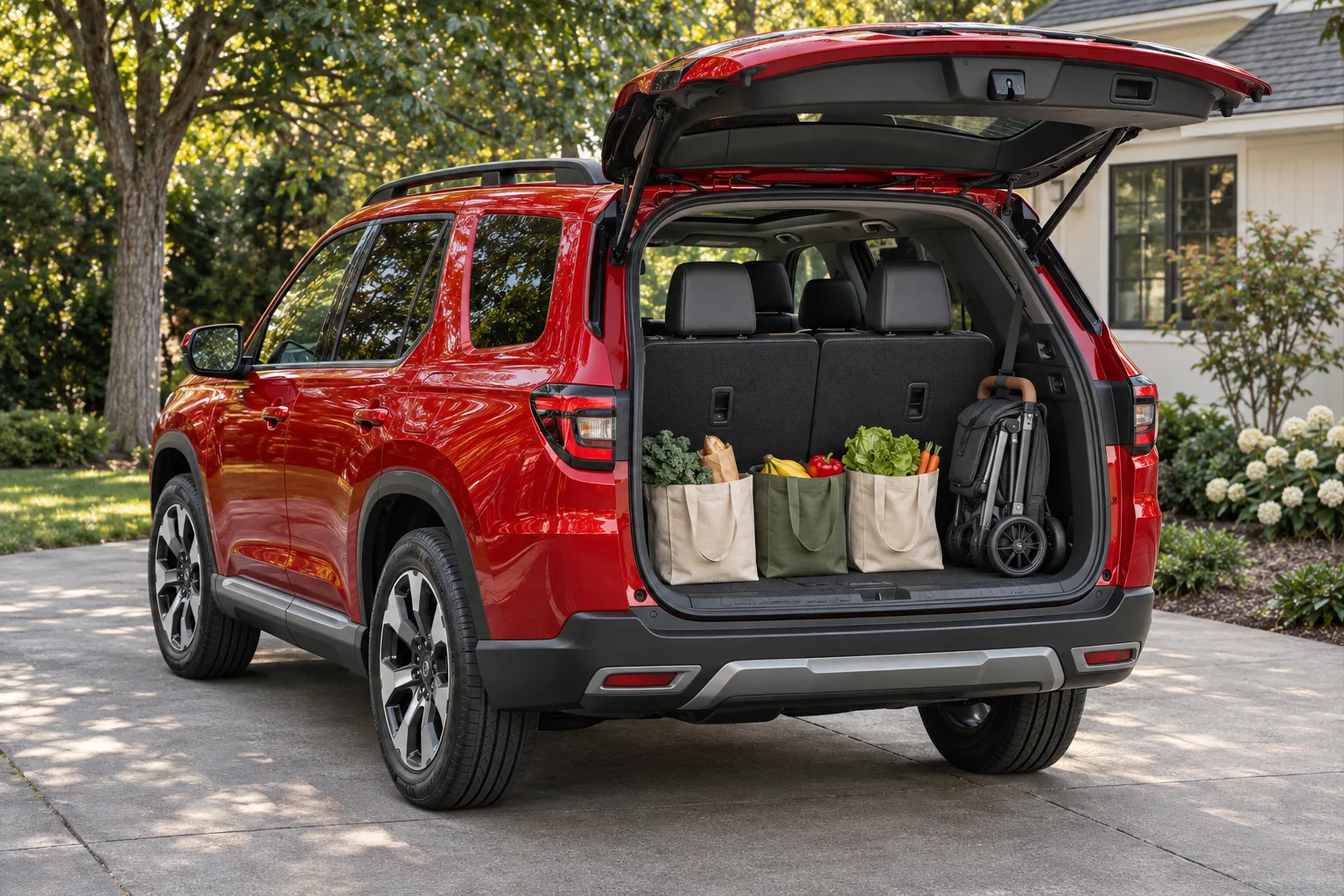
For the U.S. 2026 Honda Pilot, Honda lists 18.6 cubic feet behind the third row, 48.5 behind the second row and 86.5 to 87.0 behind the front seats as standard figures. Every trim also has a larger "maximum" figure, up to 113.7 cubic feet on TrailSport. This guide explains which number applies to the way you'll actually load the Pilot, and what the cubic-foot ratings can't tell you.
Figures come from Honda's 2026 Pilot specifications and the Honda newsroom specifications release, checked 2026-11-13. SUVLook has not physically measured or load-tested a Pilot.
Honda Pilot cargo space by row
Honda publishes two figures for each seating position: a standard figure and a maximum. Both use the SAE J1100 cargo measurement standard. The table shows every 2026 trim Honda lists.
| 2026 Pilot trim | Behind 3rd row (std / max) | Behind 2nd row (std / max) | Behind 1st row (std / max) |
|---|---|---|---|
| Sport | 18.6 / 21.8 cu ft | 48.5 / 59.5 cu ft | 87.0 / 111.8 cu ft |
| EX-L | 18.6 / 22.4 cu ft | 48.5 / 60.1 cu ft | 87.0 / 112.4 cu ft |
| TrailSport | 18.6 / 21.8 cu ft | 48.5 / 59.5 cu ft | 87.0 / 113.7 cu ft |
| Touring | 18.6 / 22.4 cu ft | 48.5 / 60.1 cu ft | 87.0 / 112.4 cu ft |
| Elite | 18.6 / 22.4 cu ft | 48.5 / 60.1 cu ft | 86.5 / 112.1 cu ft |
| Black Edition | 18.6 / 22.4 cu ft | 48.5 / 60.1 cu ft | 86.5 / 112.1 cu ft |
| The standard figures barely change across the lineup. With every seat upright, every Pilot has 18.6 cubic feet. Behind the second row, every Pilot has 48.5. Only the Elite and Black Edition drop half a cubic foot behind the front seats. |
Standard vs maximum: which number to use
The maximum figures are much larger, so it matters which one you compare. Honda's footnote describes a measurement based on SAE J1100 "plus, where applicable, floor space between seating rows and seats in their forward-most and upright position." In plain terms, the maximum counts extra floor area and assumes seats are slid forward. Honda doesn't say exactly which seat setting each maximum uses.
Use the standard figure when you compare the Pilot with another SUV, unless the other maker states that its number uses the same method. A maximum for one vehicle against a standard figure for another exaggerates the difference. For example, the Pilot's 48.5 standard figure behind the second row is the fair one to set against the Hyundai Palisade's 46.3 cubic feet in the same position.
The maximum is still useful in one way. It shows that sliding the second row forward and using the floor between rows adds real space when passengers can spare the legroom.
Behind the third row: the all-seats-up test
With all three rows in use, 18.6 cubic feet is what's left. That's enough for a grocery run or a folded stroller, but probably not a stroller plus luggage for a full car of people. Families who travel with all seats in use should test their real load before buying.
Try your biggest regular items together: the stroller, the largest suitcase and any sports bag that travels every week. A stroller that fits on its own isn't proof that the rest fits next to it. Check height as well as floor area, since the third-row seatbacks lean back into the load space.
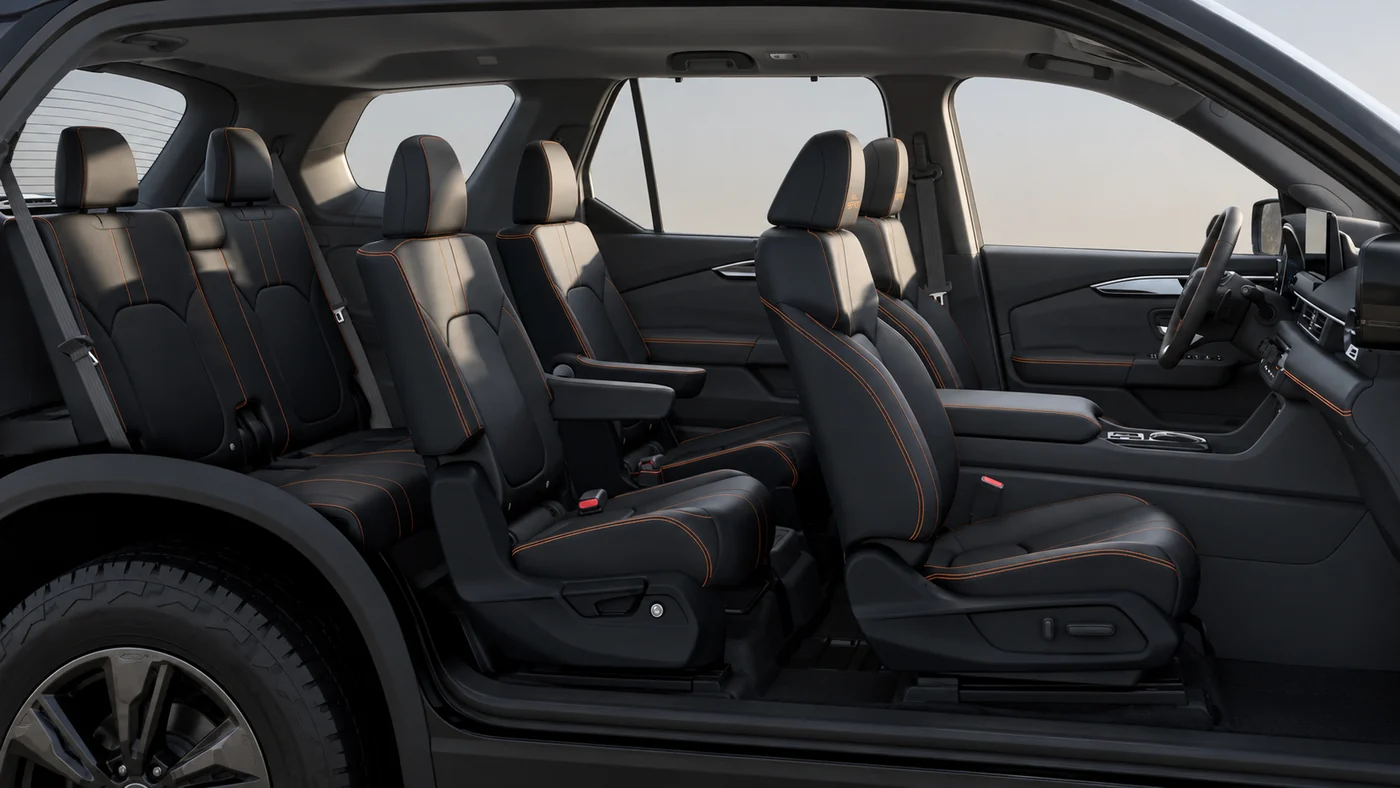
The third row is a 60/40 split bench that folds flat, according to Honda's seating feature page. Folding just the smaller section keeps one third-row seat while opening a longer strip of floor for skis or a long box.
 AI-generated editorial illustration of a split third row with one section folded. It is not an official Honda photo, and the section sizes shown are not measured.
Behind the second row and the removable middle seat
Folding the third row raises the standard figure to 48.5 cubic feet. For most families this is the everyday setup: five people up front and in row two, with the third row down for luggage.
The Pilot's second row differs by trim, and that changes how you'll use it:
| 2026 trim | Seats | Second row |
|---|---|---|
| Sport | 8 | Bench with a fixed middle seat |
| EX-L, Touring, Elite, Black Edition | 8 | Bench with a removable middle seat |
| TrailSport | 7 | Captain's chairs only |
| On trims with the removable middle seat, Honda says it "can be folded and stored in the on-demand in-trunk seat storage." That turns the bench into two captain's chairs with a walkway, and keeps the removed seat in the vehicle. If you plan to store it there, check how much underfloor space it takes on the vehicle you're buying, since that space can't then hold other items. |
Both rear rows folded: maximum cargo
With the second and third rows folded, the standard figure is 87.0 cubic feet on most trims and 86.5 on Elite and Black Edition. Use this setup for flat-pack furniture, moving boxes or a large dog crate.
Volume doesn't tell you whether a rigid item fits. A bookcase or crate has to clear the tailgate opening, the narrowest point between the wheel housings and the space between the floor and the roof. Honda doesn't publish those inch measurements for the 2026 Pilot in the sources we checked. Bring a tape measure and the item's outer dimensions, including handles and hinges.
Check that the folded seats lie flat enough for your load. A small step or gap between the folded rows can tip a long box or leave it unsupported.
Cargo-area features by trim
Honda's spec table lists these cargo features for 2026:
| Feature | Trims |
|---|---|
| Power tailgate | All trims |
| Hands-free tailgate with Walk Away Close | Touring, Elite, Black Edition |
| 12-volt outlet in the cargo area | EX-L and above |
| Second-row household-style outlet | TrailSport, Elite, Black Edition |
| Bag hooks, four tie-down anchors, LED cargo light | All trims |
| Use the four tie-down anchors for heavy items. A loose load can slide forward in hard braking, and the folded seatbacks aren't a cargo barrier. |
Size, towing and payload context
The 2026 Pilot is 200.1 inches long (200.4 inches for TrailSport), 78.5 inches wide, and 70.9 to 72.0 inches tall, on a 113.8-inch wheelbase. Measure your garage before buying, especially the height if you plan to add a roof box.
AWD Pilots can tow up to 5,000 pounds, and two-wheel-drive Sport and EX-L models are rated at 3,500 pounds. Honda notes that towing requires accessory towing equipment. Anything heavy in the cargo area also counts toward the vehicle's load limit, so check the tire-and-loading label on the driver's door jamb before a fully loaded trip with a trailer. The Pilot trim-levels guide covers how equipment changes across the lineup.
How the Pilot compares
Behind the third row, the Pilot's 18.6 cubic feet is slightly smaller than the Palisade's 19.1 and the Grand Highlander's 20.6. Behind the second row, its 48.5 beats the Palisade's 46.3. If space behind the third row matters most, the Grand Highlander and the Kia Telluride are worth a look.
For Honda's own two-row option, the Passport vs Pilot comparison shows what you give up by dropping the third row. For the cabin itself, see the Pilot interior guide and the SUVLook Pilot profile.
Honda Pilot cargo FAQs
How much cargo space does the 2026 Honda Pilot have? Honda lists 18.6 cubic feet behind the third row, 48.5 behind the second row and 86.5 to 87.0 behind the front seats as standard figures. Maximum figures run up to 22.4, 60.1 and 113.7 cubic feet.
Why does Honda list two cargo numbers? The standard figure follows SAE J1100. The maximum adds floor space between rows and assumes seats in their forward-most position. Compare standard figures across brands.
Does cargo space change by trim? Barely. Standard figures are the same on every trim except behind the front seats, where Elite and Black Edition list 86.5 instead of 87.0. Maximum figures vary more.
Does every Pilot have a removable second-row seat? No. EX-L, Touring, Elite and Black Edition have a removable middle seat. Sport has a fixed bench, and TrailSport has captain's chairs.