Dimensions · Space · Buying guides
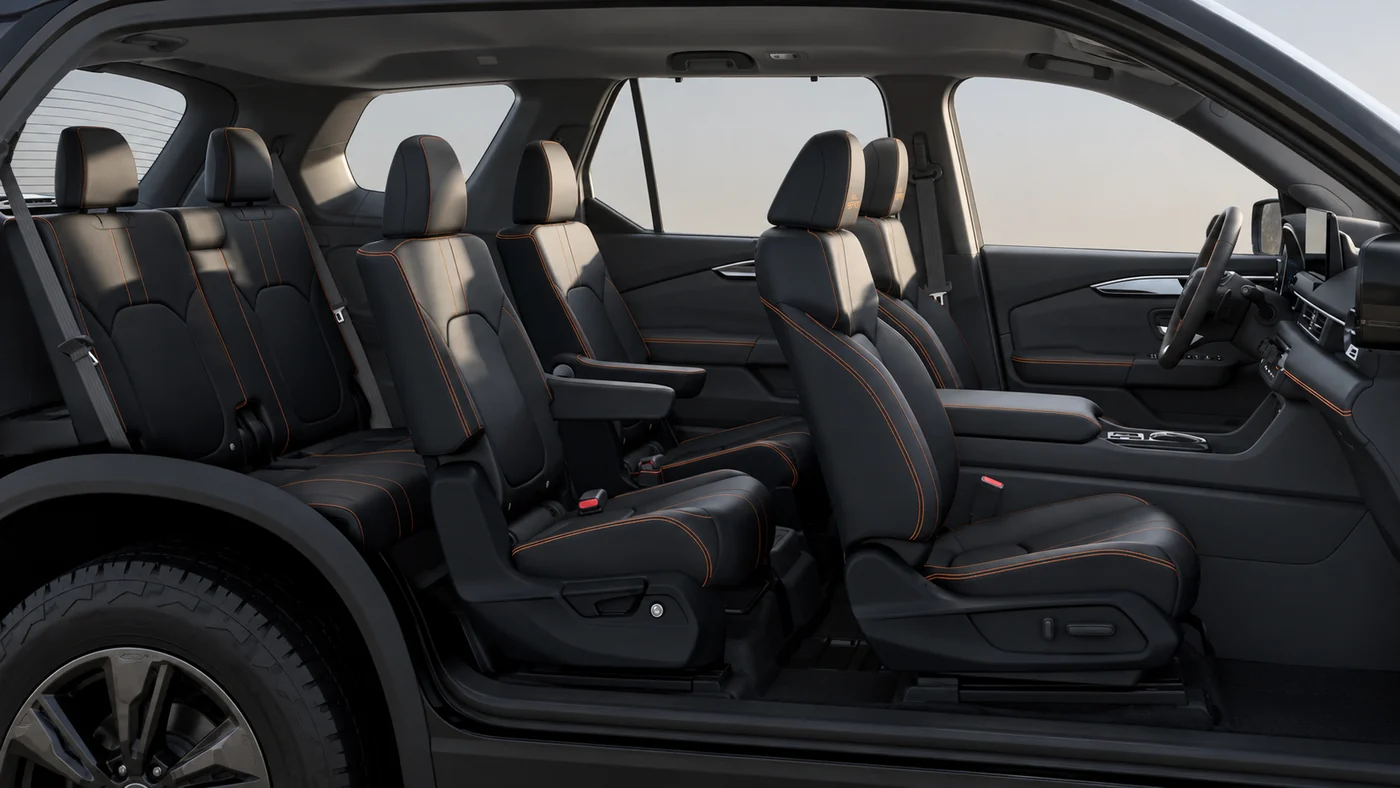
The Honda Pilot interior is a three-row cabin, but not every trim has the same passenger layout. Honda's U.S. 2026 table lists eight seats for Sport, EX-L, Touring, Touring Blackout, Elite and Black Edition; TrailSport seats seven. Published legroom is 41.0 inches in front, 40.8 in the second row and 32.5 in the third. Honda's 2026 specifications.
Start with the second-row layout, not the leather color. If you need eight seats, TrailSport won't meet that need. If someone uses the third row regularly, have them climb in and sit there with the second row set for your usual passengers. Counting seats is easy; finding a layout everyone can live with takes that extra check.
Shopping used? Compare the 2025 cabin and screens or 2023–2024 seats and equipment. For a new Pilot, start with the 2026 seating layouts and passenger dimensions.
This guide covers U.S. models. SUVLook has not performed a physical cabin measurement or child-seat installation test.
Honda Pilot seating: seven, eight and the removable center seat
| U.S. 2026 trim | Listed capacity | Second-row arrangement |
|---|---|---|
| Sport | 8 | Fixed middle seating position |
| EX-L | 8 | Removable middle seat |
| TrailSport | 7 | Captain's chairs |
| Touring / Touring Blackout | 8 | Removable middle seat |
| Elite / Black Edition | 8 | Removable middle seat |
Evidence: Honda's 2026 seating matrix and seating feature explanation. Removing a seating position changes the passenger arrangement; it does not leave eight places available while creating an aisle.
For an eight-person household, inspect every occupied position together. The middle passenger's buckle access, the space beside a child restraint and the route into the rear row can determine whether the arrangement works. Do not divide shoulder room by the passenger count to estimate each person's seat width.
For a household that alternates between seven and eight occupants, try the removable seat operation rather than only seeing a demonstration. Check its handling and the permitted storage procedure in Honda's instructions. Consider who will change the arrangement and whether they can comfortably do so. Flexibility that is inconvenient to use may not solve your daily problem.
Captain's chairs can serve a different routine, but their presence is not a universal comfort advantage. A family needing the extra middle position may prefer the bench-based layout. Our 2026 Pilot trim guide treats the broader trim decision separately; this article concentrates on the cabin you will use.
2026 Honda Pilot interior dimensions in inches
| Manufacturer-published measurement | Front row | Second row | Third row |
|---|---|---|---|
| Headroom: Sport / EX-L | 40.5 in | 40.2 in | 39.3 in |
| Headroom: other listed 2026 trims | 39.1 in | 39.2 in | 39.3 in |
| Legroom: all listed trims | 41.0 in | 40.8 in | 32.5 in |
| Shoulder room: all listed trims | 61.9 in | 61.7 in | 59.5 in |
| Hip room: all listed trims | 58.4 in | 57.4 in | 44.6 in |
Evidence: Interior section of Honda's 2026 specification table. These are factory values, not tape measurements made by SUVLook. The headroom groups matter when you compare two trims; the same model badge does not give every cabin the same roof-clearance entry.
Use legroom to decide which vehicles deserve a visit, not to predict knee clearance behind a particular driving position. Published front and second-row values cannot be added to create a usable passenger-compartment length. Shoulder room and hip room also describe different measuring locations, not the uninterrupted width of the cushions.
Our Cabin Fit Check can help organize the inspection. The result still depends on the occupants, preferred posture, actual seat positions and any equipment installed for the journey.
Third-row Honda Pilot interior: check access and the whole seating chain
The third row deserves its own test, not a glance through the open tailgate. Begin with the driver and front passenger in their normal positions. Place the second-row occupants next, then let the rear-row passengers enter and sit without moving the other rows to artificial demonstration positions.
Check the entry path, the step over the opening and the ability to settle into the seat without twisting uncomfortably. Once seated, inspect foot placement, cushion support, knee contact and headliner clearance. Then ask the second-row passenger whether their position remains acceptable. A good rear-row demonstration should not quietly sacrifice another occupant's usable space.
A three-person row does not mean three adults will find it equally comfortable. Compare the actual passengers side by side and make sure each can use their own belt normally. Individual build, posture and the seat's contour matter; the published cabin widths are only a starting point.
If you usually carry child restraints in row two, bring those exact models. Consult the restraint instructions and vehicle manual before evaluating permitted access or installation. An empty second-row demonstration does not establish access with restraints installed, and no AI image here verifies a permitted setup.
For frequent rear-row trips, test getting out as carefully as getting in. Repeat the exercise with bags, coats or other items your passengers routinely carry. A configuration that is manageable once may be less suitable for repeated school-run or family-trip use.
Front-seat comfort, roof clearance and console contact
Set a normal driving position while stationary. Confirm pedal operation, steering-wheel reach and a comfortable view out before assessing space around your knees or head. Lowering the seat or reclining unusually just to clear the headliner can create another fit problem.
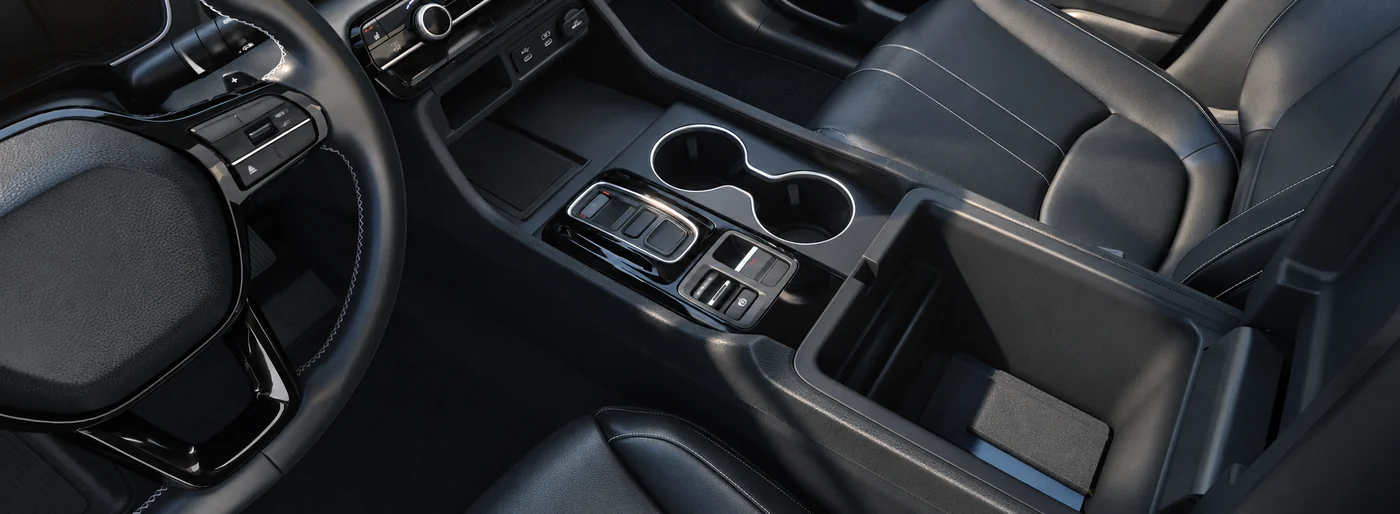
AI-generated editorial illustration based on a Honda console reference. It identifies an area to inspect for reach and contact; it does not provide a knee-space measurement or demonstrate equipment on every trim.
Check where your leg naturally rests against the console, whether you can change foot position comfortably and whether the seat supports your thighs. Give the front passenger an independent check. Their seat adjustment and footwell experience are not established by the driver's result.
Honda's headroom table makes Sport and EX-L useful comparison vehicles when roof clearance is a concern. That is a specification-led reason to try them, not a claim that every tall driver should choose one. Standing height does not capture torso length or preferred posture, and the table supplies no maximum occupant-height rating.
Record the trim and roof equipment before drawing a conclusion about Pilot as a whole. If you will share the vehicle with another driver, repeat the position-setting routine for both. A cabin can fit one person well yet require a compromise for the second.
Pilot interior materials and technology: separate appearance from function
Honda's current 2026 table distinguishes EX-L's leather-trimmed seats with fabric accents, TrailSport's synthetic-leather/orange-stitching treatment, Touring's leather trim and the perforated upper-trim treatment. It also lists a 12.3-inch center touchscreen across the 2026 grades. Verify the exact seat material, color and equipment on the vehicle's window sticker rather than treating one interior picture as the entire range. Honda's 2026 equipment matrix.
For material choice, inspect contact areas and stitching in normal daylight. Sit long enough to evaluate the cushion and backrest rather than selecting by the upholstery's appearance. If ventilation or another seat function is decisive, operate it on the exact trim; an equipment list cannot predict whether you will like its feel.
Test the controls you use most while parked. Adjust climate settings, pair your own phone and check whether the display remains readable from your normal position. Familiarity during a sales demonstration is different from comfort with the system you will use every day.
For Honda Pilot interior colors or pictures, use the manufacturer's model-year color guide to identify permitted combinations. The AI illustrations in this article explain layout; they are not verified paint or upholstery swatches. Lighting and screen reproduction can change how a finish appears.
2025 Honda Pilot interior: separately checked comparison
Honda's archived 2025 specifications independently list the same legroom, shoulder-room and hip-room values shown in the 2026 table. Its headroom entries also separate Sport/EX-L from TrailSport/Touring/Elite/Black Edition in the same way. This comparison comes from checking both year-specific tables, not inferring continuity from photographs. Honda's 2025 specifications.
The center screen is a concrete difference. Honda lists a 7-inch touchscreen on the 2025 Sport and a 9-inch screen on EX-L, TrailSport, Touring, Elite and Black Edition. The separately checked 2026 matrix lists a 12.3-inch screen across its grades. A used 2025 EX-L therefore doesn't have the newer display just because the passenger dimensions match.
| Center touchscreen | 2025 Pilot | 2026 Pilot |
|---|---|---|
| Sport | 7 in | 12.3 in |
| EX-L / TrailSport / Touring / Elite / Black Edition | 9 in | 12.3 in |
| Touring Blackout | Not listed in the checked 2025 matrix | 12.3 in |
Evidence: the Audio & Connectivity sections of Honda's 2025 table and 2026 table, checked October 10, 2026. Display size is not a verdict on usability or software; try phone pairing and the controls you use most while parked.
If passenger space is your main reason for changing cars, these matching dimensions alone aren't a reason to rule out a 2025. If the newer screen is important, make that a separate buying requirement. Keep photographs year-labeled too: the illustrations here don't document the older dashboard.
For a useful back-to-back comparison, use the same passengers and the same seat-setting sequence in both cars. Keep a note of the limiting issue: entry, roof clearance, console contact, support or buckle access. That produces a decision relevant to your household rather than a score built from unrelated specifications.
2023 and 2024 Honda Pilot interiors: what to check used
Shopping for a used Pilot? Start with the second-row seats and the dashboard, because a 2026 description won't tell you exactly what the older car has. Honda's separate 2023 and 2024 tables both list 41.0, 40.8 and 32.5 inches of legroom across the three rows. They also agree on shoulder room of 61.9 / 61.7 / 59.5 inches and hip room of 58.4 / 57.4 / 44.6 inches. That gives you a useful starting point for passenger space, not a promise that every seat or control is identical.
| Detail | 2023 Pilot | 2024 Pilot |
|---|---|---|
| Seven-seat versions | EX-L (7P) and TrailSport | EX-L with captain's chairs and TrailSport |
| Eight-seat versions | LX, Sport, EX-L (8P), Touring, Elite | LX, Sport, EX-L without captain's chairs, Touring, Elite |
| Center touchscreen | LX/Sport: 7 in; other listed trims: 9 in | LX/Sport: 7 in; other listed trims: 9 in |
Both years also share the same headroom groups: LX/Sport/EX-L list 40.5 / 40.2 / 39.3 inches across the three rows; TrailSport/Touring/Elite list 39.1 / 39.2 / 39.3. Those are trim-specific specifications, not an occupant-height limit.
Evidence: Honda's 2023 specifications and features and 2024 Information Center matrix. Both years were checked independently; the table is not a carryover assumption.
An EX-L badge alone isn't enough to settle seven versus eight seats for either older year. Ask for a picture of the complete second row, confirm the original seating configuration and inspect the actual car. A listing can show only the front seats and leave that important choice out.
The smaller older-year screens are also worth trying before you buy. Pair your phone and use the climate and audio controls while parked. If the 2026 screen is part of what attracted you to Pilot, don't assume a 2023 or 2024 example supplies it. Our AI pictures remain labeled as 2026 references; they don't show these older dashboards. Earlier Pilot years still need their own specifications rather than an extension of this table.
Interior length and cargo: different questions from passenger legroom
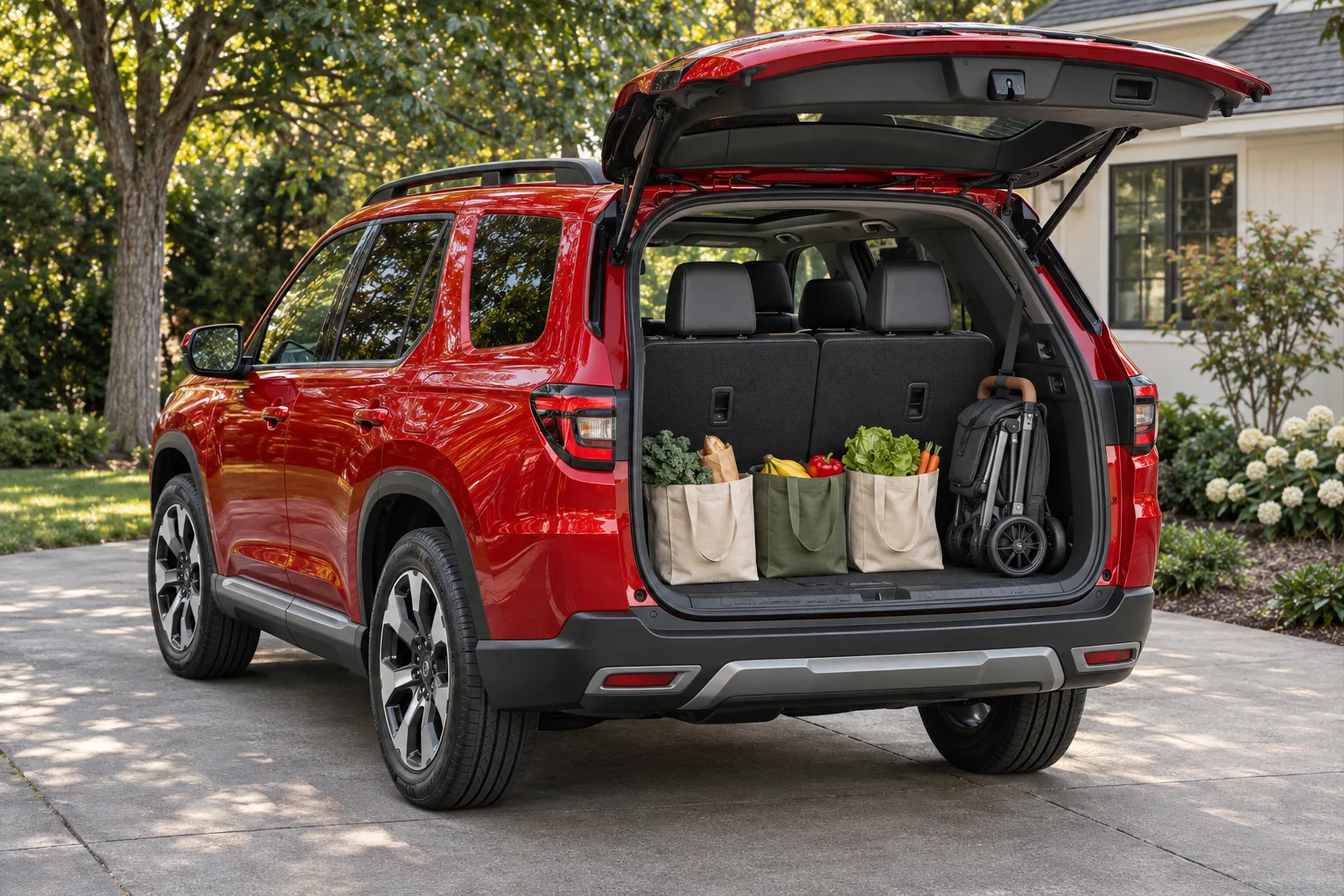
Honda Pilot interior length can mean the passenger compartment, the floor behind the third row, or a loading arrangement with seats folded. This guide does not verify one continuous passenger-compartment length. Adding the three legroom figures does not create one.
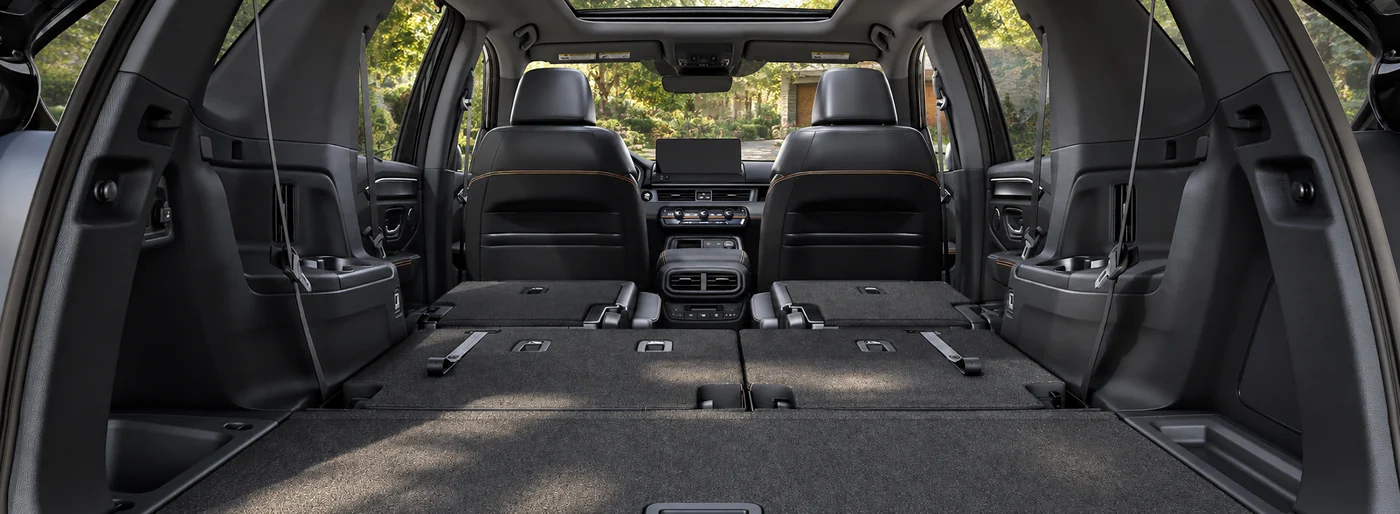
AI-generated editorial illustration based on a Honda cargo reference. It is not a measured loading length, guaranteed luggage fit or proof that a load can be transported safely.
Honda publishes standard and maximum cargo-volume entries separately. Do not compare a maximum with another vehicle's standard figure or treat either as floor length. For a stroller, crate or sleeping platform, identify the actual linear measurement needed and verify it on the intended arrangement.
The 2026 Pilot model page has the broader specifications. For the cabin decision, keep it simple: Pilot is worth considering if you need three rows, but bring your household along before settling on a trim. The right second-row layout and a comfortable seating check matter more than a long equipment list.
Frequently asked questions
Does the 2026 Honda Pilot seat seven or eight?
TrailSport seats seven. Sport, EX-L, Touring, Touring Blackout, Elite and Black Edition are listed with eight seats. Removing an equipped middle seat changes the usable arrangement.
How much third-row legroom does the Pilot have?
Honda lists 32.5 inches in the checked 2025 and 2026 tables. That does not establish knee clearance with your particular second-row seat positions.
Which Pilot trims have the greater published headroom?
Sport and EX-L list 40.5 inches in front and 40.2 in row two for 2026. Other listed trims have 39.1 and 39.2 respectively. Try the exact trim rather than converting headroom into an occupant-height limit.
Are the 2025 and 2026 Pilot interiors identical?
No. Their checked passenger dimensions match, but the 2025 center screen is 7 inches on Sport and 9 inches on the other listed trims. Honda lists a 12.3-inch screen across the 2026 grades. Other equipment still needs a year-and-trim check.