Dimensions · Space · Buying guides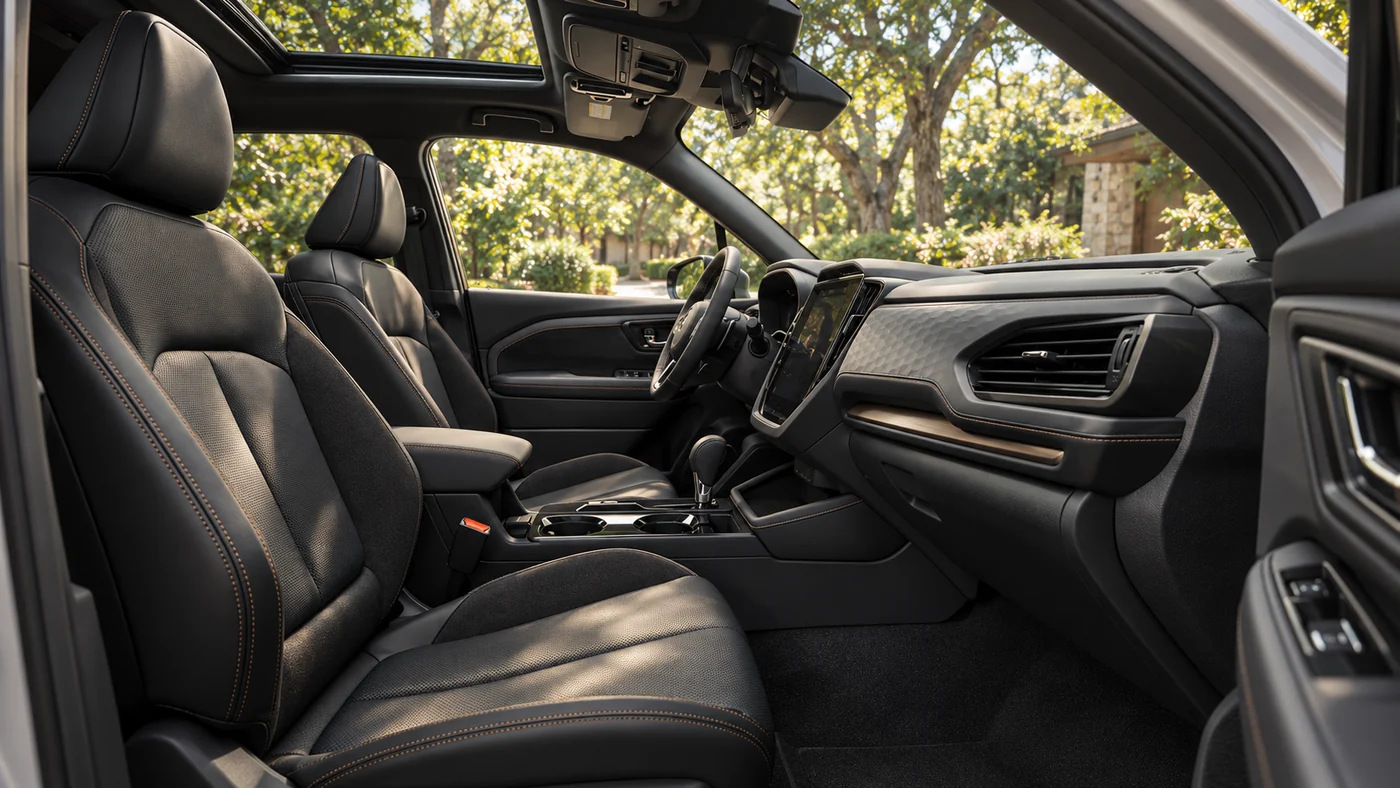
Subaru Forester interior dimensions depend on the roof configuration. Subaru's U.S. 2026 trim table lists 41.2 inches of front headroom and 39.6 inches in the rear for Base, versus 40.0 and 37.7 inches for the other listed trims. Front and rear legroom are 43.3 and 39.4 inches throughout the table, including the hybrid versions. Subaru's 2026 specifications.
If headroom is tight, try Base as well as the moonroof-equipped trim you want. For an adult sitting behind a tall driver, leave the driver's seat in its comfortable position while checking the back seat. Moving it forward just to show more rear space won't tell you whether the car works for both people at once.
This guide separates 2026 manufacturer figures from a checked 2025 lookup. It also explains why older Wilderness entries and luggage-area measurements need their own labels. Sources were checked October 5, 2026; SUVLook has not physically measured these vehicles or conducted a child-seat installation test.
2026 Subaru Forester interior dimensions in inches
| Published passenger measurement | Front row | Rear row | Scope |
|---|---|---|---|
| Headroom | 41.2 in | 39.6 in | Base |
| Headroom | 40.0 in | 37.7 in | Other listed trims, including hybrids |
| Legroom | 43.3 in | 39.4 in | All listed trims |
| Shoulder room | 57.7 in | 56.7 in | All listed trims |
Evidence: the Interior Dimensions entries in Subaru's 2026 trim comparison. The 2026 brochure's Dimensions page, PDF page 3, also shows the headroom pairs and front/rear legroom in a side-view diagram. Its illustration caveat says dimensions and features may vary by trim.
We have not independently verified a separate 2026 hip-room entry in the sources used for this guide. That field is omitted rather than filled with a 2025 number or a dealer-site estimate. The 2025 lookup below identifies its own source and scope.
Use headroom to shortlist roof configurations, legroom to shortlist seating arrangements and shoulder room to identify cabins worth trying with your passengers. Shoulder room is not the distance between an individual seat's bolsters. None of these figures establishes the space left beside a particular installed child seat.
Base versus moonroof-equipped Forester: why the roof matters
Subaru's 2026 equipment matrix lists no panoramic power moonroof for Base and lists it as standard in the other displayed trims. 2026 manufacturer trim matrix, PDF page 2. That is a useful configuration distinction when interpreting the two headroom entries.
Calculated from the published 2026 figures, the front headroom difference is 1.2 inches and the rear difference is 1.9 inches. Those are differences between specification entries, not measurements of the extra gap above an individual occupant's head.
The practical question is whether the moonroof and other equipment in your preferred trim are worth the seating trade-off for your household. Do not assume the more expensive configuration is the better fit. Equally, do not rule it out on arithmetic alone if you find its actual seating position comfortable.
Try the roof configuration you will own. A quick sit in a different Forester can be misleading if its seat height, adjustment controls or roof differ. Record the trim and roof when taking notes; otherwise, a remembered impression of generous room may be impossible to reproduce at another dealer.
If you lower the seat to create more head clearance, recheck the view out, steering-wheel reach and thigh support. A fit that works only with an awkward driving posture is not a useful improvement. Evaluate the combined seating position rather than maximizing one gap in isolation.
Forester hybrid interior dimensions: compare like configurations
The checked 2026 trim table assigns the listed hybrid models the same headroom, legroom and shoulder-room entries as the other non-Base trims. This does not establish a passenger-room penalty from selecting the hybrid over a comparable gasoline trim. 2026 Subaru specification entries.
Comparing a hybrid with Base answers a different question because the roof/equipment configuration also changes. If a salesperson or comparison chart presents only the maximum headroom for the model, ask which trim supplies that figure before applying it to a hybrid.
Matching published dimensions are not proof that every contact point feels identical. Seat upholstery, cushion shape, adjustment range and console contact should still be checked in the exact vehicle. Nor do matching passenger measurements mean every cargo-floor or storage detail is interchangeable between powertrains.
Our editorial recommendation is to establish that both configurations work for your occupants, then evaluate the powertrain separately using appropriate efficiency, price and ownership evidence. There is no need to invent a cabin advantage simply because two versions have different mechanical systems.
2025 Forester interior dimensions: a separate lookup
For the standard 2025 Forester family, Subaru's brochure provides the following manufacturer measurements. The same page carries explicitly labeled 2024 Wilderness exceptions, which are not included in this table.
| 2025 manufacturer measurement | Front row | Rear row | Qualification |
|---|---|---|---|
| Headroom without moonroof | 41.2 in | 39.6 in | No-moonroof configuration |
| Headroom with moonroof | 40.0 in | 37.7 in | Moonroof configuration |
| Legroom | 43.3 in | 39.4 in | Standard 2025 family |
| Shoulder room | 57.7 in | 56.7 in | Standard 2025 family |
| Hip room | 54.7 in | 53.7 in | Standard 2025 family |
Evidence: Subaru's 2025 Forester brochure, PDF page 12, printed Dimensions section. Hip room here is a 2025 brochure figure, not an independently checked 2026 or hybrid hip-room measurement.
For a 2025 hybrid lookup, Subaru's separate 2025 trim table lists the hybrid columns with the non-Base headroom, legroom and shoulder-room entries. That Subaru U.S. page has a Spanish navigation shell but English measurement labels and inch units; it is not a specification table for another country's vehicle.
The comparable headroom, legroom and shoulder-room figures match between the checked standard 2025 and 2026 entries. This is a limited passenger-dimension comparison, not a claim that all trims, equipment or cargo specifications carried over unchanged.
Why Wilderness needs its own model-year label
A brochure's year on the cover is not enough to establish the year of every vehicle in its tables. The checked 2025 brochure includes a separately labeled 2024 Forester Wilderness alongside the standard 2025 family. Its exception rows must remain attached to that older vehicle.
That matters because a combined table can make an older Wilderness measurement look like the figure for a newer Forester. We have excluded those exceptions from the 2025 lookup above. The 2026 trim table is a separate check and must not be populated by copying the older brochure's Wilderness column.
When researching used inventory, match the vehicle's actual model year and trim to the evidence. A Wilderness badge alone does not establish that a current-model cabin diagram applies. If the specific source for your vehicle is missing, keep the measurement unavailable until you can confirm it or inspect the vehicle.
A Forester fit check for tall drivers
Do the evaluation in the configuration you intend to buy, wearing normal footwear. The objective is a comfortable, repeatable driving position, not an impressive photograph of open space.
- Establish comfortable pedal reach with the backrest in your usual position.
- Adjust seat height, then the steering wheel, so you can see out and reach the controls naturally.
- Check the headliner above you and near the door edge. Turn your head as you normally would instead of holding one idealized posture.
- Check knee contact with the console and dashboard while moving your foot between its ordinary positions.
- Check cushion support and whether the seat edge creates uncomfortable pressure behind your knees.
- Get out and back in, noting whether you must duck or twist more than you are willing to do every day.
If roof clearance is marginal, repeat the exercise in Base. If thigh support or console contact is the problem, a larger headroom entry may not solve it. This is why an individual's height cannot be turned into a guaranteed fit result from the published table.
Do not assume that a few minutes in a showroom establishes long-distance comfort. If a seating position is promising, spend more time evaluating it and, where possible, use an ordinary test drive to assess comfort without changing the seat to make the rear row appear larger.
Rear passengers, child seats and shared cabin space
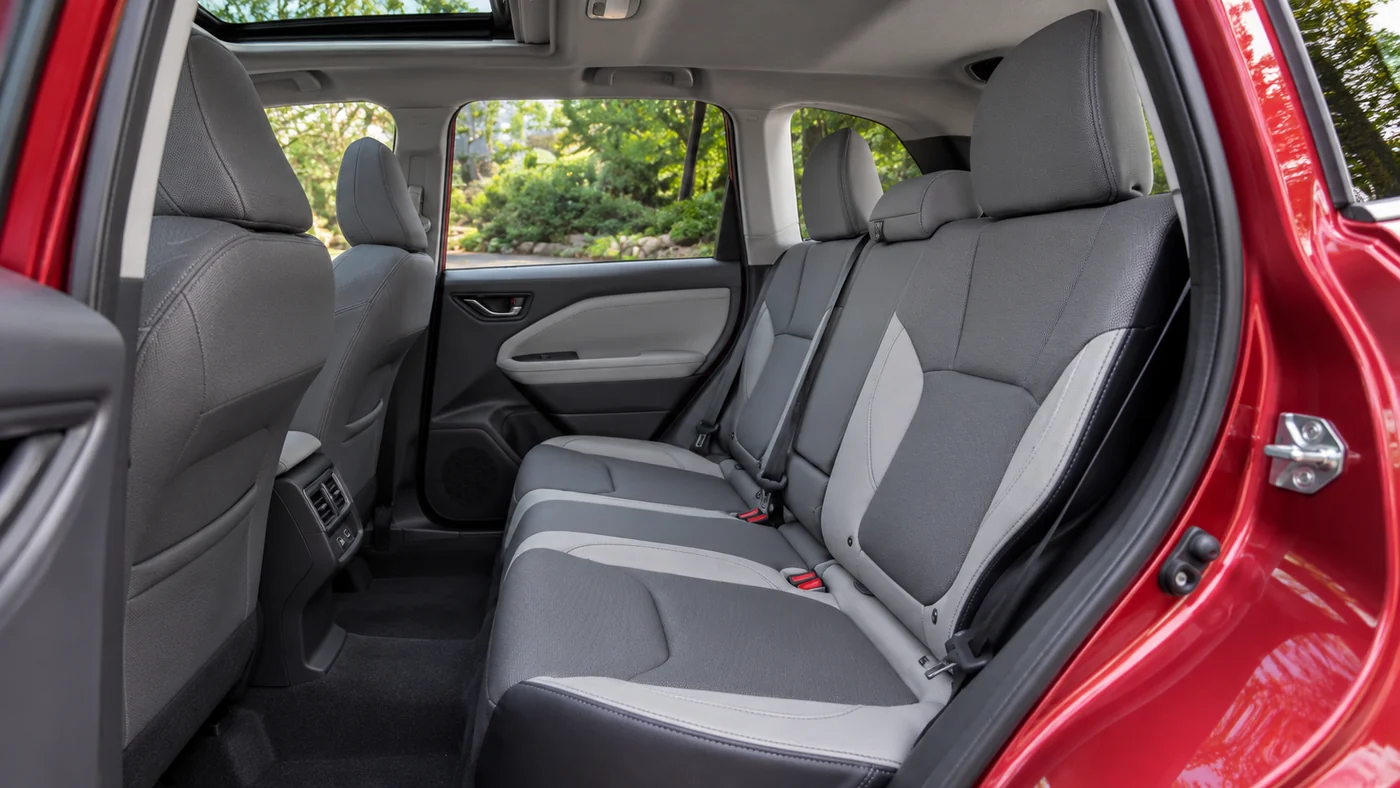
AI-generated editorial illustration based on the rear-seat view in Subaru's U.S. 2026 Forester brochure. Upholstery varies by configuration. The pictured bench and footwell do not establish actual knee clearance, three-adult comfort or child-seat installation fit.
Leave the front seat where its real occupant needs it, then assess the rear position. Check your knees, where your feet can go, roof clearance and whether you can sit with a relaxed hip and knee angle. Try both sides if the driver and front passenger use different settings.
For a regular center-seat occupant, check that position directly. Dividing the shoulder-room figure by three does not calculate seat width or predict three-adult comfort. Door trim, seat contours, belt hardware and passengers' posture change the usable arrangement.
For a child-seat household, bring the actual seat if the dealer permits. Follow the child-seat and vehicle instructions when evaluating installation. Check the installed configuration with the front passenger in their normal position and confirm access to the relevant buckles and restraints. This guide does not certify an installation or claim a tested three-across arrangement.
Write down what did and did not work. A note such as console contact at the driver's preferred position or limited rear foot space behind a particular seat is useful when comparing vehicles. A general note that the cabin felt big is much less informative.
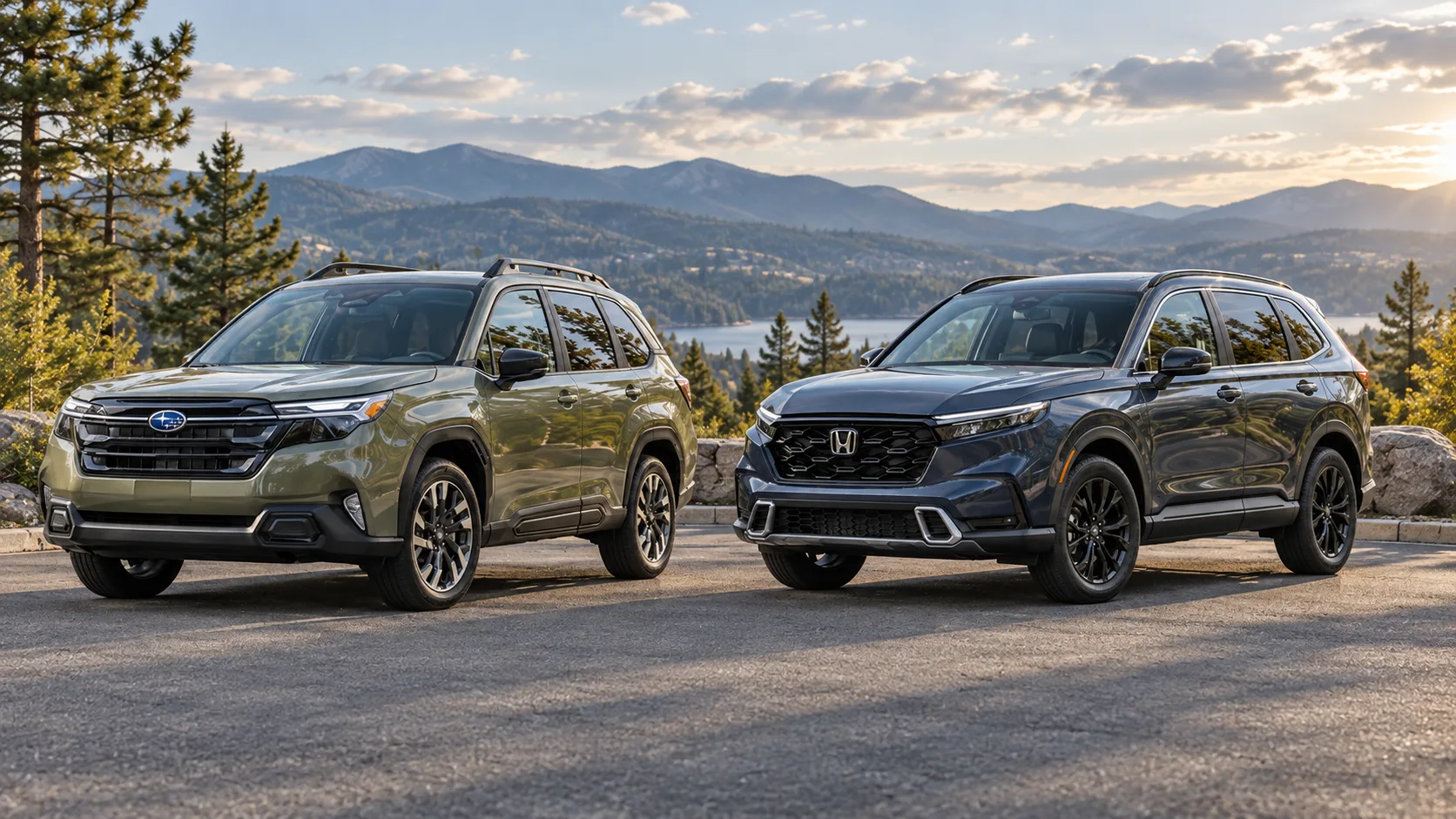
For another shortlist option, our Forester versus CR-V comparison provides a broader decision context. Its model-year labels still apply; this guide's new source checks do not silently update every fact in the comparison.
Cabin space versus cargo dimensions
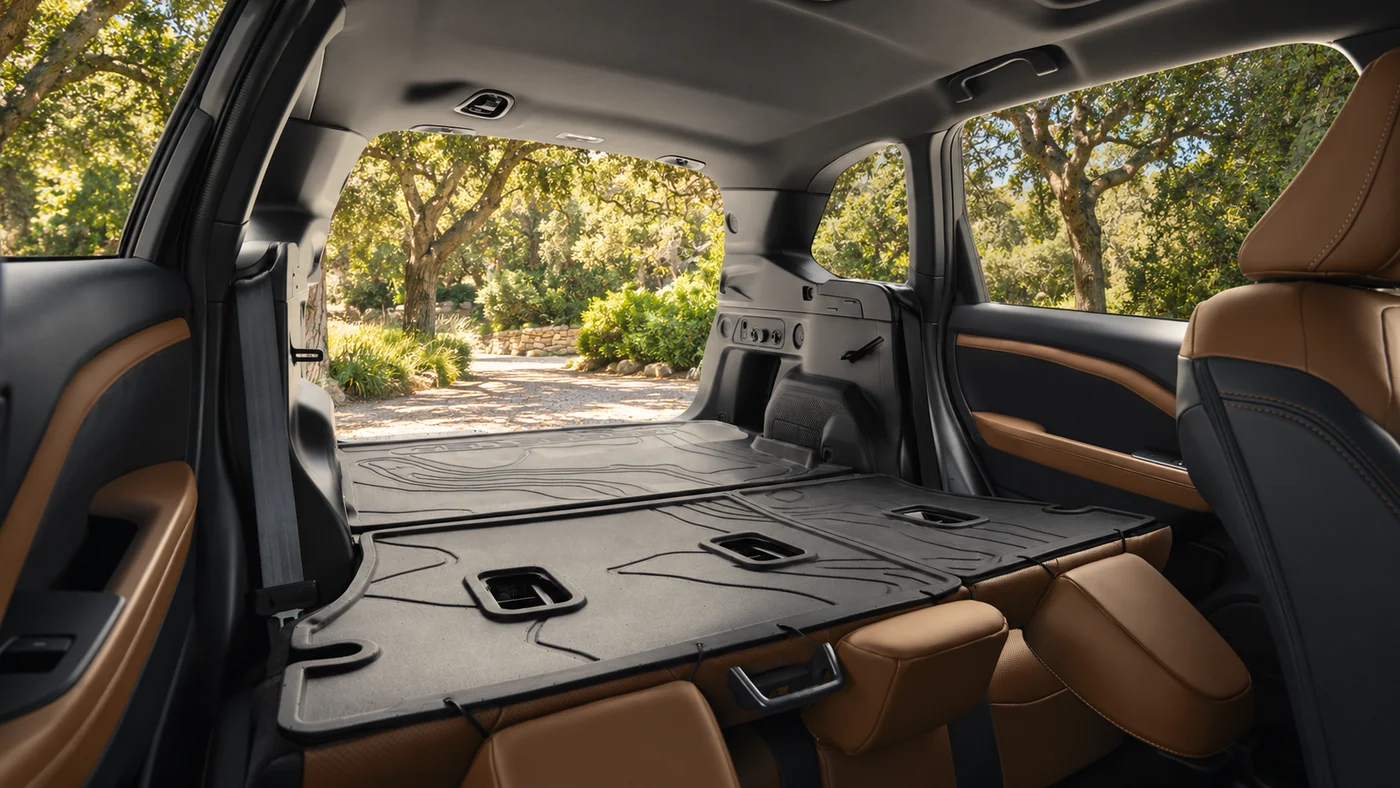
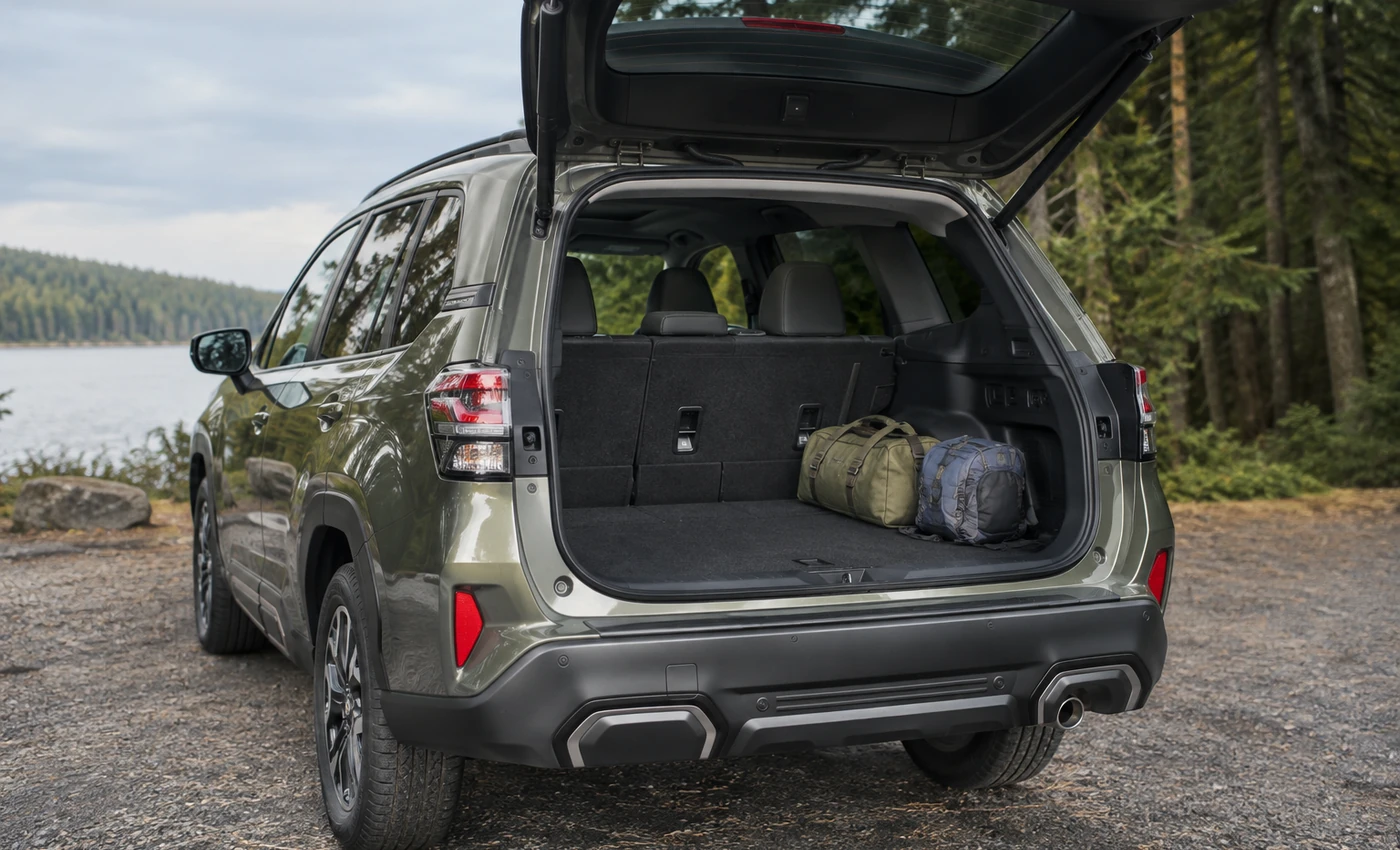
AI-generated editorial illustration based on Subaru's 2026 folded-seat gallery reference, which shows accessory seatback protectors and a cargo tray. These accessories are not presented as standard equipment; the image does not establish cargo dimensions or item fit.
Use our Forester cargo dimensions guide for luggage-area length, width, hatch-opening references and measurement limits. This passenger guide does not convert legroom, hip room or cubic-foot volume into a rectangular cargo box.
If you need to carry a stroller or crate while retaining passengers, check the passenger arrangement first and the remaining cargo configuration second. Folding a seat may improve an item's fit but remove a position your household needs. Treat that as a practical trade-off rather than reporting only maximum capacity.
A critical fit question needs the object's dimensions, the vehicle's exact configuration and the relevant clearance along the loading path. Where a year-specific hatch or floor measurement is unavailable, verify it on the actual vehicle. For a wider shortlist, use the 2026 compact-SUV comparison and keep the same measurement standards across candidates.
Frequently asked questions
Which Forester has the most published headroom?
Base supplies the higher front and rear entries in the checked 2026 table. Try it alongside your preferred moonroof-equipped trim if roof clearance matters; specifications alone do not prove an individual's comfortable seating fit.
Does the Forester hybrid have less legroom?
The checked 2026 table lists the same front/rear legroom for hybrid and gasoline columns. Roof configuration changes the headroom comparison with Base, so compare equivalent trims rather than assigning every difference to the hybrid system.
Are 2025 and 2026 Forester interior dimensions identical?
The comparable checked headroom, legroom and shoulder-room entries match for the standard family. We have not established blanket carryover for every specification or configuration. The 2025 hip-room entry and older Wilderness exceptions retain their original scope.
Will two tall adults fit one behind the other?
Set the front seat for its real occupant and test the rear position behind it. Check feet, knees, roof clearance and posture together. Published legroom makes a vehicle worth trying but cannot guarantee that a particular pair will fit comfortably.
Sources and known limits
- Subaru 2026 Forester trim specifications: passenger-dimension entries across gas and hybrid columns.
- Subaru 2026 trim-comparison PDF: roof equipment, PDF page 2.
- Subaru 2026 Forester brochure: Dimensions diagram, PDF page 3.
- Subaru 2025 Forester brochure: PDF page 12, standard-family dimensions and separately labeled 2024 Wilderness exceptions.
- Subaru U.S. 2025 hybrid trim table: headroom, legroom and shoulder-room columns.
Manufacturer specifications, arithmetic differences and SUVLook editorial fit advice are distinct. No current hip-room figure is invented from older evidence, and no image or cabin diagram is treated as a physical fit test. Older generations and non-U.S. specifications are outside the scope of the main tables.