Dimensions · Space · Buying guides
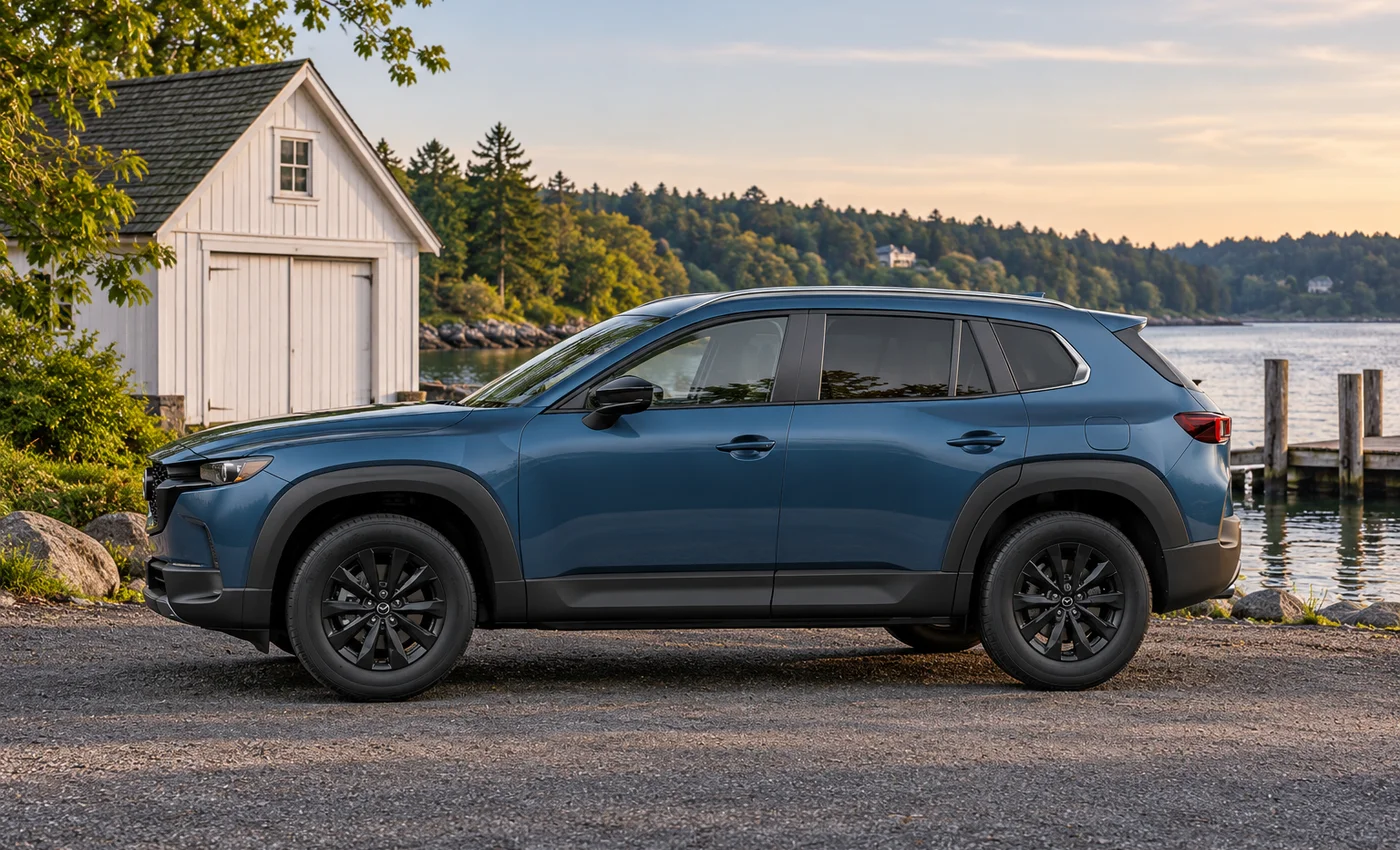
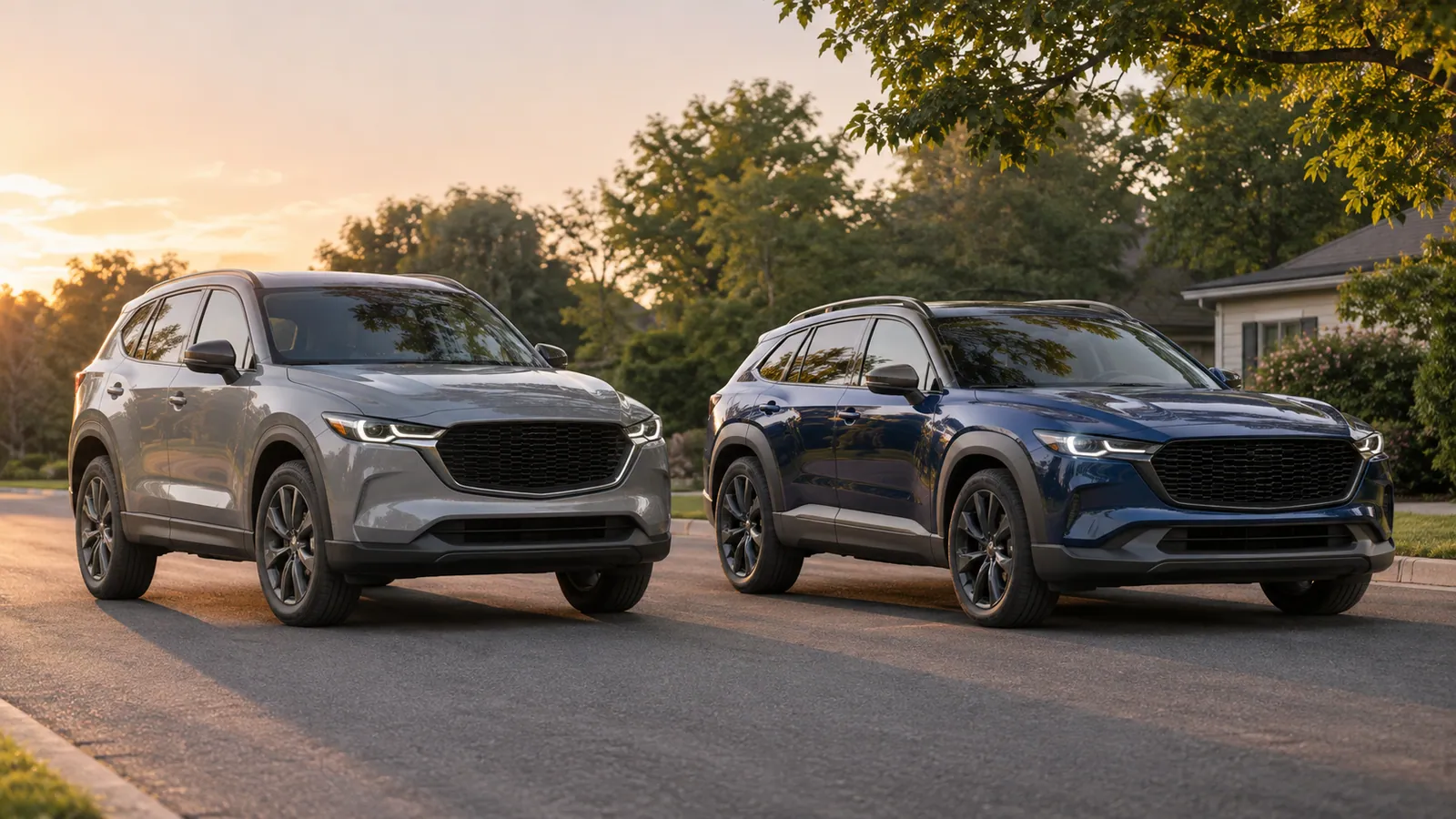
For the U.S. 2026 Mazda CX-50, choose the powertrain before choosing a trim. Start with 2.5 S Preferred for everyday convenience, compare Hybrid Preferred if fuel use matters more, and look at 2.5 Turbo when you specifically want the turbocharged engine. Meridian Edition is a separate equipment choice within the gas range; the name does not automatically mean turbo power.
There are ten versions across three powertrain families. A Hybrid Premium and a 2.5 S Premium are not the same vehicle with a different badge. Comparing their complete names will save more time than memorizing a single ladder from cheapest to most expensive.
This guide covers 2026 U.S. models, checked October 20, 2026. Equipment comes from Mazda's manufacturer material. The recommendations are SUVLook editorial judgments; we have not road-tested these configurations. Prices below exclude destination and are starting MSRPs, not dealer transaction quotes.
2026 CX-50 trims and starting prices
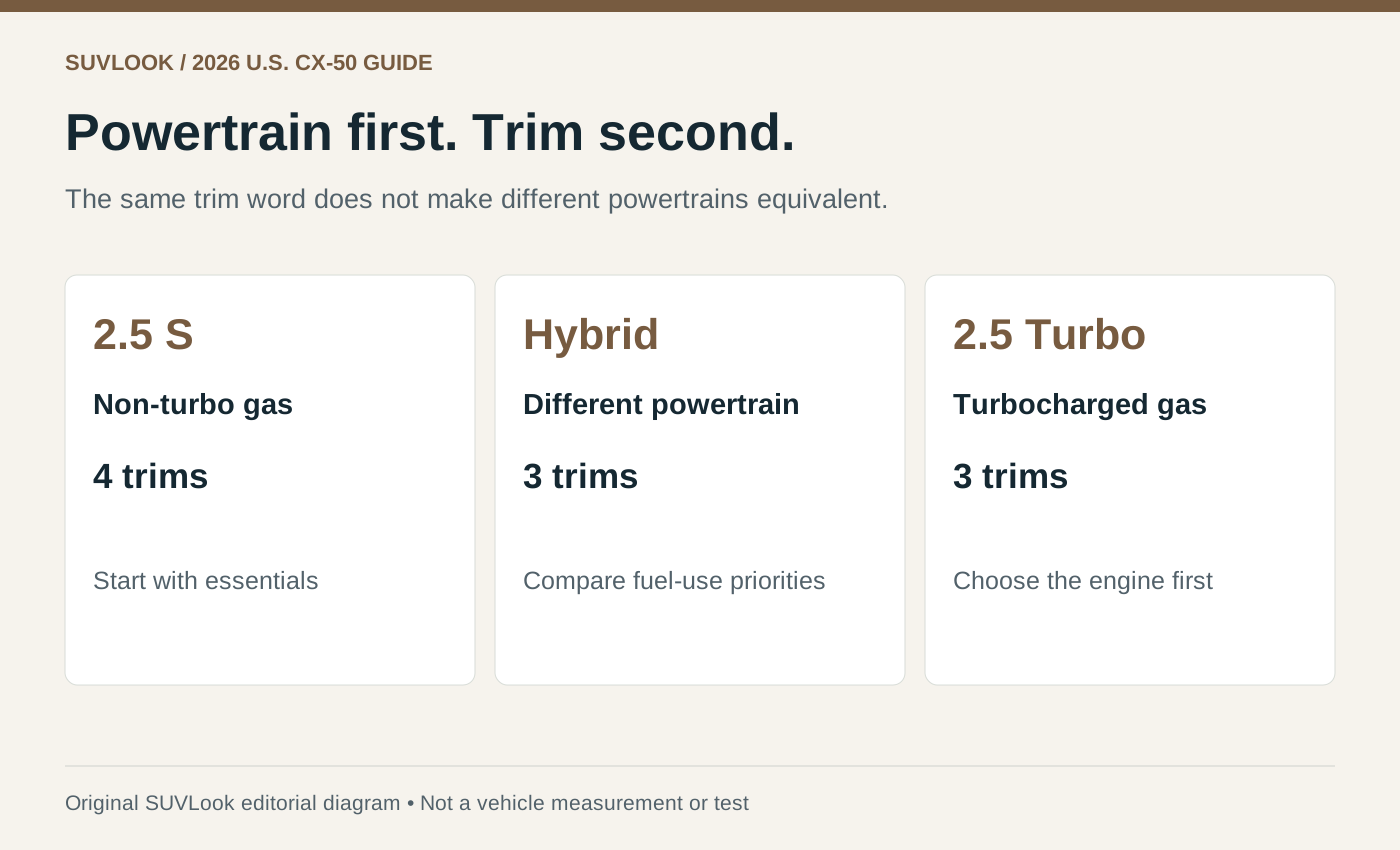
Original SUVLook decision diagram. It separates powertrain choices rather than depicting a measured vehicle.
The first four versions belong to the naturally aspirated gas family. The three Hybrid versions form their own range, followed here by the three Turbo versions. This grouping follows the buying decision rather than pretending that every price increase buys the same kind of improvement.
| Powertrain family | Full trim name | Starting MSRP before destination |
|---|---|---|
| Gas, non-turbo | 2.5 S Select | $29,900 |
| Gas, non-turbo | 2.5 S Preferred | $32,400 |
| Gas, non-turbo | 2.5 S Meridian Edition | $33,150 |
| Gas, non-turbo | 2.5 S Premium | $34,900 |
| Hybrid | Hybrid Preferred | $34,750 |
| Hybrid | Hybrid Premium | $38,150 |
| Hybrid | Hybrid Premium Plus | $40,450 |
| Gas, turbocharged | 2.5 Turbo | $37,900 |
| Gas, turbocharged | 2.5 Turbo Meridian Edition | $40,400 |
| Gas, turbocharged | 2.5 Turbo Premium Plus | $42,900 |
Mazda's current 2026 gas and Turbo trim selector and 2026 Hybrid trim selector supply these prices. Mazda lists destination at $1,595, or $1,640 in Alaska, separately from these MSRPs. Options, taxes, registration and other transaction charges also change the total. Check whether a dealer's advertised figure already includes destination before adding it.
There is a source discrepancy worth recognizing if you have an older comparison open. The September 2025 pricing release lists Hybrid Premium Plus at $40,150; the current identified 2026 retail page lists $40,450. This table uses the retail figure. The older release also disagrees with itself on the entry price: its opening paragraph says $29,990, while its table and the current retail page say $29,900. Use the vehicle's window sticker for an actual purchase comparison.
Choose gas, Hybrid or Turbo first
Mazda's 2026 specification deck distinguishes the three systems. The non-turbo gas and Turbo models use a six-speed automatic; the Hybrid uses an electronically controlled continuously variable transmission and electric AWD. AWD is standard across these families, but the systems are not identical.
Do not make the choice from a horsepower headline alone. Drive the candidates on the same sort of roads, with the climate system operating and the usual passengers if practical. Pay attention to the response when joining traffic, how easy it is to maintain a comfortable pace, and whether the engine and transmission behavior suit you. A published specification cannot settle those preferences.
For a lower purchase-price starting point, investigate the non-turbo range first. For a fuel-use priority, compare the Hybrid against the gas version you would actually buy. For someone who wants the Turbo, establish that preference before paying for additional cabin equipment. Otherwise it is easy to end up comparing an entry Turbo with a richly equipped Hybrid and attribute the whole price difference to the engine.
The CX-50 is also a different shortlist from the three-row Traverse and Acadia guides. Resolve passenger capacity before choosing a badge or powertrain; moving up the CX-50 range does not turn it into the same seating proposition as those vehicles.
2.5 S Select versus Preferred: which features would you use?
Select is the appropriate reference point when controlling the purchase price is the main goal. Mazda's gas trim page lists wireless Apple CarPlay and radar cruise control with Stop & Go among its highlights. Preferred adds a power liftgate, power-adjustable driver's seat and front and rear parking sensors.
The starting-price step is $2,500, calculated from the table. That is enough to deserve a specific reason. If two drivers share the car and repeatedly readjust the seat, try the adjustment procedure in both versions. If you load shopping while carrying other items, demonstrate the liftgate. If you regularly park in a confined garage, try the parking aids there or in a comparable space with the dealer's permission.
It is perfectly reasonable to prefer the cheaper car if those tasks are already easy. Equally, equipment you use every weekday can be a stronger reason to upgrade than something impressive in a brochure that you rarely touch. Write down the inconvenience the feature solves, rather than simply marking every extra as desirable.
Our starting recommendation is Preferred for buyers who value those conveniences. It is a starting point for inspection, not a claim that Select is inadequate or that Preferred is universally the best value. Sit in both if the seat and driving position matter to the decision, especially before assuming the power adjustment automatically gives you a better fit.
What does the 2.5 S Meridian Edition change?
For 2026, Meridian Edition is available with the non-turbo engine as well as in the Turbo family. Mazda's packaging announcement describes the 2.5 S Meridian Edition's all-terrain tires and 18-inch wheels, with other convenience equipment based on Preferred.
The gas Meridian starts $750 above Preferred. That is a smaller step than moving from Preferred to Premium, but it buys a different direction. Consider it when the tire specification and appearance are the actual attraction. If your shortlist is driven by cabin comfort or the fuel-use question, the Meridian label does not answer either of those on its own.
Inspect the fitted tire model and its replacement cost on the actual car. Ask for a drive on the pavement you normally use, not only a smooth road near the showroom. We have not measured noise, ride comfort or loose-surface traction, so there is no test result here that makes one tire type a universal winner.
The practical mistake to avoid is shortening the name to “Meridian” in a listing search. A low-priced 2.5 S Meridian and a 2.5 Turbo Meridian are different powertrain purchases. Keep the complete trim on the comparison sheet, and check that the stock photo belongs to the advertised vehicle. Exterior styling is a poor substitute for reading the specification.
2.5 S Premium: cabin upgrades without switching engines
The non-turbo Premium is for someone who likes the gas powertrain but wants more cabin equipment. The 2026 packaging description identifies leather seating, ventilated front seats, a power passenger seat and driver-seat memory among its changes. Its starting MSRP is $2,500 above Preferred.
These are features to try while stationary before the test drive. Have the usual front passenger adjust their own seat. Check whether the driving position returns as expected when the settings are changed. Try the seat ventilation in suitable conditions, while remembering that a brief demonstration is not a controlled hot-weather comparison.
Separate the upholstery decision from the seat-function decision. You may like a particular color but be indifferent to the other equipment, or find the adjustment functions useful without caring about the trim's appearance. Because features come together in a factory version, the question is whether the complete step is worth buying for your household.
There is a close cross-family comparison here: Hybrid Preferred starts $150 below 2.5 S Premium. That does not make either an automatic bargain. One path puts more of the decision into cabin equipment, while the other changes the powertrain. Drive those exact versions if this is your budget range. Comparing only the word “Preferred” with “Premium” would hide the more important choice.
Hybrid Preferred, Premium and Premium Plus
The Hybrid has its own three-trim progression. Mazda's Hybrid page lists leather-trimmed seats and front-seat ventilation for Premium, with a head-up display and heated rear seats among Premium Plus highlights. Do not import a feature from a gas trim solely because its name sounds similar.
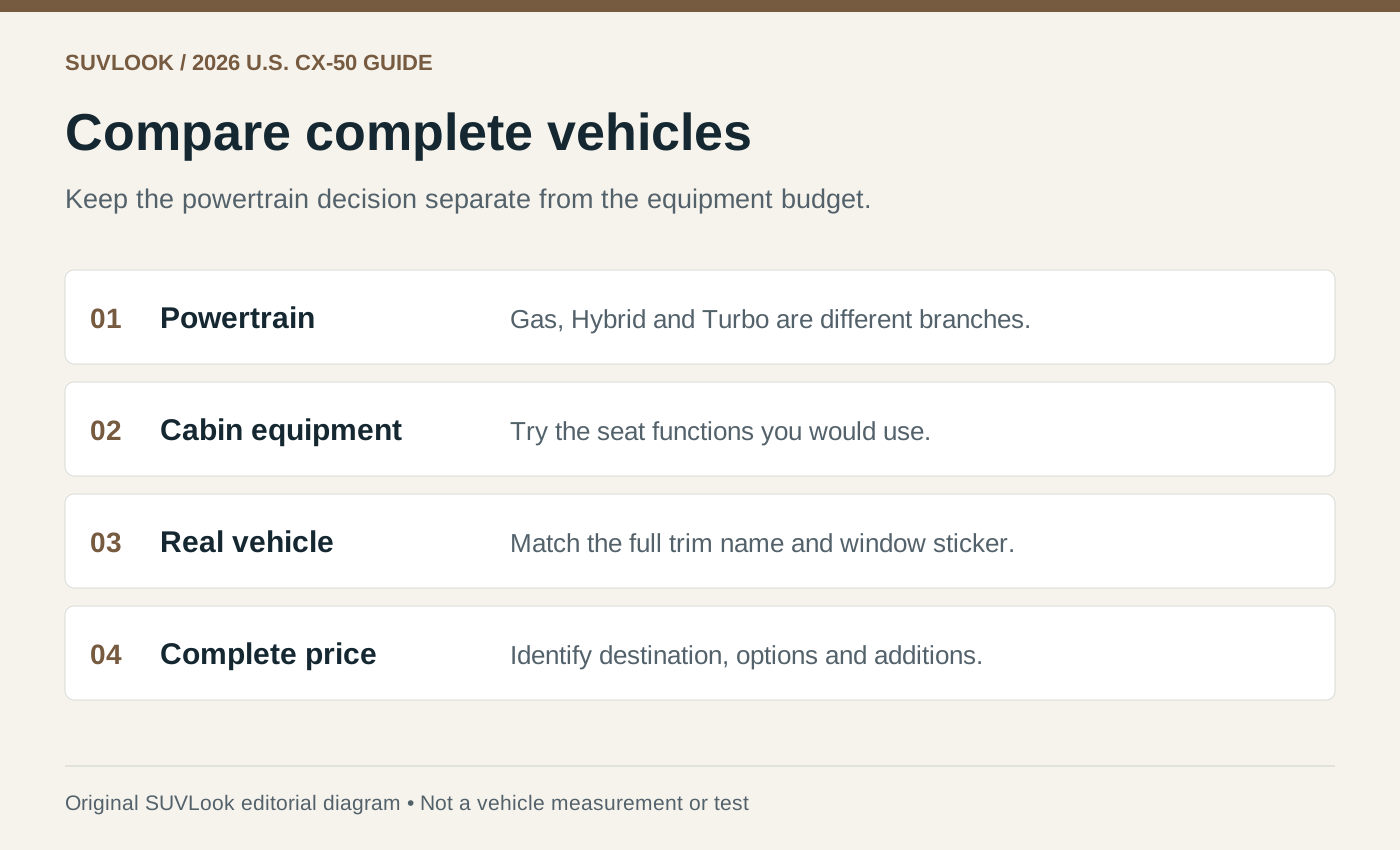
Original SUVLook comparison worksheet. It is a shopping aid, not a factory equipment diagram or a road-test result.
The first question is whether you want the Hybrid at all. Mazda publishes an EPA-estimated 38 mpg combined for the 2026 Hybrid. That is a labeled estimate, not a SUVLook fuel test, and it does not guarantee your own result. We have not used the gas page's inconsistent fuel-economy FAQ to manufacture a precise payback period.
Next, compare Preferred with Premium as complete vehicles. The $3,400 starting-price step matters if the additional seat equipment is useful to the people who travel in front. If the Hybrid powertrain is the main attraction and the lower trim already suits your seating needs, an upper cabin package is a separate purchase decision.
Premium Plus is $2,300 above Hybrid Premium using the current retail figures. Rear-seat heating is a more relevant feature when those positions are regularly occupied. Try the head-up display from your normal driving position, including with the glasses you use for driving. Check readability and adjustment rather than assuming that every driver will find it helpful.
Keep the Hybrid's actual cargo arrangement in the inspection. Mazda identifies dimensional differences associated with the hybrid battery. This guide does not publish unverified linear cargo measurements or promise that a rigid item fits. Bring the object or measure the real opening and floor where it will sit; a related gas version is not a substitute for checking the Hybrid you intend to buy.
Turbo, Turbo Meridian and Turbo Premium Plus
Look at the entry 2.5 Turbo when the engine is the reason for changing branches. Mazda's gas trim selector highlights adaptive front lighting alongside the turbocharged powertrain. The upper Turbo versions should then be assessed for their own equipment, rather than treated as prerequisites for getting a Turbo.
There are two further starting-price steps: $2,500 to Turbo Meridian Edition and another $2,500 to Turbo Premium Plus. The labels point toward different priorities. Someone attracted by Meridian's tire and design specification may not be looking for the same upgrades as someone shopping for the upper version's cameras and assistance equipment.
The specification deck also distinguishes Turbo output by fuel: 227 hp on 87-octane gasoline and 256 hp on 93-octane gasoline. Do not compare its premium-fuel headline against another powertrain without keeping that condition attached. Follow the vehicle manual for fuel guidance; the higher number is not a promise about acceleration in your own driving.
If the upper Turbo's camera equipment is important, demonstrate it while parked around ordinary obstacles. Check the views, switching controls and visibility in the conditions that concern you. A long list of assistance features is not a guarantee of detecting every obstacle, and we do not rank crash protection from the trim price. Confirm the installed features and read their operating limits.
For towing, Mazda's specification deck separates the maximums: 2,000 lb for non-turbo gas, 1,500 lb for Hybrid, and 3,500 lb for Turbo. Equipment and operating conditions apply. This is a useful reason to check the powertrain first, but it is not approval for an individual trailer. Verify the manual, hitch equipment, loaded trailer, tongue load and vehicle loading before deciding whether a particular combination is suitable.
Compare the upgrades you would actually buy
Use the differences below to narrow the shortlist. All are calculated from the published starting MSRPs above; they are not dealer offers or equipment-matched transaction differences.
| Comparison | Starting-price difference | What the decision turns on |
|---|---|---|
| 2.5 S Preferred over Select | $2,500 | Whether the convenience features solve daily problems |
| 2.5 S Meridian over Preferred | $750 | Whether you specifically want its tire and design direction |
| 2.5 S Premium over Preferred | $2,500 | Whether the cabin additions matter to the occupants |
| Hybrid Preferred over gas Preferred | $2,350 | Powertrain choice, then the exact equipment on each car |
| Hybrid Premium over Hybrid Preferred | $3,400 | Useful cabin equipment within the Hybrid range |
| Hybrid Premium Plus over Hybrid Premium | $2,300 | Upper-trim equipment using the current retail price |
| 2.5 Turbo over 2.5 S Premium | $3,000 | Whether the Turbo branch is worth choosing |
The useful final comparison normally has two vehicles, not all ten. Keep one that meets your essentials at the lower complete price and one that adds the upgrade you genuinely want to evaluate. If you cannot describe the benefit of the second vehicle in a sentence, spend more time with the first before moving farther up the range.
A short inspection and quote checklist
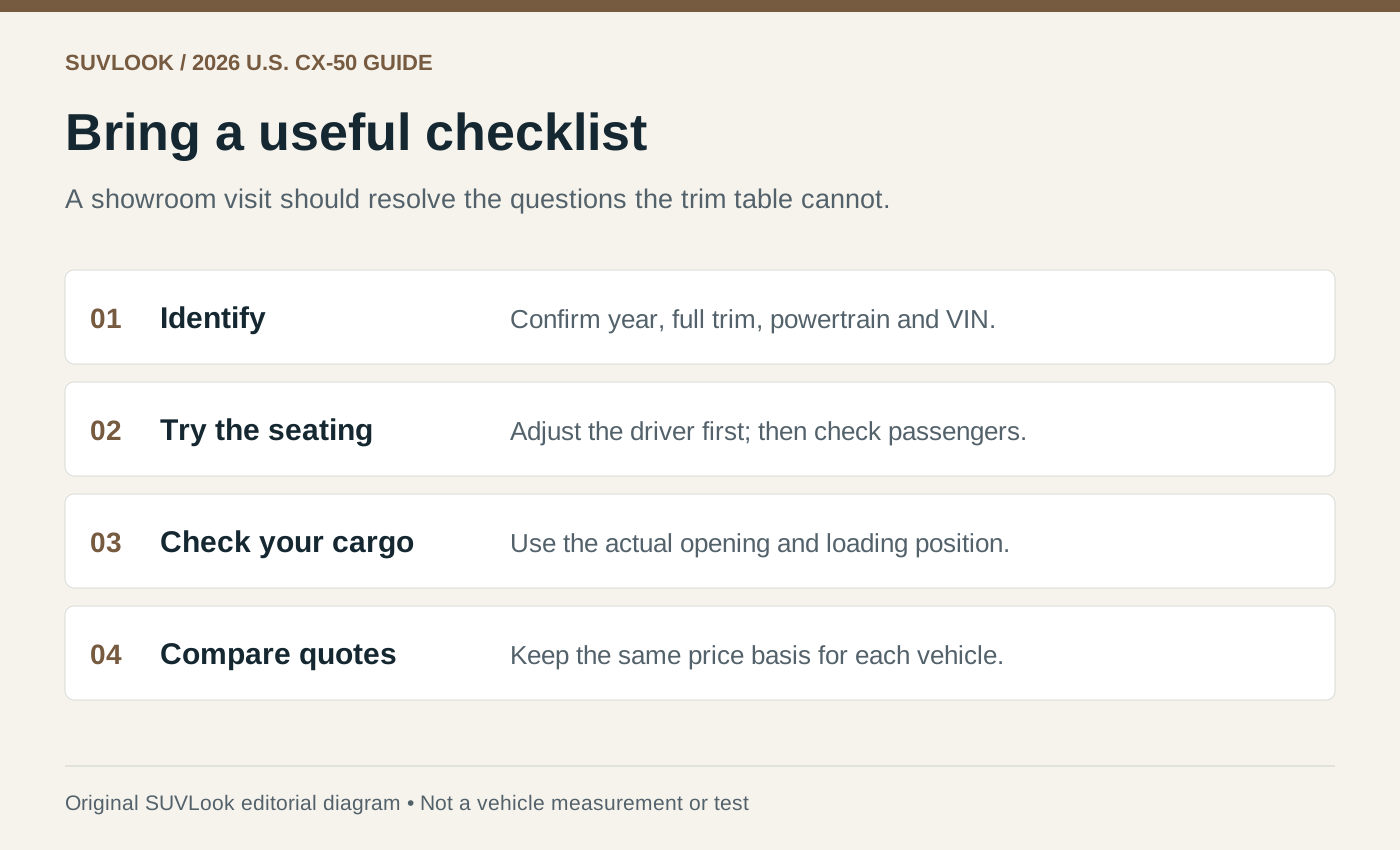
Original SUVLook checklist for comparing specific stock vehicles. The diagram does not establish a vehicle's installed options.
Get the full model year, powertrain, trim and VIN before visiting. Ask for the window sticker and a complete itemized vehicle price. Keep optional paint, accessories and dealer-installed additions visible. A difference between two advertisements may come from those items rather than the factory trim step you are trying to judge.
At the car, set the driver's seat first and then check the rear seats with your usual passengers. If you use a child restraint, arrange a proper fit check with your own restraint and the relevant manuals. Do not judge usable room from an empty cabin with the front seats pushed forward. Try the cargo you carry regularly where the seller permits; the shape of the opening can matter more than an overall volume number.
Finally, take a comparable drive in each candidate. Keep the route and conditions reasonably similar so you can identify what you actually prefer. Record the difference that matters immediately afterward: seat fit, control usability, powertrain response or loading convenience. That note is more useful than trying to remember which version had the longest feature list.
For a wider shortlist, our compact SUV comparison is a starting point only if its vehicle and model-year scope match your search. Return to the individual vehicle's documentation before treating a comparison-page feature as installed equipment.
Frequently asked questions
How many 2026 Mazda CX-50 trims are there?
Ten across the U.S. range: four non-turbo 2.5 S versions, three Hybrid versions and three Turbo versions. Choose a powertrain family before comparing the equipment steps within it.
Does every CX-50 Meridian Edition have a turbo?
No. The 2026 range includes both 2.5 S Meridian Edition and 2.5 Turbo Meridian Edition. Use the complete name and the vehicle's window sticker to distinguish them.
Is Hybrid Premium the same as gas Premium?
No. They belong to different powertrain families. Compare their actual equipment and driving behavior rather than assuming the shared Premium name makes them equivalent.
Why does Hybrid Premium Plus have two starting prices online?
Mazda's older pricing release lists $40,150, while the identified 2026 retail page checked for this guide lists $40,450 before destination. We use the current retail figure and recommend checking the actual vehicle sticker.