Dimensions · Space · Buying guides
For U.S. models - specifications checked September 11, 2026
If you are comparing the Subaru Outback interior dimensions, the 2026 redesign gives passengers noticeably more vertical space without changing rear legroom. Subaru lists 43.0 inches of front legroom and 39.5 inches in the rear for 2026, while the 2025 model has 42.8 inches up front and the same 39.5 inches in back. The bigger change is headroom: rear headroom grows from 39.1 inches in 2025 to 40.5 inches in 2026.
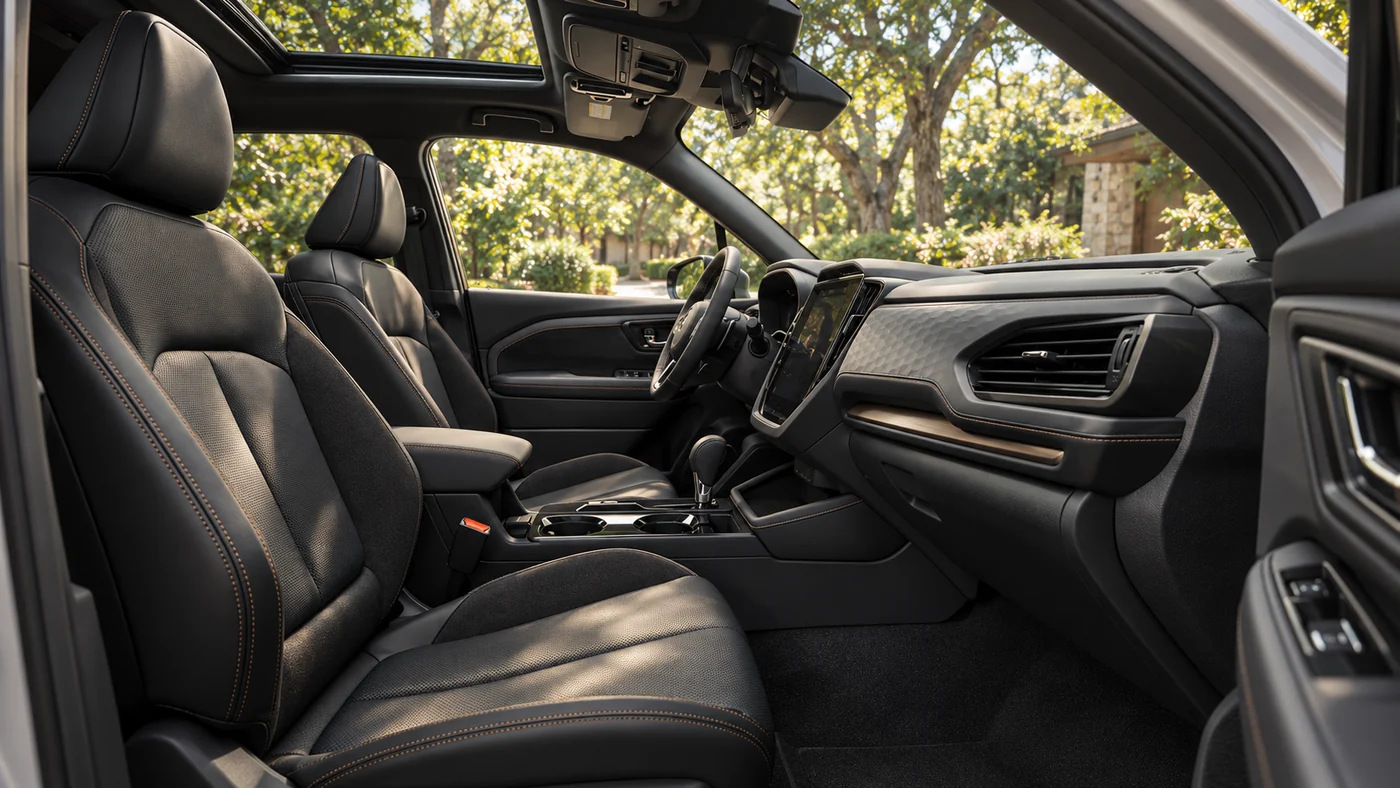
If you need that extra room above your head, check the roof on the vehicle you're considering. A moonroof changes the published front headroom and passenger volume. Sit in the exact trim with the seat set for your normal posture rather than relying on the largest figure in the brochure.
Subaru Outback interior dimensions: 2025 vs. 2026
The table below puts the cabin measurements most people actually compare in one place. For 2026, the main Subaru U.S. comparison page publishes headroom, legroom, shoulder room and passenger volume. Hip room is listed separately by U.S. specification databases; it is included here with that source called out.
| Interior measurement | 2025 Outback | 2026 Outback |
|---|---|---|
| Seating capacity | 5 | 5 |
| Front headroom, maximum published | 40.1 in | 41.0 in |
| Rear headroom | 39.1 in | 40.5 in |
| Front headroom with moonroof / moonroof-equipped configuration | 39.1 in | 40.2 in |
| Front legroom | 42.8 in | 43.0 in |
| Rear legroom | 39.5 in | 39.5 in |
| Front shoulder room | 58.1 in | 57.9 in |
| Rear shoulder room | 57.4 in | 57.4 in |
| Front hip room | 55.5 in | 55.0 in* |
| Rear hip room | 54.8 in | 55.1 in* |
| Passenger volume, maximum published | 109.0 cu ft | 112.3 cu ft |
| Passenger volume with moonroof / applicable trims | 107.5 cu ft | 111.1 cu ft |
The 2026 model is not simply "bigger everywhere." Front shoulder room drops by 0.2 inch, rear shoulder room stays the same, and rear legroom is unchanged. The redesign's clearest gains are headroom and total passenger volume.
Headroom: the biggest 2026 interior change
For taller occupants, headroom is the most meaningful year-to-year change. A 2025 Outback without the available moonroof can provide 40.1 inches in front and 39.1 inches in the rear. With the moonroof, the 2025 front figure drops to 39.1 inches.
For 2026, Subaru lists up to 41.0 inches of front headroom and 40.5 inches in the rear. On configurations with the moonroof, front headroom is 40.2 inches while rear headroom remains 40.5 inches.
That means the rear seat gains 1.4 inches of published headroom from 2025 to 2026. Subaru itself highlighted the extra vertical room when explaining the redesigned 2026 cabin.
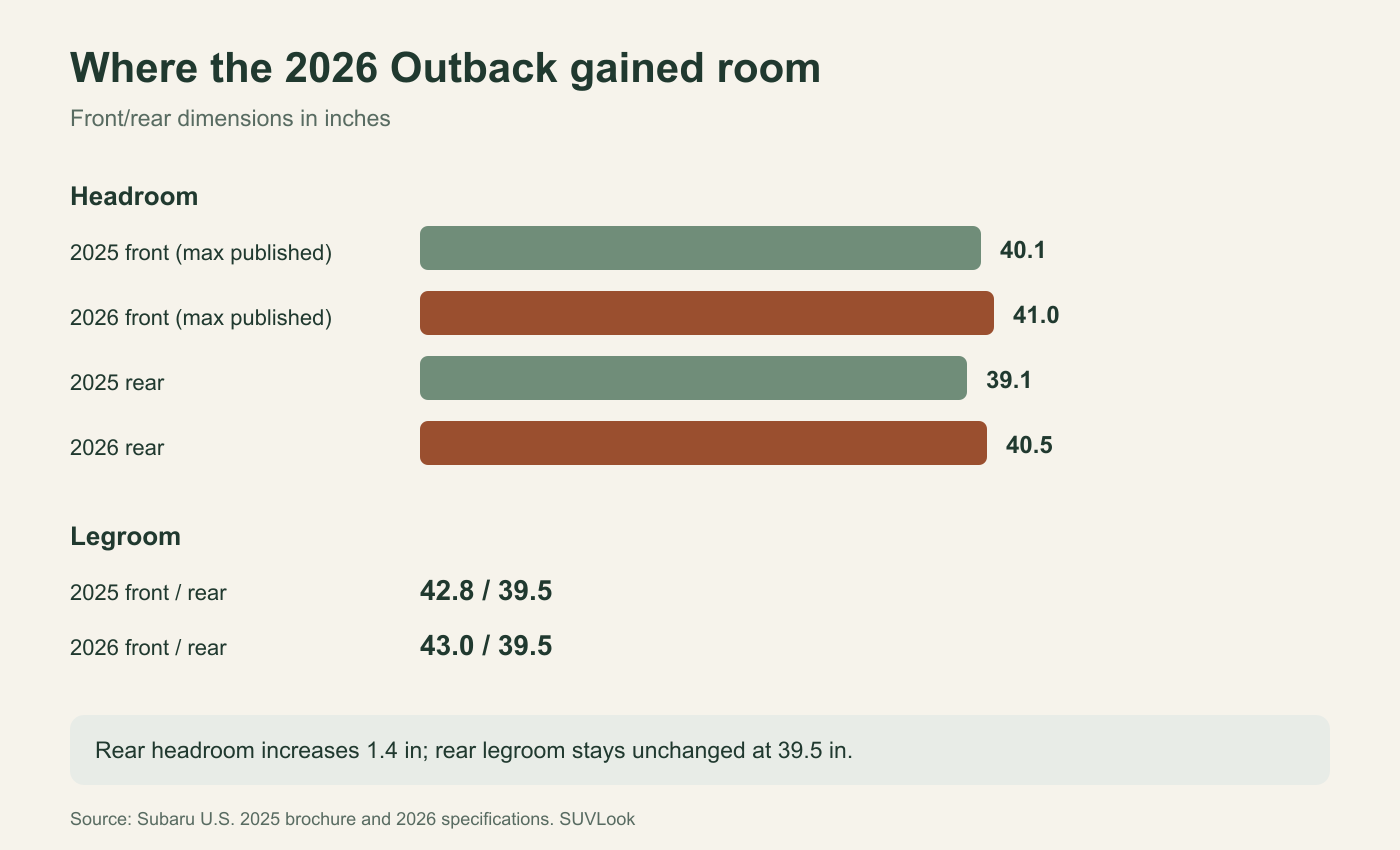
Published U.S. dimensions. Front headroom varies by trim and moonroof configuration; check the exact vehicle you are shopping for.
A tape measure still cannot tell you exactly how roomy a seat will feel. Seat cushion height, seatback angle, hairstyle, torso length and preferred driving position all affect real clearance. Use the factory headroom number as a comparison point, then sit in the exact trim if head clearance is close for you.
Subaru Outback legroom: front and rear
The 2026 Subaru Outback has 43.0 inches of front legroom and 39.5 inches of rear legroom. The 2025 model lists 42.8 inches in front and 39.5 inches in the rear.
So the driver and front passenger gain only 0.2 inch on paper, while rear legroom does not change. If you are searching specifically for Subaru Outback rear legroom, 39.5 inches is the published figure for both model years.
Legroom specifications are useful for comparing vehicles, but they are not a promise that every driver can sit in front of every rear passenger. Front-seat track position changes the usable knee room behind it. For a family fit check, set the driver's seat for the actual driver first, then test the rear seat without moving the front seat forward just to create space.
Back-seat dimensions and seating capacity
The Outback is a two-row, five-seat vehicle. There is no third row. For 2026, the rear seat combines 39.5 inches of legroom, 40.5 inches of headroom and 57.4 inches of shoulder room. The secondary hip-room source lists 55.1 inches in the rear.
For 2025, Subaru publishes 39.5 inches of rear legroom, 39.1 inches of rear headroom, 57.4 inches of rear shoulder room and 54.8 inches of rear hip room.
If your real question is whether three adults or multiple child seats fit across, shoulder and hip room alone are not enough. Door trim, seat contour, buckle location and the width of the actual child restraints matter. Check the owner's manual for approved child-restraint positions and test the specific seats you plan to use.
Passenger volume: why the cubic-foot number changes
Passenger volume is an aggregate cabin-volume figure, not a measurement you can reproduce with one tape measure. It is useful for broad comparisons, but it should sit behind headroom and legroom when you are deciding whether a particular person will fit comfortably.
The 2025 Outback is rated at up to 109.0 cubic feet of passenger volume, or 107.5 cubic feet with the available moonroof. The redesigned 2026 Outback reaches up to 112.3 cubic feet, with 111.1 cubic feet shown for moonroof-equipped or applicable trim configurations.
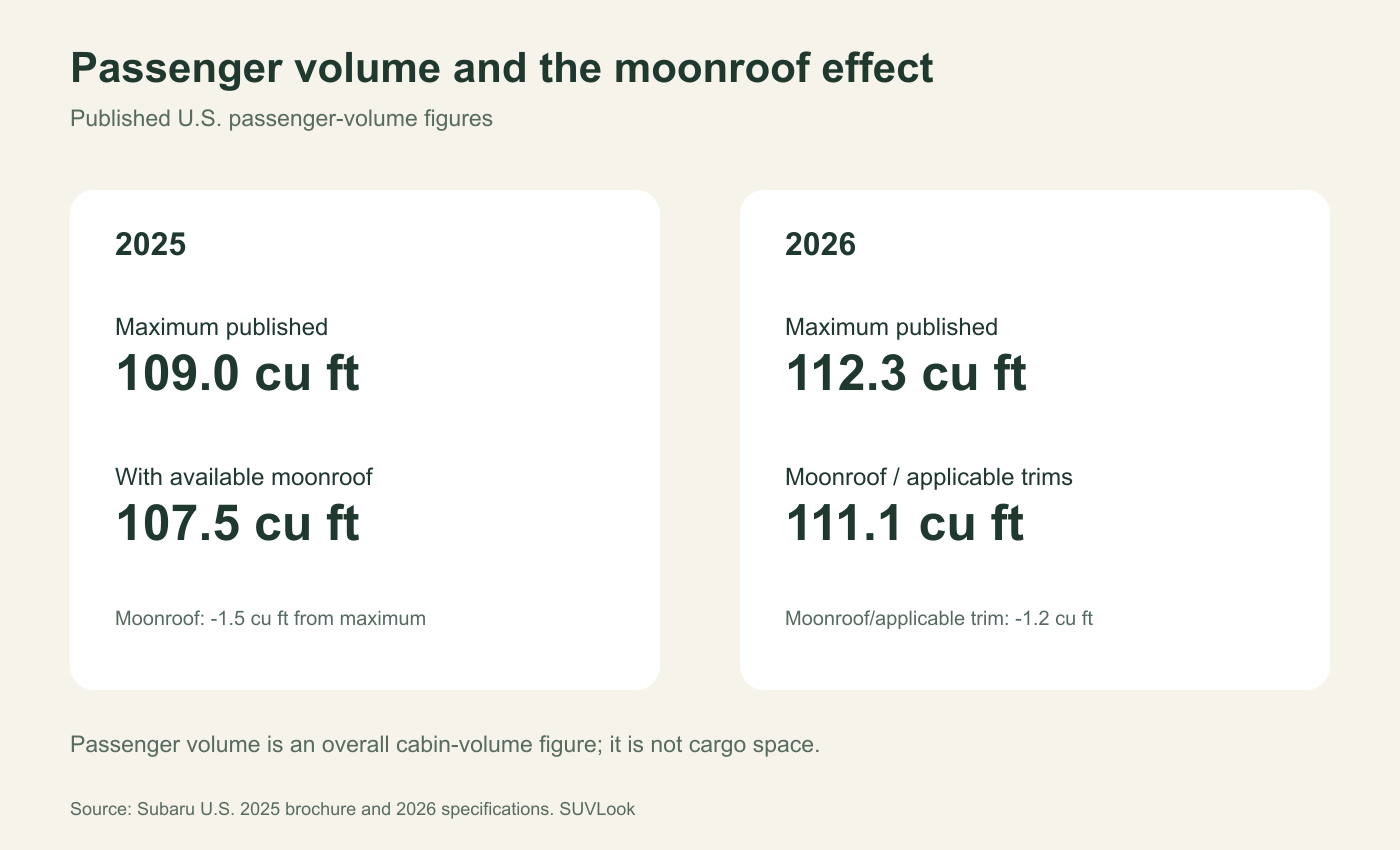
Passenger volume is an overall cabin-volume specification. It should not be read as usable cargo volume or as a direct measurement of knee room.
The difference between 109.0 and 112.3 cubic feet sounds large, but the dimensional table explains where some of that gain goes: more headroom, especially in the back, rather than a major increase in rear legroom.
2024 and older Subaru Outback interior dimensions
The 2024 Subaru Outback interior dimensions closely match 2025 in the measurements most shoppers search. Subaru lists 40.1/39.1 inches of front/rear headroom before the moonroof adjustment, 42.8/39.5 inches of front/rear legroom, 58.1/57.4 inches of shoulder room and 55.5/54.8 inches of hip room. Passenger volume is up to 109.0 cubic feet. 2024 Subaru brochure
That makes 2024 and 2025 easy to compare on paper. The 2026 redesign is the year where the cabin-height and passenger-volume figures make a clearer jump.
For older used Outbacks, use the brochure for the exact model year rather than assuming every sixth-generation car has identical figures. Equipment changed during the run, and moonroof-related headroom figures are especially easy to mix up across years.
If you are researching a 2022 Subaru Outback interior, Subaru's 2022 brochure still lists 42.8 inches of front legroom, 39.5 inches in the rear, 58.1/57.4 inches of shoulder room and 55.5/54.8 inches of hip room. 2022 Subaru brochure
Interior passenger space vs. cargo dimensions
Interior-dimension searches often mix passenger room with trunk measurements. They answer different questions. Headroom and legroom describe occupant space; cargo-floor length, wheel-housing width and hatch opening describe whether an object can actually be loaded.
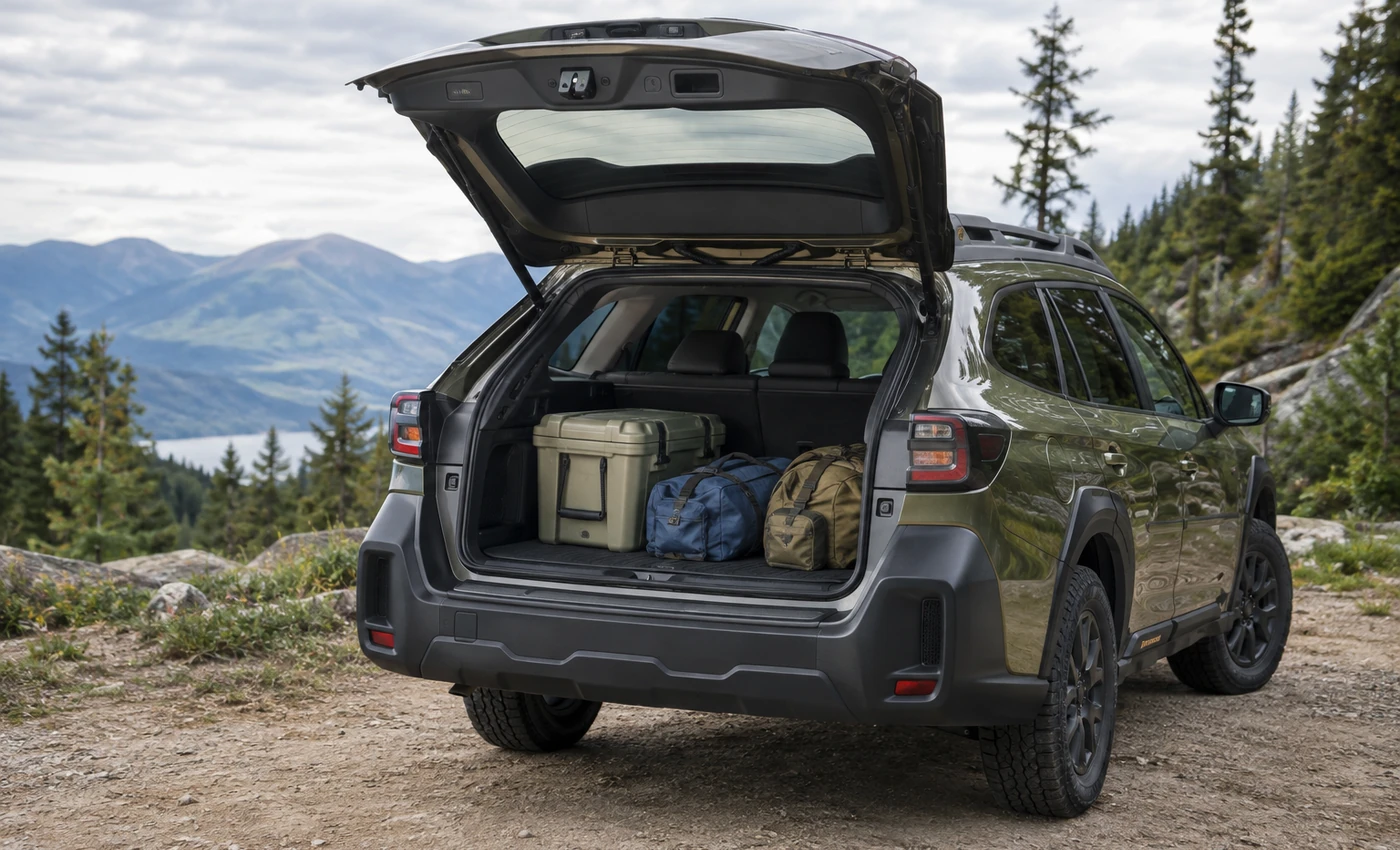
For 2026, Subaru lists 34.6 cubic feet of cargo volume behind the rear seats and 80.5 cubic feet with the rear seatbacks lowered. The 2025 figures are 32.6 and 75.6 cubic feet. For the floor lengths, hatch opening and wheel-housing width, use our Subaru Outback cargo dimensions guide. That page keeps the cargo measurements separate so this cabin guide does not blur passenger and loading-space intent.
How to check cabin fit before you buy
Factory dimensions are a good filter. A real seating check is better when you are close to a limit.
- Set the driver's seat first. Put it where the primary driver actually needs it, including seat height and recline.
- Check head clearance in normal posture. Do not slouch just to make the number work. Wear the hairstyle or headwear you usually drive with.
- Move to the rear seat behind the driver. Check knee, shin and foot room with the front seat left in its real position.
- Check the exact trim. Moonroof packaging changes front headroom. Seat design and upholstery can also change how a cabin feels.
- For child seats, use the real restraint. Published shoulder room does not tell you where buckles, anchors and door trim will land.
- For cargo, measure the cargo area separately. Do not use passenger-volume figures to estimate whether a crate, mattress or box will fit.
SUVLook separates manufacturer specifications from physical measurements. Where a manufacturer does not publish a dimension in the current U.S. table, we label the secondary source instead of presenting it as a Subaru factory figure. See our measurement approach and editorial policy.
Once the cabin fits your needs, use our 2026 Outback trim-level comparison to separate comfort packages, XT turbo models and Wilderness hardware.
Frequently asked questions
How much rear legroom does a Subaru Outback have?
The 2025 and 2026 U.S. Outback both list 39.5 inches of rear legroom. The 2026 redesign increases rear headroom, but the published rear-legroom figure stays the same.
Is the 2026 Outback interior bigger than the 2025 interior?
In several useful ways, yes. Maximum published passenger volume rises from 109.0 to 112.3 cubic feet, rear headroom rises from 39.1 to 40.5 inches, and maximum front headroom rises from 40.1 to 41.0 inches. Rear legroom remains 39.5 inches and rear shoulder room remains 57.4 inches.
Does a moonroof reduce Subaru Outback headroom?
It can. Subaru lists 2025 front headroom at 40.1 inches without the available moonroof and 39.1 inches with it. For 2026, certain configurations list 41.0 inches without the moonroof and 40.2 inches with it; other trims are listed at 40.2 inches in front.
How many people does the Subaru Outback seat?
The Outback seats five people in two rows. It does not have a third-row seat.
What are the 2024 Subaru Outback interior dimensions?
For 2024, Subaru lists 42.8/39.5 inches of front/rear legroom, 58.1/57.4 inches of shoulder room, 55.5/54.8 inches of hip room and up to 109.0 cubic feet of passenger volume. Headroom is 40.1/39.1 inches before the moonroof adjustment.
A quick note on the numbers: Most dimensions here come from Subaru's U.S. specifications; the 2026 hip-room figures are clearly attributed in the table where Subaru does not publish them alongside the other cabin measurements. These are published specs, so use an in-person seating check when you are close to a comfort limit.