Dimensions · Space · Buying guides
For U.S. vehicles; figures from Ford's 2026 Explorer page and 2026 Explorer ST page, plus SUVLook's 2026 Explorer profile, checked November 4, 2026. Ford's 2027 pages are live too; this guide uses the 2026 model year.
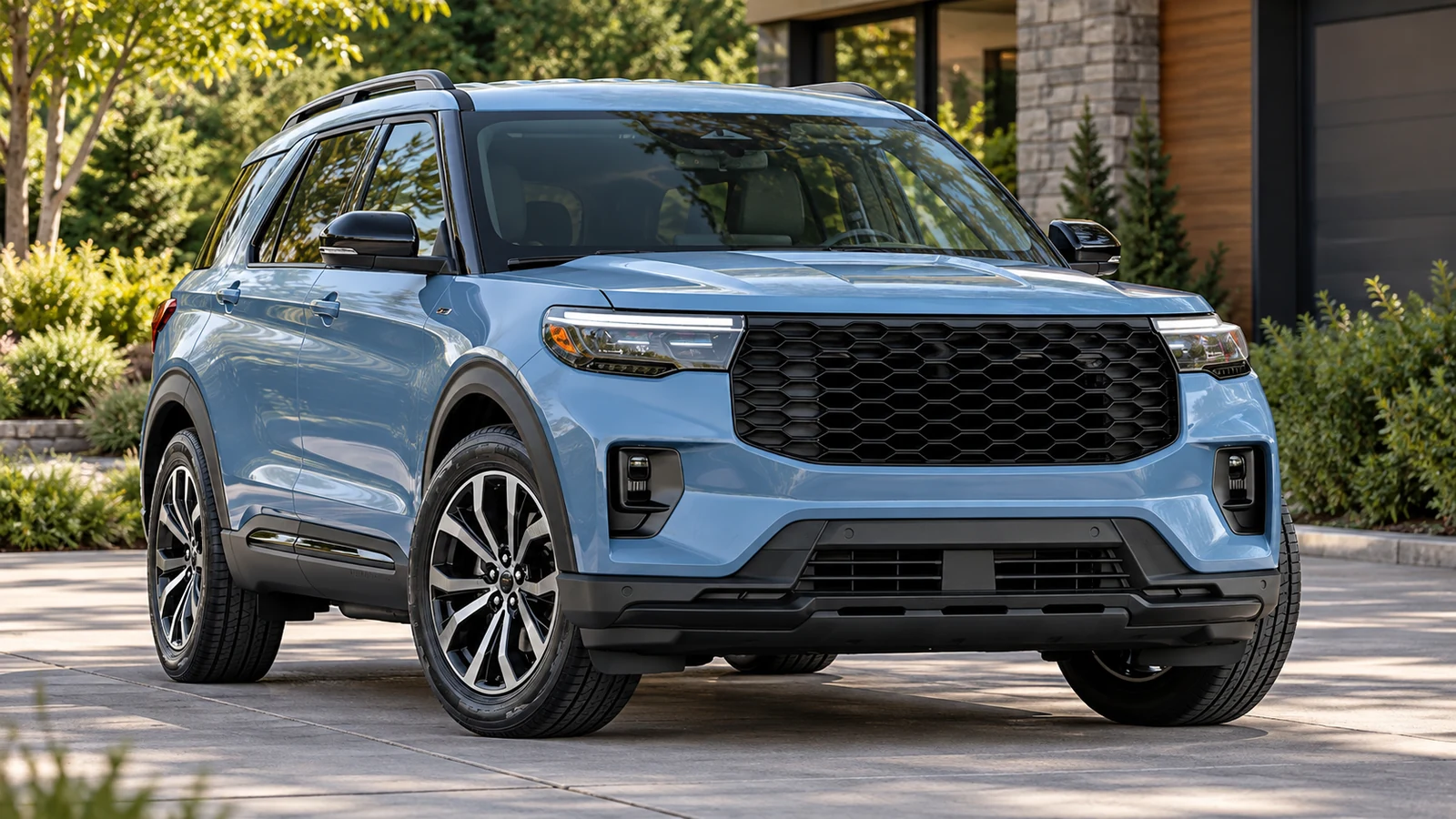
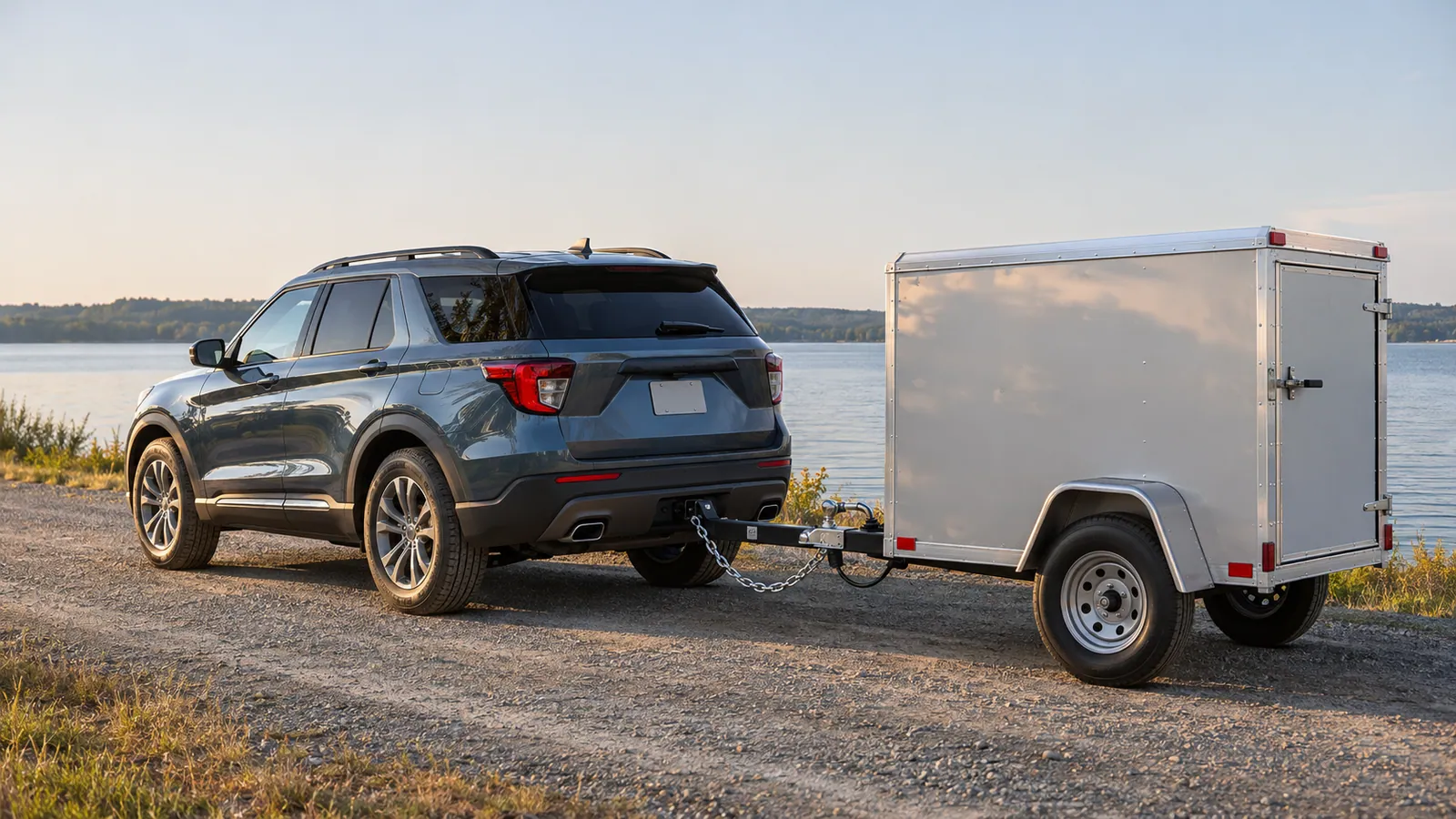
A 2026 Ford Explorer can tow up to 5,000 lb when properly equipped. Ford's 2026 page lists that same maximum for both engines, the 2.3L EcoBoost four-cylinder and the 3.0L twin-turbocharged EcoBoost V6, and says the Class III Tow Package is standard on all models. That makes the Explorer simple to shop: you do not need to pick a particular trim or engine to reach the headline number, but you still need to check the actual trailer against the rating, the vehicle label and the owner's manual.
2026 Explorer towing capacity table
| 2026 Explorer configuration | Engine | Maximum towing | Tow package |
|---|---|---|---|
| Active, ST-Line, Tremor, Platinum | 2.3L EcoBoost I-4 | 5,000 lb | Class III, standard |
| Tremor (V6 listed as available; see note) | 3.0L EcoBoost V6 | 5,000 lb | Class III, standard |
| ST | 3.0L EcoBoost V6 | 5,000 lb | Class III, standard |
| A caution on the table: the 2026 page's engine-by-trim listing is not fully consistent. It shows the 2.3L for Active, ST-Line, Tremor and Platinum, lists the 3.0L V6 as available on Tremor, and shows the 3.0L only on ST; another part of the same page describes a V6 with Intelligent 4WD on Tremor. Ford's 2026 order guide is the document to use for which engine is offered on which 2026 trim. The 5,000 lb rating is the same either way. |
What Ford attaches to the 5,000 lb number
Ford marks the towing figure with a footnote on its model pages, but the footnote text did not come through in the page content we could read. That means we cannot quote the exact conditions Ford applies, and we will not guess at them. SUVLook's profile records the rating as "properly equipped," and Ford's page says the Class III Tow Package is standard.
Ford lists the Class III Tow Package as including:
- a Class III hitch receiver
- a seven-wire harness
- four-pin and seven-pin trailer connectors
Separately, Ford's ST page lists a Tow/Haul drive mode among its six selectable modes.
For a specific vehicle, the door-jamb label and the owner's manual for that model year are the authority. Ford's pages did not publish a separate braked-versus-unbraked trailer rating, a tongue-weight limit or a gross combined weight rating in the content we reviewed, so we leave those out. If you need them, the manual lists them.
Engines and drivetrains
Ford's 2026 ST page lists the 3.0L EcoBoost with up to 385 hp and 415 lb-ft of torque and a 10-speed automatic transmission. Rear-wheel drive is standard and Intelligent four-wheel drive is optional. Ford's 2027 Active page lists the 2.3L EcoBoost at 300 hp; we mention it only to show the engine class, because that is a 2027 page, and we did not find a 2026 four-cylinder horsepower figure on the 2026 pages we read.
The key point for towing is what Ford does not say: it does not publish a higher rating for the V6 or for 4WD. Some third-party websites quote 5,300 or 5,600 lb for older Explorers. Those are not 2026 Ford figures, and the 2026 pages say 5,000 lb. Do not apply an older model year's number to a 2026 vehicle.
If you tow near the limit often, compare how each engine is rated for performance and ask a dealer about the equipment on the exact vehicle; SUVLook has not tested either engine under load.
Match the rating to a loaded trailer
A trailer's listed dry weight is not the weight you will tow. Add the water, propane, batteries, gear and anything else in or on the trailer. For a boat, count the trailer, fuel and equipment, not just the hull. Compare that loaded total, as measured at a scale if possible, with the 5,000 lb rating.
Then account for the vehicle. Ford's Expedition spec sheet, for example, says maximum towing varies with cargo, vehicle configuration, accessories and the number of passengers. A full seven-seat Explorer with luggage and a roof box has less capacity left for a trailer than a lightly loaded one. The tongue weight pushes down on the hitch and counts against the vehicle's load capacity. Ford's 2026 pages did not list a payload figure, so read the label on your own vehicle.
Brakes are another item to settle before you buy a trailer. Many trailers have their own braking systems, and the electrical connection and any control equipment need to be compatible with the vehicle. Ford's pages describe the seven-wire harness and connectors but not a specific brake-controller setup, so ask a qualified installer and follow the owner's manual rather than assuming that a connector alone makes a trailer ready to tow. Also remember that a hitch or accessory with a higher stamped capacity does not raise the vehicle's own rating; the lowest-rated component in the setup governs.
How the Explorer compares with rivals
Here are the published maximum towing figures for other three-row SUVs in SUVLook's profiles, each with its manufacturer-stated condition:
| 2026 SUV | Published towing | Condition |
|---|---|---|
| Ford Explorer | 5,000 lb | Properly equipped; both engines (Ford) |
| Chevrolet Traverse | 5,000 lb | Properly equipped (Chevrolet) |
| Honda Pilot | 5,000 lb AWD; 3,500 lb 2WD | By drivetrain (Honda) |
| Toyota Grand Highlander | 5,000 lb for gas and Hybrid MAX; 3,500 lb for the regular hybrid | By powertrain (Toyota) |
| Hyundai Palisade | 5,000 lb gas; 4,000 lb hybrid | With trailer brakes (Hyundai) |
These come from the matching SUVLook profiles: Traverse, Pilot, Grand Highlander and Palisade. The Explorer ties the others at the top figure and, unlike the Pilot, Grand Highlander and Palisade, does not drop its rating on a particular drivetrain in Ford's published pages. For a direct look, SUVLook has a Traverse vs Explorer comparison.
If you need more than 5,000 lb, none of these mid-size three-row SUVs are the answer. Ford's larger Expedition is rated up to 9,600 lb in its standard-body 4x4 form under Ford's conditions; see our Expedition trim guide.
Checking your own Explorer
- Confirm the model year, trim and engine from the window sticker or VIN.
- Check the factory tow package on that vehicle and have a qualified installer confirm that the hitch, wiring and any brake controller fit your trailer. We do not give installation steps here; the owner's manual does.
- Weigh the loaded trailer and measure the tongue weight.
- Compare the weights with the manual's limits and the door-jamb label, not with a figure from an older model year or a website.
For other Explorer questions, see our Explorer interior guide, cargo dimensions guide and trim levels guide. The SUV towing capacity chart lists more models, and the Ford SUV size guide helps if you are comparing sizes.
Related SUVLook research
- 2026 Ford Explorer research profile: specs, dimensions and towing by model year
- SUV towing capacity chart
- Ford Explorer trim levels
- Ford Explorer cargo space
Frequently asked questions
How much can a Ford Explorer tow?
Ford lists 5,000 lb maximum for the 2026 Explorer when properly equipped, for both the 2.3L and 3.0L engines.
Does the V6 Explorer tow more than the four-cylinder?
Not according to Ford's 2026 page, which lists 5,000 lb for both engines.
Is a tow package standard?
Ford says the Class III Tow Package is standard on all 2026 Explorer models.
Can an Explorer tow a camper?
Only if the loaded camper and its tongue weight fit within the limits in your owner's manual and on your door-jamb label. A camper's dry weight is not enough.
Has SUVLook tested these ratings?
No. The ratings are manufacturer-published; the checklists and comparisons are editorial.