Dimensions · Space · Buying guides
Honda CR-V interior dimensions are useful for narrowing your shortlist, but the trim matters. For the U.S. 2026 model, Honda lists 41.3 inches of front legroom and 41.0 inches in the rear across the lineup. Front headroom is 40.0 inches in LX and 38.2 inches in the other trims; rear headroom is 38.2 inches throughout. Honda's 2026 specifications.
If you need more room above your head, try LX alongside the better-equipped trim you're considering. If the problem is an adult sitting behind a tall driver, have both people settle into their normal positions at the same time. The rear-legroom figure can't tell you how much space will remain once that driver's seat is pushed back.
This guide covers manufacturer-published U.S. 2026 passenger measurements, a separately checked 2025 comparison, and a repeatable showroom fit check. It does not substitute current specifications for older CR-V generations or claim that SUVLook physically tested the cabin. Sources were checked October 5, 2026.
2026 Honda CR-V interior dimensions in inches
| Passenger measurement | Front row | Rear row | Trim scope |
|---|---|---|---|
| Headroom | 40.0 in | 38.2 in | LX |
| Headroom | 38.2 in | 38.2 in | EX, EX-L and all listed hybrid trims |
| Legroom | 41.3 in | 41.0 in | All listed trims |
| Shoulder room | 57.9 in | 55.9 in | All listed trims |
| Hip room | 55.6 in | 52.6 in | All listed trims |
Evidence: the Interior Measurements section of Honda's 2026 CR-V specification table. These are manufacturer specifications, not SUVLook tape measurements.
Read the rows by the problem you are trying to solve. Headroom helps shortlist a cabin for an upright seating position. Legroom is relevant to knee and foot space. Shoulder and hip room describe widths at their respective measurement locations; neither gives the usable width of an individual seat cushion.
Do not divide rear hip room by three to estimate the space available to each passenger. The bench shape, door trim, belt hardware and an installed child seat can all affect how occupants actually sit. Similarly, subtracting a person's height from headroom does not calculate their roof clearance: overall height includes legs, while seating posture and torso length vary.
Which CR-V trim has the most published headroom?
LX is the configuration to put on your test-drive list when front roof clearance matters most. The difference between Honda's listed LX and other-trim front headroom is 1.8 inches, calculated as 40.0 minus 38.2. That is a difference between specification entries, not a guarantee that every driver will gain exactly 1.8 inches above their head.
Honda's 2026 table lists the moonroof on the other trims and not on LX. It also lists passenger volume as 106.0 cubic feet for LX and 103.5 cubic feet for the other trims. The useful conclusion is to compare the actual roof and seat configuration, not simply the words gas and hybrid. Honda's 2026 trim and specification matrix.
If you tried one CR-V and found the roof too close, record the trim before ruling out the entire model. Conversely, a comfortable experience in LX does not establish that a hybrid or EX-L will feel identical. Check the version you will own, with the seat at a height that still gives you a comfortable view and steering-wheel position.
Lowering the seat solely to avoid the headliner can introduce a different problem: a poor view out, an awkward thigh angle or a steering wheel that no longer meets your arms naturally. A usable fit is the position in which those requirements work together, not the position that creates the largest visible gap above your head.
2025 versus 2026 CR-V interior dimensions
The passenger measurements in Honda's separately published 2025 table match the 2026 entries shown above. That applies to front/rear legroom, shoulder room, hip room, LX front headroom and the other listed trims' headroom. We checked the two model-year tables rather than inferring carryover from the vehicle's appearance. 2025 specifications and 2026 specifications.
For a used 2025 CR-V, the cabin table is therefore a useful starting point. It is not evidence that equipment, seats, cargo specifications or every buyer-relevant feature are identical between years. Keep the year attached to any other figure you use.
The 2026 specification matrix includes TrailSport Hybrid, which is not a column in the checked 2025 table. Do not create a 2025 TrailSport entry by copying the newer model's measurements. For either year, identify the exact trim on the vehicle rather than relying on a dealer's generic model description.
Shopping for a 2017 or 2020 CR-V? Don't use the 2026 table to judge its cabin. Different generations need their own specification sheets, and a used vehicle's model year matters more than a similar-looking interior photograph. Ask for the matching-year figures before ruling a vehicle in or out.
Honda CR-V hybrid interior dimensions: what actually differs?
In the checked 2026 table, Sport Hybrid, TrailSport Hybrid, Sport-L Hybrid and Sport Touring Hybrid share the passenger measurements assigned to the non-LX group above. There is no published legroom, shoulder-room or hip-room penalty relative to EX or EX-L in that table. Honda's 2026 specifications.
That is a more useful comparison than contrasting a hybrid with LX and calling every difference a hybrid-system effect. LX and the other gasoline trims already differ in published front headroom. Treat roof/trim configuration and powertrain as separate questions.
Our editorial advice is to choose the powertrain on its own verified merits once you know both cabins work for you. Do not assume the hybrid is unsuitable for your rear passengers because its luggage capacity differs, and do not assume matching passenger dimensions make its cargo area interchangeable with the gasoline model.
For a hybrid shopper, repeat the same front-and-rear seating exercise in the exact hybrid trim. The specification table is the shortlist; the visit determines whether the seat support, console contact and rear foot placement suit your occupants.
How to check CR-V space for a tall driver
Start with your ordinary driving posture, not the rear-seat demonstration position a salesperson may have used. Wear normal footwear and bring the person who usually sits behind you if possible.
- Set the seat so you can operate the pedals comfortably without stretching or keeping your knees sharply bent.
- Adjust the backrest and steering wheel for a relaxed reach. Do not recline far beyond your usual posture just to create apparent headroom.
- Check clearance at the headliner and near the door opening. Turn your head normally rather than assessing only one perfectly centered position.
- Check whether your knee rests against the console and whether you can change foot position without rubbing the underside of the dashboard.
- Check whether the cushion supports your thighs without uncomfortable pressure behind your knees.
- Get out and back in. A cabin that works once seated may still be awkward to enter regularly.
These are fit checks, not a height-based scoring system. We do not promise that everyone of a particular height will fit, because torso length, seat adjustment and preferred posture can differ substantially.
If LX works and another trim does not, you have a meaningful trade-off to evaluate. If neither works without compromising your driving posture, use our small-SUV guide for tall drivers to identify other candidates, then repeat the same test.
Rear-seat space: test behind the actual front occupant
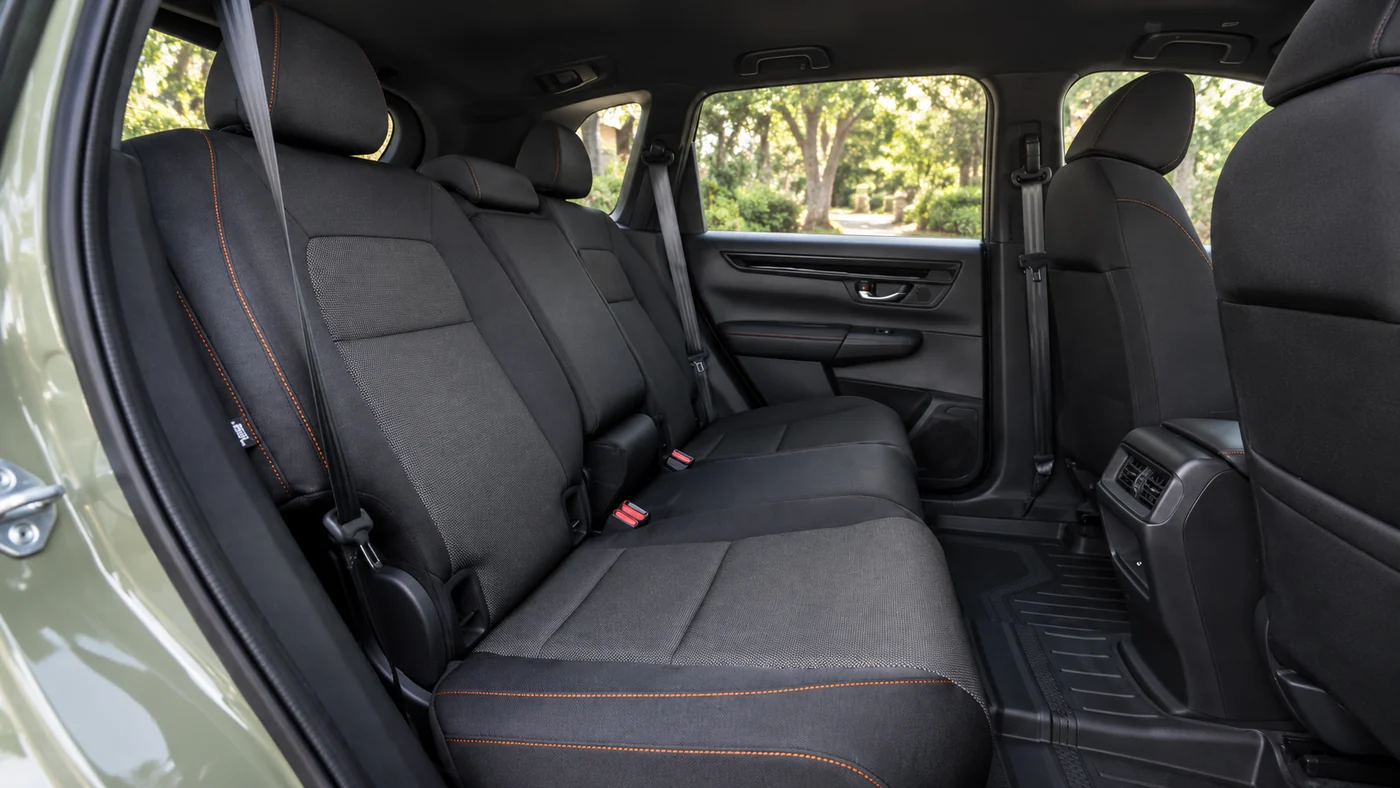
AI-generated editorial illustration based on Honda's 2026 CR-V TrailSport Hybrid rear-seat reference. It illustrates the seating arrangement; depicted gaps do not establish knee clearance, three-adult comfort or child-seat installation fit.
Leave the front seat exactly where its normal occupant needs it. Then sit behind it and check knee clearance, foot space under the front seat, roof clearance and the angle of your hips and knees. Ask the front occupant to remain seated so the arrangement is realistic.
For a family using both outer rear positions, test behind the driver and behind the front passenger separately. Those front seats may be set differently. A comfortable position on one side does not automatically prove the other side works.
Try the center position if you expect to use it regularly. Published shoulder and hip room do not establish the comfort of three adults together, and a wide child seat can change the usable arrangement. Check access to belt buckles with the seats and passengers in the configuration you intend to use.
When evaluating a child seat, follow the vehicle and child-seat manufacturers' installation instructions. Bring the actual seat if the dealer allows it. Confirm the installation, front-occupant position and buckle access together; this article is not a child-seat installation test or proof that a particular seat combination works.
A useful visit note is specific: which trim, which front-seat position, which rear passenger or child seat, and which interference occurred. That is more actionable than writing only that the car felt spacious.
Passenger room is not cargo length and width
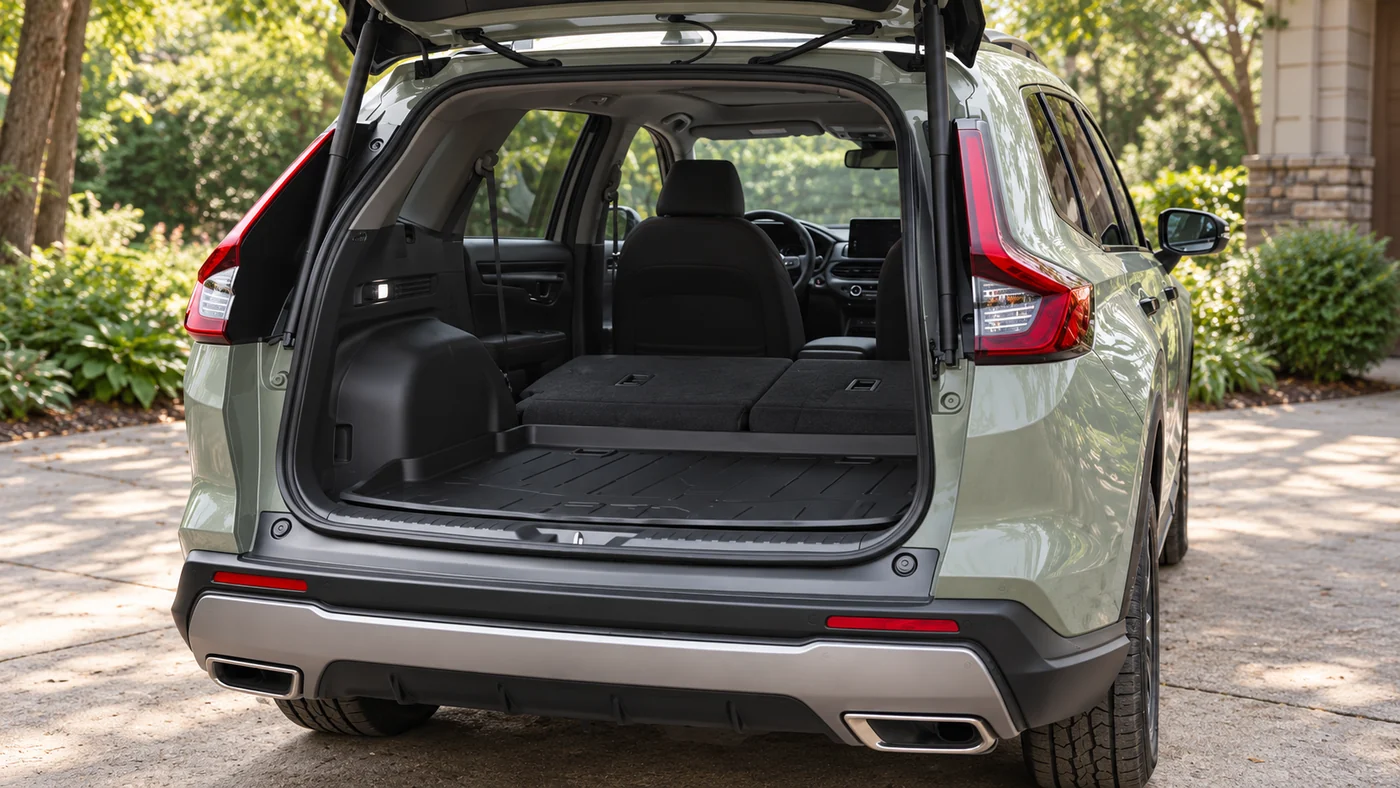
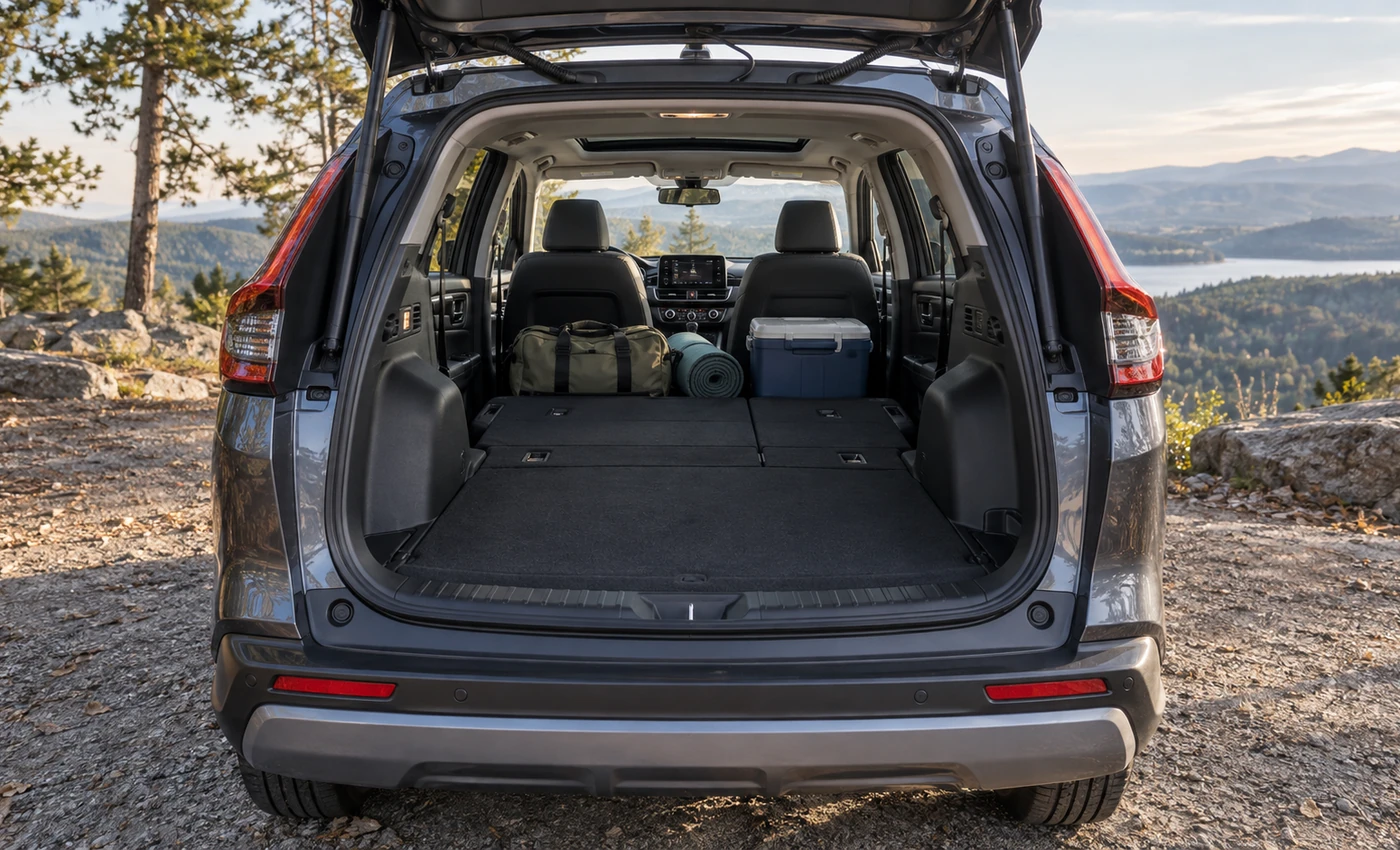
AI-generated editorial illustration based on Honda's 2026 CR-V TrailSport Hybrid cargo reference. The folded-seat view and pictured cargo tray illustrate a loading configuration, not usable floor dimensions, standard equipment or proof that an item fits.
If your real question is whether a stroller, dog crate or long object fits, use the CR-V cargo length, width and hatch-opening guide. Its measurements have their own model-year and source labels. This cabin guide does not turn passenger legroom or cubic-foot volume into a luggage-area measurement.
For 2026, Honda's behind-second-row table distinguishes gasoline trims at 39.3 cubic feet from hybrid trims at 36.3 cubic feet. Those capacities describe volume, not a rectangular box that an object can occupy. Honda's 2026 cargo entries.
Keep the separate cargo guide's older references within their stated scope. If a critical hatch or floor measurement is unavailable for the exact vehicle you are considering, measure that vehicle rather than treating an older reference as a guaranteed fit.
For a broader shortlist, the 2026 compact-SUV comparison organizes several buyer criteria. Compare matching-year and matching-configuration data; do not choose a cabin on one headline room figure alone.
Frequently asked questions
What are the interior dimensions of the 2026 Honda CR-V?
Use the front/rear table above for headroom, legroom, shoulder room and hip room. The important qualifier is front headroom: LX has a different published figure from the other trims. Identify the trim before comparing it with another SUV.
Does the CR-V hybrid have less passenger space?
Honda's checked 2026 passenger table gives hybrid trims the same listed dimensions as EX and EX-L. Comparing a hybrid directly with LX introduces a trim/roof distinction. Cargo capacity is a separate question and should not be used as a substitute for passenger measurements.
Are 2025 and 2026 CR-V cabin measurements the same?
The checked manufacturer passenger measurements match for the relevant trims. That does not establish that every feature or cargo specification matches, and it does not extend the result to older generations.
Is the CR-V comfortable for tall drivers and rear passengers together?
Specifications make it worth checking, but cannot guarantee your combined seating fit. Set the front seat for its real occupant, keep it there, then evaluate the rear position. Check roof, knees, feet, console contact and entry/exit rather than relying only on total height.
Sources and measurement limits
- Honda Information Center: 2026 CR-V specifications, Interior Measurements and trim equipment matrix.
- Honda Information Center: 2025 CR-V specifications, separately checked Interior Measurements.
Manufacturer specifications and SUVLook's practical fit advice are identified separately. The 1.8-inch trim difference is arithmetic from the published entries, not an independently measured clearance. No first-hand road test, tape measurement, child-seat installation result or guaranteed item fit is claimed. No 2027 specifications are substituted into this 2025/2026 guide.