Dimensions · Space · Buying guides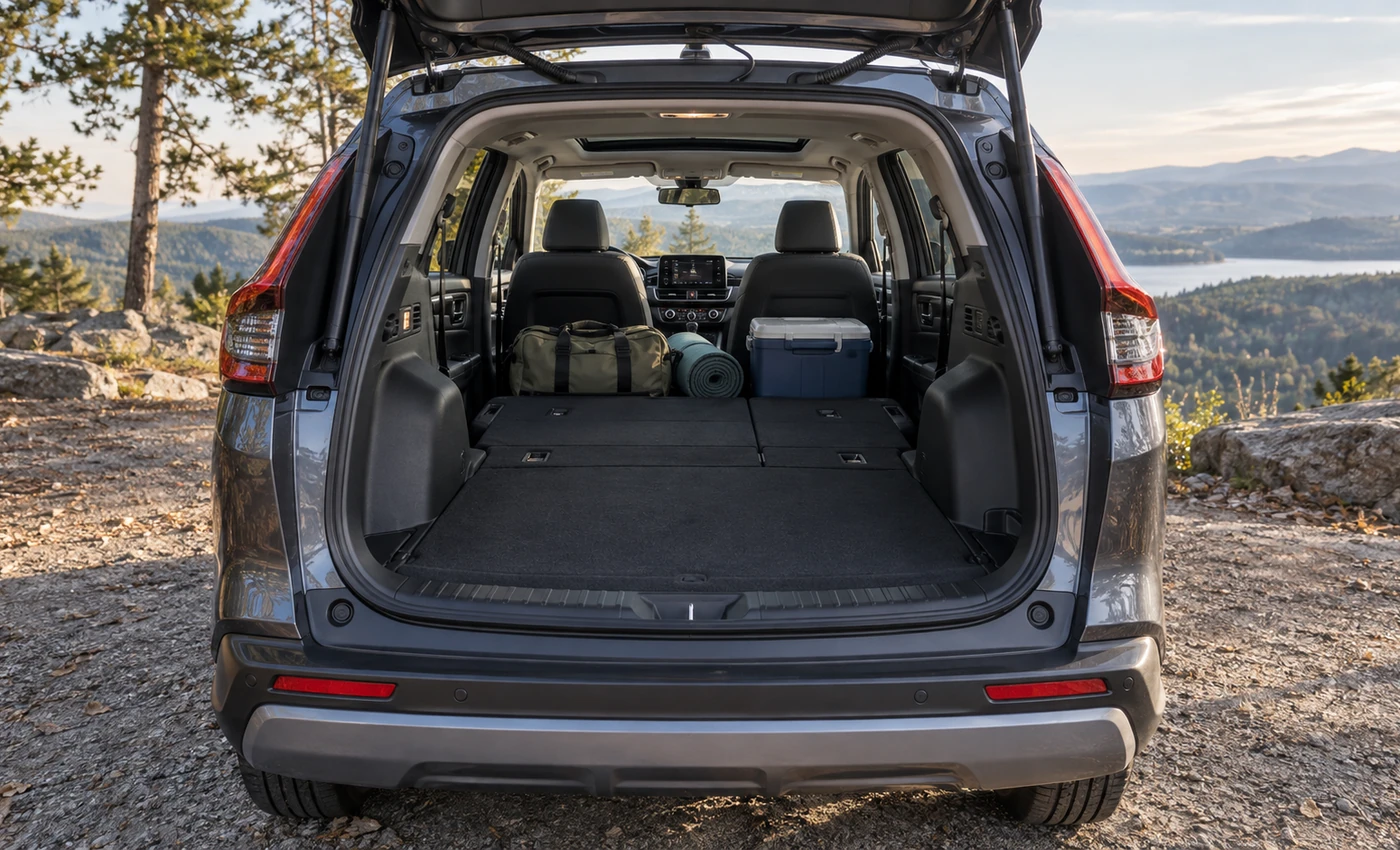
U.S. models · Sources checked September 10, 2026
For a recent Honda CR-V, about 41 inches between the wheel housings is a useful starting point. One 2025 Sport Touring owner reported roughly 36 inches of cargo depth with the rear seats up and 72 inches with them folded. Those are owner-reported measurements, and the longer figure depends on front-seat position. Owner's measurement report
Buying a crate or building a sleeping platform? Check the loading path as well as the floor. A box can fit inside and still be too tall to get through the hatch, while a folded seatback can shorten the space available higher up. Below are the sourced measurements and Honda's year-by-year cargo volumes, with their limitations kept separate.
Honda CR-V cargo dimensions in inches
The Honda specification tables reviewed for this guide give cargo volume, but not a complete set of floor and hatch measurements. The following references come from two third parties. They describe particular vehicles, not guaranteed dimensions for every 2023–2026 CR-V.
| Measurement | Sixth-generation CR-V reported by SteadyHome | 2025 Sport Touring owner report |
|---|---|---|
| Width between wheel housings | About 41 in | About 41 in |
| Floor depth, rear seats upright | About 41 in | About 36 in |
| Length with rear seats folded | Not measured | About 72 in |
| Hatch-opening width | About 42 in | Not reported |
| Hatch-opening height | About 32 in | About 32 in |
| Cargo-floor-to-ceiling height | About 33.5 in | Varies by position; see source |
| Ground-to-loading-sill height | About 27.5 in | Not reported |
The five-inch difference in seats-up depth is a reason to check your own car, not average the two figures. The reports don't establish identical tape endpoints or seat and floor settings. A measurement along the floor can also be longer than the room available near the top of a sloping seatback.
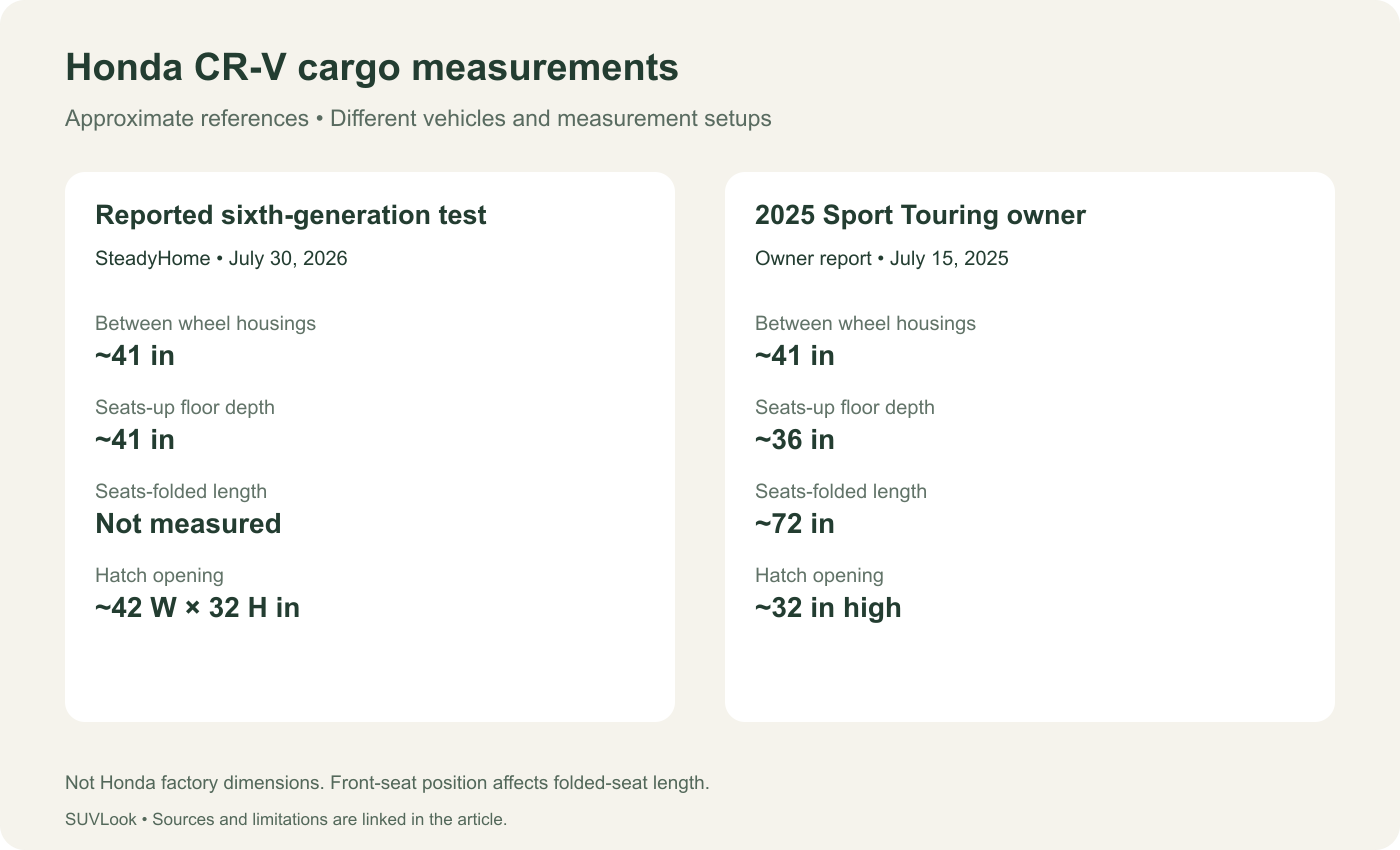
Reference diagram, not to scale. Measurements from different vehicles are kept separate.
For a consistent set of endpoints, follow our guide to measuring SUV cargo space.
How long is the CR-V cargo area with the seats down?
The owner's roughly six-foot figure is a planning reference, not a maximum you can apply to every CR-V. The owner notes that front-seat position affects the result and that the folded-seat section sits higher than the rear cargo area. Read the original measurement notes
Measure twice: once with the driver's seat where you drive, and again with it in your intended parked sleeping position. Keep those results separate. A mattress that works overnight still needs somewhere to go when you move the seat back to drive.
For a rigid platform, check the entire footprint at platform height. A long narrow object might clear a seatback where a wide rectangular platform won't. Check the join between the folded seats and cargo floor, too, before deciding how much support you need.
Check the hatch before checking the floor
The opening has curved corners. A quoted maximum width and height do not promise a rectangle of that size will pass through. Measure at the height of your item's widest part, including its handles, feet, hinges, and packaging.
A cardboard outline is useful for a bulky crate or cabinet. Try the loading angle first, then check where the object will sit. Leave enough clearance for the inside of the hatch when it closes; the bumper edge is not the closed-hatch boundary.
2021–2026 Honda CR-V cargo space by year
These are Honda's U.S. cargo-volume figures, in cubic feet. Each pair means rear seats up / maximum with seats folded. The 2023 figures are reported in Cars.com's original review; the other years link directly to Honda's tables. Volume is useful for comparing capacity; it cannot establish whether a single rigid object fits.
| Model year | Gasoline CR-V | Hybrid CR-V | Source |
|---|---|---|---|
| 2021 | 39.2 / 75.8 | 33.2 / 68.7 | 2021 specifications |
| 2022 | 39.2 / 75.8 | 33.2 / 68.7 | 2022 specifications |
| 2023 | Up to 39.3 / 76.5 | 36.3 / 76.5 | 2023 review reporting Honda figures |
| 2024 | 39.3 / 76.5 | 34.7–36.3 / 76.5 | 2024 specifications |
| 2025 | 39.3 / 76.5 | 34.7–36.3 / 76.5 | 2025 specifications |
| 2026 | 39.3 / 76.5 | 36.3 / 71.8 | 2026 specifications |
2026 CR-V: don't reuse the 2025 hybrid figure
Honda lists the 2026 gasoline LX, EX, and EX-L at 39.3 cubic feet behind the rear seats and 76.5 maximum. Sport Hybrid, TrailSport Hybrid, Sport-L Hybrid, and Sport Touring Hybrid are listed at 36.3 and 71.8 cubic feet. That hybrid maximum differs from the preceding year's published figure. The tables establish the specification difference; they do not, by themselves, explain its engineering or measurement basis. Honda's 2026 table
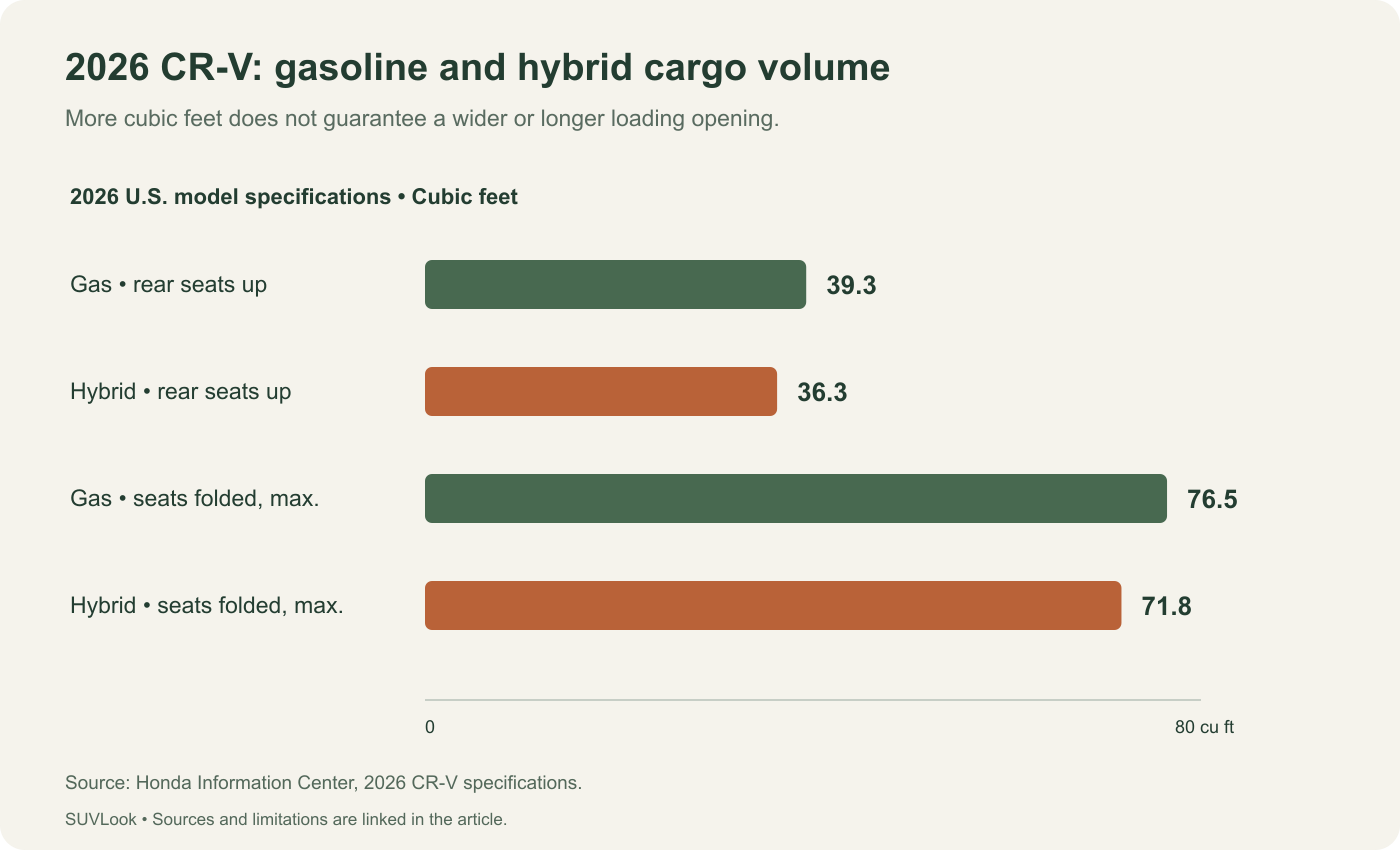
Manufacturer volume figures. The bars compare cubic feet, not floor length.
2024 and 2025 CR-V: the hybrid trim matters
For both years, Sport Hybrid and Sport-L Hybrid list 36.3 cubic feet behind the rear seats; Sport Touring Hybrid lists 34.7. All list 76.5 cubic feet maximum in the cited Honda tables. Gasoline trims list 39.3 behind the rear seats. Use the trim-specific row when comparing two used cars. 2024 specifications · 2025 specifications
2023 CR-V: check the load-floor position
Cars.com's original 2023 review reports Honda's figures of 36.3 cubic feet behind the rear seats and 76.5 with them folded. It also reports 39.3 behind the rear seats in gasoline models with the load floor at its lowest position. That floor position matters when comparing height measurements or ordering a fitted liner. 2023 CR-V review
2021 and 2022 CR-V: keep the earlier model separate
The older models have different published capacities, particularly in hybrid form. We haven't verified a complete, model-specific set of linear measurements for them, so we don't apply the newer vehicle's inch measurements to these years.
Honda's 2021 cargo guide describes a two-position floor on non-hybrid trims: lower for taller cargo or higher for a flatter folded-seat loading surface. Check that setting before comparing an owner's reported cargo height with your own car. Honda's adjustable-floor explanation
The e:FCEV needs its own figures
The hydrogen-powered e:FCEV is a separate configuration. Honda lists the 2026 version at 25.2 cubic feet behind the second row and 61.0 maximum. Don't use the standard gasoline or hybrid table for a fitted e:FCEV cargo system. 2026 e:FCEV specifications
Will a mattress, dog crate, bicycle, or plywood fit?
The checks below help spot a mismatch before you order. They are dimensional examples, not tests of particular products.
A twin mattress
Take a mattress listed at 38 × 75 inches. Against a 41-inch width reference, its width looks promising. Against a 72-inch length reference, it is three inches longer. Neither comparison tells you whether that mattress can bend around the trim or whether moving a front seat gives you enough room.
Use the product's actual inflated or uncompressed dimensions. Check raised edges, mattress thickness, and the floor transition. A flexible sleeping pad and a rigid plywood platform need different fit checks.
A queen mattress
A mattress listed at 60 × 80 inches is far wider than the reported narrow floor section. It should not be expected to lie there flat and uncompressed. Folding a foam mattress for transport is a different question from having enough room to sleep on it at full size.
A large dog crate
Start with the entrance. Then check the crate's upper corners against the seatbacks and closed hatch. A crate may have enough room at floor level yet run out of space higher up.
Measure latches and handles, not just the advertised box dimensions. Physical fit also doesn't establish whether a crate and its restraint system are appropriate for vehicle travel.
An adult bicycle
Measure the setup you're willing to load: front wheel on or off, handlebars turned, saddle at its intended height. Check pedals and bar ends as you move the bike through the opening. A wheel-size label alone doesn't answer the fit question.
A full 4×8 sheet
A 48 × 96-inch sheet exceeds both reported floor references when placed flat, lengthwise between the wheel housings. Don't plan on that arrangement with the hatch closed. Diagonal loading, supports above the floor, and an open hatch require separate checks and are not covered by those measurements.
If you're comparing vehicles for long loads, our Subaru Outback cargo dimensions guide includes published floor lengths and hatch-opening measurements. Compare the same measurement points, not just total cubic feet.
How to measure your own CR-V for a close fit
- Note the vehicle and floor setting. Record year, trim, powertrain, cargo liner, and any removable accessories.
- Set the seats as you'll use them. Keep required passenger seats usable. Record a separate measurement if you move the front seats for parked sleeping.
- Measure the narrowest width. Check at floor level and at the height of the item, along its whole length.
- Measure depth to the closed hatch. Include the inward shape of the hatch trim and the slope of the seatback.
- Check the loading path. Measure the opening where the widest and tallest parts of the object will pass.
- Try a lightweight template. Leave working clearance; don't design around a zero-margin fit or force the hatch against a load.
Our cargo measurement method explains how to record comparable results. If you find an error in this guide, send SUVLook the model details and source.
Frequently asked questions
Are these official Honda cargo dimensions?
The cubic-foot figures are from Honda. The inch measurements are attributed third-party reports. SUVLook has not performed its own tape-measure test on these vehicles.
Are all 2023–2026 CR-V cargo areas identical?
Don't assume every clearance is interchangeable. The third-party measurement describes a generation, while Honda's tables show trim and year differences in volume. For fitted equipment, check your exact car and floor configuration.
Does the CR-V Hybrid have less cargo space?
Often, yes. The comparison table shows the difference by year and trim. Check both seats-up capacity and the maximum; a single headline number can hide a relevant difference.
Can I build a platform from the reported seats-down length?
Use it to plan your measurement session, not as a cut list. Check the full outline at platform height, with the seats set correctly and the hatch closed, before cutting material.
A quick note on the numbers: Honda provides the cargo-volume figures; inch measurements in this guide are labeled where they come from third-party reports. SUVLook has not tape-measured these CR-Vs. The illustrations are explanatory rather than scaled engineering drawings, so verify your own vehicle before buying a tight-fitting crate, mattress or platform.