Dimensions · Space · Buying guides
For U.S. vehicles; figures from Subaru's 2026 Outback specifications and Subaru's 2026 Forester trim comparison, as recorded in SUVLook's vehicle profiles (last updated September 16, 2026).
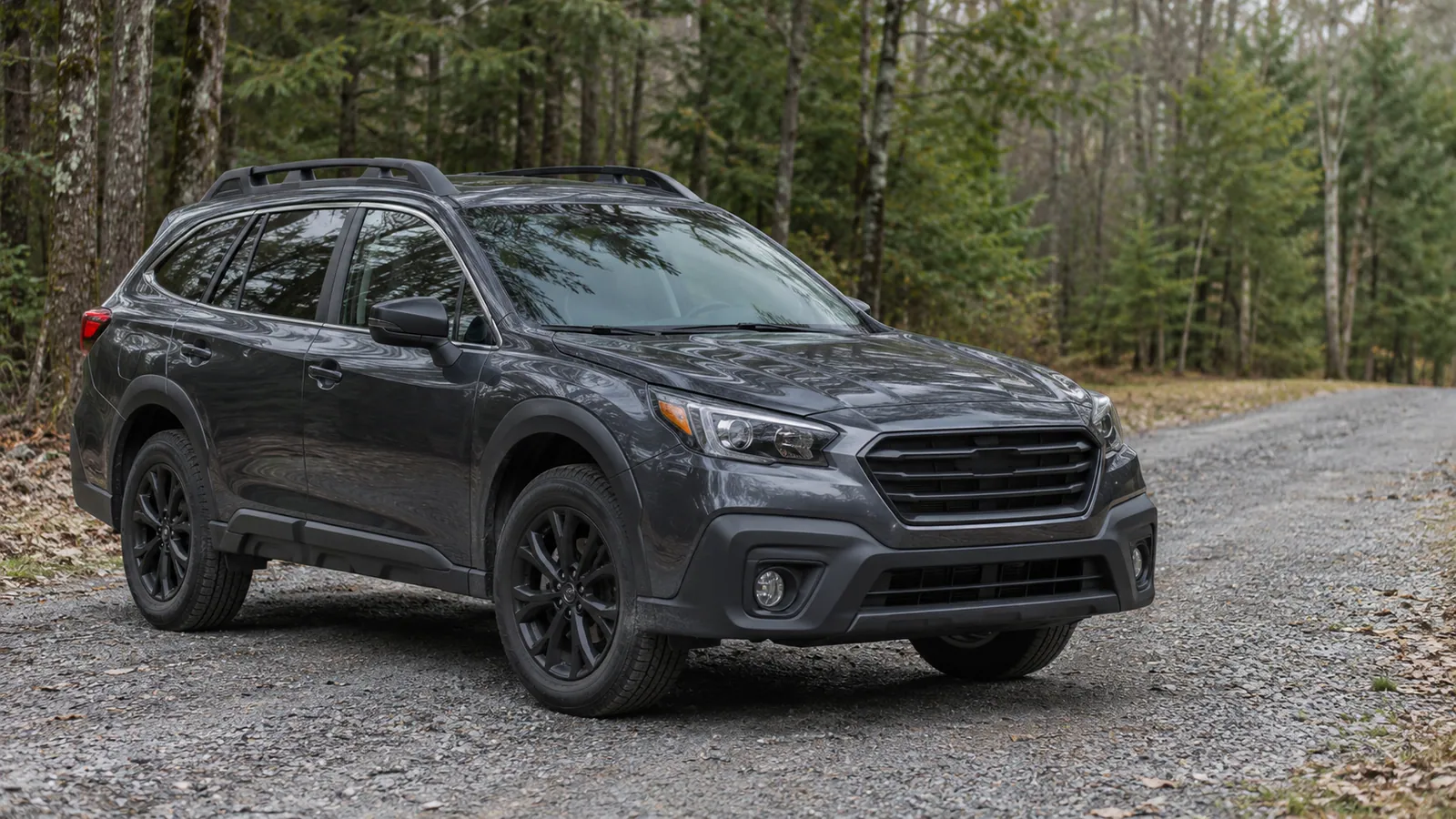
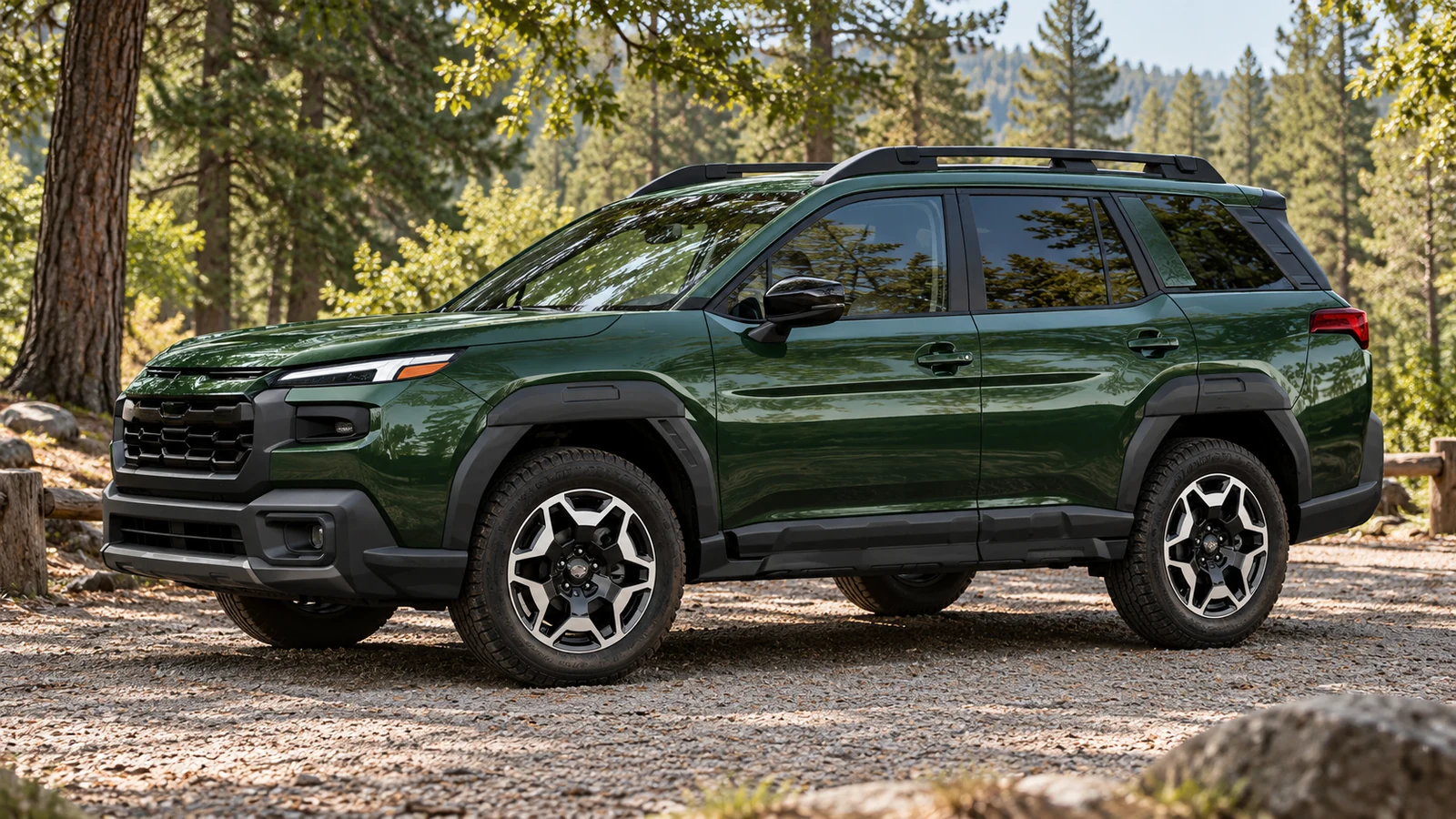
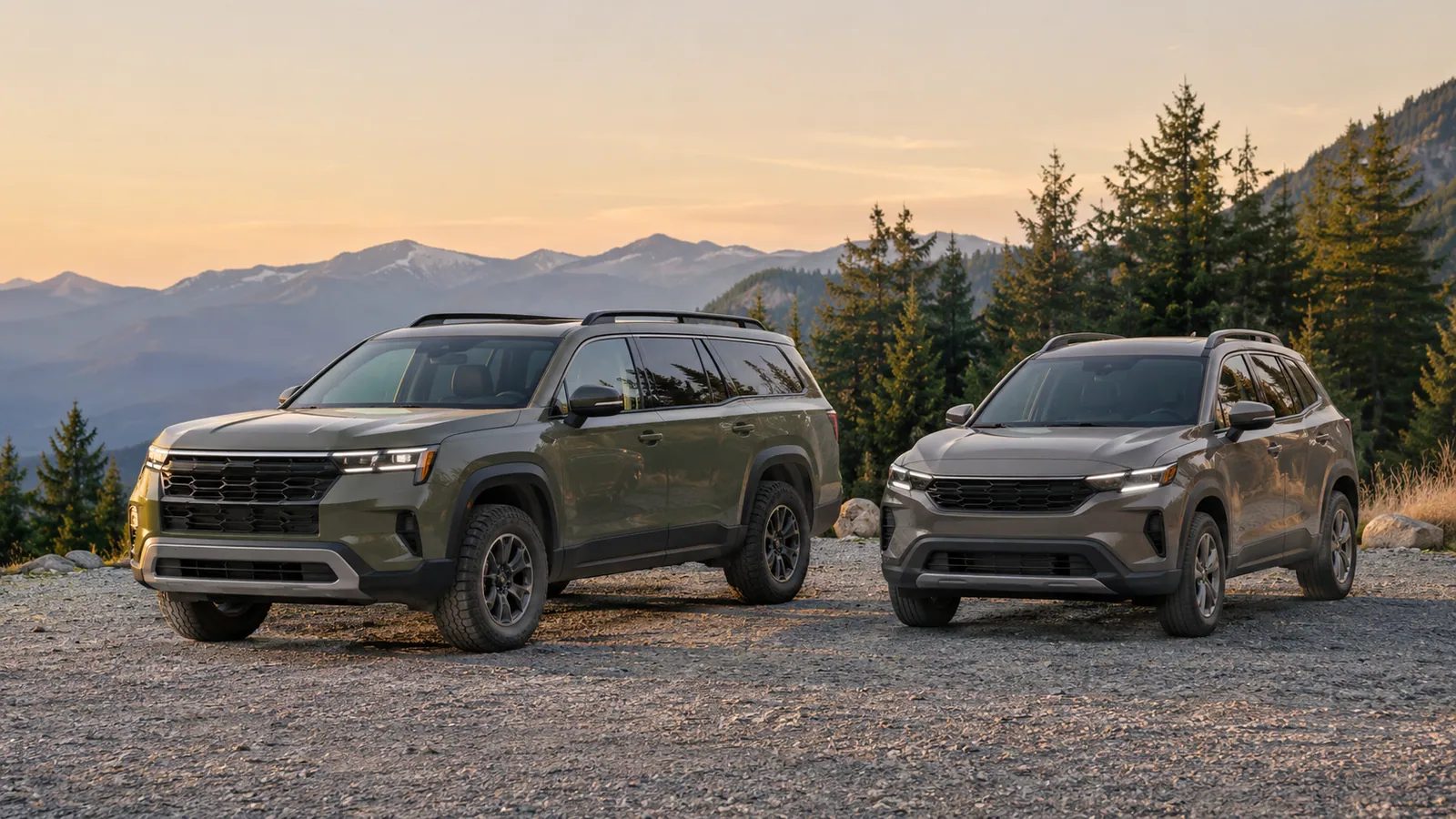
The 2026 Subaru Outback is the larger, more powerful choice; the 2026 Forester is the cheaper, more fuel-efficient one and the only one of the two with a hybrid. Both come with standard Symmetrical all-wheel drive and a 180-hp 2.5-liter Boxer engine in base form, and both earned an IIHS Top Safety Pick+ award for 2026. The differences that matter are the roughly $5,000 gap in starting price, the Outback's extra cargo room and optional turbo engine, and the Forester Hybrid's city mileage.
Quick comparison table
| 2026 spec | Outback | Forester |
|---|---|---|
| Starting MSRP (before destination) | $34,995 (Premium) | $29,995 (Base) |
| Base engine | 2.5L Boxer, 180 hp / 178 lb-ft | 2.5L Boxer, 180 hp / 178 lb-ft |
| Other powertrain | 2.4L turbo, 260 hp / 277 lb-ft | Hybrid, 194 hp system output |
| Drivetrain | Symmetrical AWD, standard | Symmetrical AWD, standard |
| Length / width / wheelbase | 191.7 / 74.0 / 108.1 in | 183.3 / 72.0 / 105.1 in |
| Cargo behind rear seat | 34.6 cu ft | 29.6 cu ft (27.5 on many equipped trims) |
| Maximum cargo | 80.5 cu ft | 74.4 cu ft (69.1 on many equipped trims) |
| Towing, base engine | 2,700 lb | 1,500 lb (most trims) |
| Towing, Wilderness | 3,500 lb (also XT trims) | 3,500 lb |
Price and trims
Subaru's starting prices below exclude destination, taxes and options.
| Trim | Outback | Forester |
|---|---|---|
| Base | Not offered | $29,995 |
| Premium | $34,995 | $31,995 |
| Sport | Not offered | $34,795 |
| Limited | $41,715 | $35,995 |
| Touring | $45,395 | $39,995 |
| Wilderness | $44,995 (turbo) | $36,995 (gas) |
| Limited XT / Touring XT (turbo) | $44,365 / $47,995 | Not offered |
| Forester Hybrid: Premium / Sport / Limited / Touring | Not offered | $34,730 / $37,930 / $38,995 / $41,545 |
The same-name trims show the real gap. The Forester Premium is $3,000 below the Outback Premium. The Forester Limited is $35,995 and the Outback Limited is $41,715, a $5,720 difference. At Touring it is $39,995 against $45,395, a $5,400 difference. The lowest entry points are $5,000 apart (differences calculated from the table).
The Outback Wilderness is turbo-powered at $44,995, while the Forester Wilderness uses the gas engine at $36,995. That makes the Forester Wilderness the less expensive route to a 3,500-pound tow rating. Prices change, so check Subaru's current pricing and your dealer's quote before deciding.
Powertrain and fuel economy
Both vehicles start with the same 180-hp, 178 lb-ft 2.5-liter Boxer four-cylinder and a Lineartronic CVT. After that they diverge.
The Outback adds a 2.4-liter turbo Boxer with 260 hp and 277 lb-ft on Wilderness and XT trims. The Forester instead adds a hybrid system with 194 hp of published output.
| Subaru-published fuel economy (city / highway mpg) | Outback | Forester |
|---|---|---|
| Base 2.5L gas | 25 / 31 | Up to 26 / 33 (selected trims) |
| Sport and Touring gas | Not listed | About 25 / 32 |
| Turbo (XT) | 21 / 29 | Not offered |
| Wilderness | 21 / 27 | About 24 / 28 |
| Hybrid | Not offered | 35 / 34 |
The Forester Hybrid's published range is up to 581 miles. Subaru's figures put the Forester ahead on every comparable gas row, and the hybrid's city number is far higher. If you want the strongest acceleration, the Outback's turbo is the only 260-hp option here.
These are manufacturer estimates recorded in SUVLook's profiles, not SUVLook tests. Check the window sticker for your exact trim.
Size and dimensions
| Dimension | Outback | Forester |
|---|---|---|
| Overall length | 191.7 in | 183.3 in |
| Overall width | 74.0 in | 72.0 in |
| Wheelbase | 108.1 in | 105.1 in |
| Ground clearance | 8.7 in | 8.7 in |
| Wilderness ground clearance | 9.5 in | 9.3 in |
The Outback is 8.4 inches longer and 2.0 inches wider, and its wheelbase is 3.0 inches longer (calculated from the table). That is the physical reason it feels bigger in a garage, and it shows up mainly in cargo volume rather than in front-seat space. Ground clearance is identical on most trims; the Outback Wilderness has 0.2 inch more than the Forester Wilderness.
If your garage or parking space is tight, measure before buying. The Outback is the one more likely to be a problem.
Cabin space
| Cabin figure | Outback | Forester |
|---|---|---|
| Front legroom | 43.0 in | 43.3 in |
| Rear legroom | 39.5 in | 39.4 in |
| Front headroom | Up to 41.0 in | Up to 41.2 in |
| Rear headroom | 40.5 in | Not in SUVLook profile |
| Passenger volume | Up to 112.3 cu ft | Up to 110.8 cu ft |
| Seating | 5 | 5 |
The cabins are closer than the exterior sizes suggest. The Forester has slightly more front legroom and headroom on paper; the Outback has 0.1 inch more rear legroom and 1.5 cubic feet more passenger volume. Those differences are tiny, so sit in both with your tallest regular passenger behind you. Headroom depends on roof equipment, so moonroof trims differ.
Technology differs more than space. SUVLook's profiles list a 12.1-inch center touchscreen as standard on the Outback, while the Forester's 11.6-inch screen is available on higher trims. For more detail see our Outback interior dimensions guide and Forester interior dimensions guide.
Cargo space
| Cargo figure | Outback | Forester (roomiest) | Forester (many equipped trims) |
|---|---|---|---|
| Behind rear seats | 34.6 cu ft | 29.6 cu ft | 27.5 cu ft |
| Maximum | 80.5 cu ft | 74.4 cu ft | 69.1 cu ft |
The Outback leads by 5.0 cubic feet behind the rear seats and 6.1 cubic feet at maximum against the Forester's roomiest configuration. Against a moonroof-equipped Forester the gap grows to 7.1 and 11.4 cubic feet (calculated from the table).
The Outback also has published linear dimensions: a 75.9-inch floor length with the seats folded, 43.3 inches between the wheel housings and a 31.5-inch-high hatch opening. Cubic feet do not prove a rigid item will fit, so use those measurements for long or boxy loads. Details are in our Outback cargo dimensions guide and Forester cargo dimensions guide.
Towing
| Configuration | Published tow rating | Condition |
|---|---|---|
| Outback 2.5L | 2,700 lb | Properly equipped |
| Outback Wilderness / XT | 3,500 lb | Properly equipped |
| Forester, most trims | 1,500 lb | Properly equipped |
| Forester Wilderness | 3,500 lb | Properly equipped |
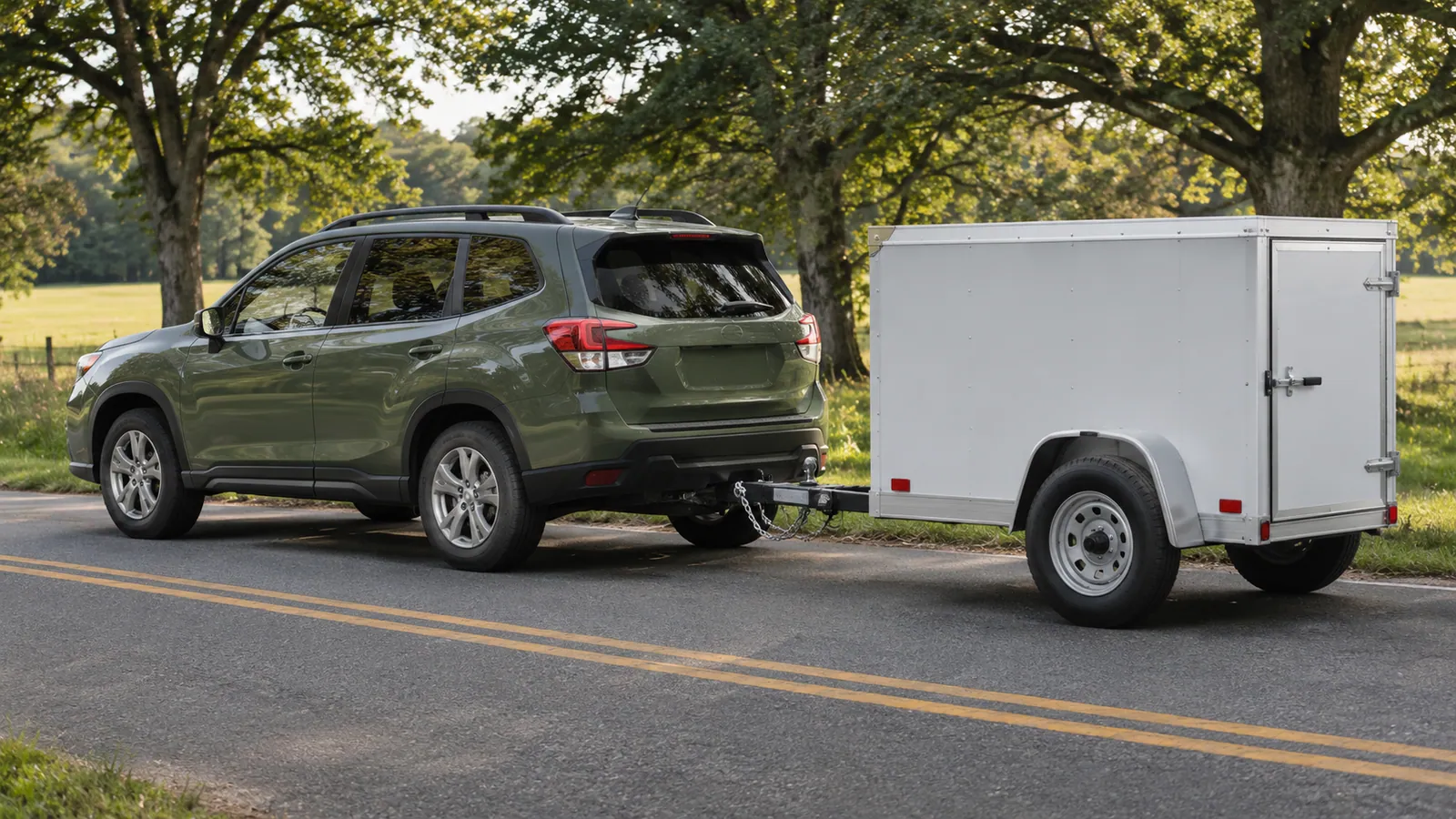
The Outback's regular gas models are rated 1,200 lb higher than most Foresters. Only the Wilderness trims close the gap. SUVLook's Forester profile does not list a separate hybrid tow rating, so confirm it in the owner's manual or with a dealer. Check the braking, tongue-weight and equipment requirements in the owner's manual and the door-jamb label before towing. For other SUVs see our SUV towing capacity guide, or the model-specific Forester towing capacity page.
Safety and warranty
Both 2026 models earned an IIHS Top Safety Pick+ award, and SUVLook's profiles list Good ratings for each in the small overlap front, updated moderate overlap front, updated side and headlight tests. See IIHS for the 2026 Outback and the 2026 Forester. Both include EyeSight driver assistance; the profiles list DriverFocus as standard on the Outback and on selected upper Forester trims.
Warranty terms are not in SUVLook's profiles, so confirm the current Subaru warranty booklet for the vehicle you buy.
Which should you choose?
- Lowest price: Forester. It starts $5,000 lower, and no Outback trim undercuts it.
- Best fuel economy: Forester, especially the hybrid at 35 city / 34 highway mpg.
- Most cargo: Outback, though rear legroom is nearly identical.
- Towing more than 1,500 lb without a Wilderness trim: Outback, rated 2,700 lb on the base engine.
- Strongest acceleration: Outback with the 260-hp turbo.
- Off-road focus on a smaller budget: Forester Wilderness at $36,995 with a 3,500-lb rating.
- Tight parking: Forester, because it is shorter and narrower.
The simplest rule is to decide on the powertrain and tow rating first, because those are the two areas where the models cannot substitute for each other. If you need a hybrid, only the Forester offers one. If you need a turbo engine or a 2,700-pound rating without paying for a Wilderness, only the Outback delivers. If neither applies, the Forester's lower price and shorter body make it the default, and the Outback's extra cargo room is the reason to pay more. Whichever you pick, compare the exact trim, because moonroof and equipment packages change published cargo and headroom figures, and prices and ratings are set by the model year and can change.
Related SUVLook research
- 2026 Subaru Outback research profile
- 2026 Subaru Forester research profile
- Forester vs Outback side-by-side comparison
- Outback trim levels
- Outback cargo dimensions and Forester cargo dimensions
- SUV Fit Finder: shortlist SUVs by budget, seats, cargo and towing
Frequently asked questions
Is the Subaru Outback bigger than the Forester?
Yes. The 2026 Outback is 191.7 inches long against 183.3 inches for the Forester, and it has more published cargo volume.
Which is cheaper, the Outback or the Forester?
The Forester. Its Base trim starts at $29,995 and the Outback Premium starts at $34,995, before destination.
Which gets better gas mileage?
The Forester. Subaru lists up to 26 city / 33 highway mpg on gas trims and 35 / 34 for the hybrid, against 25 / 31 for the base Outback.
Which tows more?
The Outback is rated 2,700 lb on the 2.5L engine and 3,500 lb with Wilderness or XT trims. The Forester is rated 1,500 lb on most trims and 3,500 lb on the Wilderness.
Does the Outback have a hybrid?
SUVLook's 2026 profile lists only the 2.5L and the 2.4L turbo for the Outback. The Forester is the model with a hybrid.
Do both come with all-wheel drive?
Yes. Symmetrical AWD is standard on both.
Has SUVLook tested these vehicles?
No. All figures are manufacturer-published and recorded in SUVLook's vehicle profiles.