Dimensions · Space · Buying guides
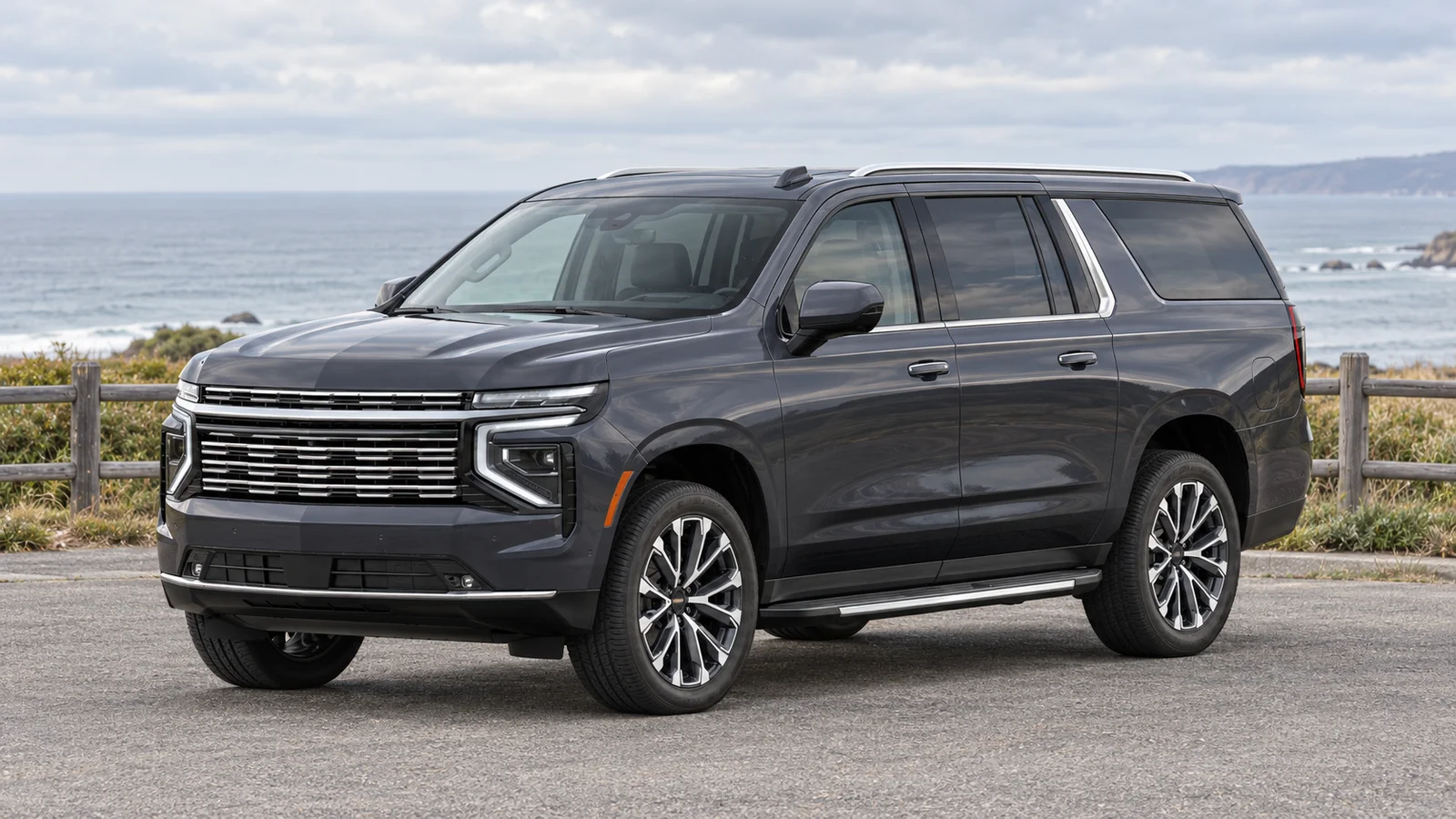
The 2026 Chevrolet Suburban has 41.5 cubic feet of cargo space behind the third row, 93.8 behind the second row and 144.5 behind the first row, according to Chevrolet’s U.S. 2026 model page. If you need all three seating rows on a family trip, start with the 41.5 figure. The larger numbers require giving passenger space over to cargo.
This guide covers the U.S. 2026 Suburban. We checked the manufacturer’s figures on October 28, 2026; we have not physically measured the vehicle or tested luggage in it. Below, you’ll find the seating trade-offs, the measurements worth collecting and a practical way to check your own load before buying.
2026 Suburban cargo space by seating row
| Cargo area | Published volume | Passenger-space trade-off |
|---|---|---|
| Behind the third row | 41.5 cu. ft. | All three seating rows remain available |
| Behind the second row | 93.8 cu. ft. | Third-row space becomes part of the cargo area |
| Behind the first row | 144.5 cu. ft. | Both rear seating rows give way to cargo |
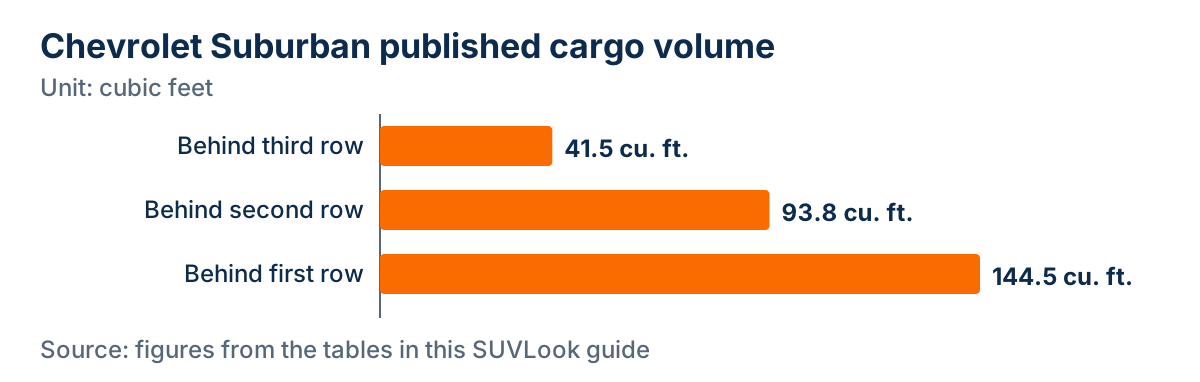 Chart: Published Suburban cargo volume in cubic feet behind the third, second and first rows. Figures from the table above.
These are the row-specific volumes in Chevrolet’s 2026 Suburban FAQ. They are volumes, not a set of rectangular floor dimensions. You cannot calculate a reliable floor length or hatch opening from them.
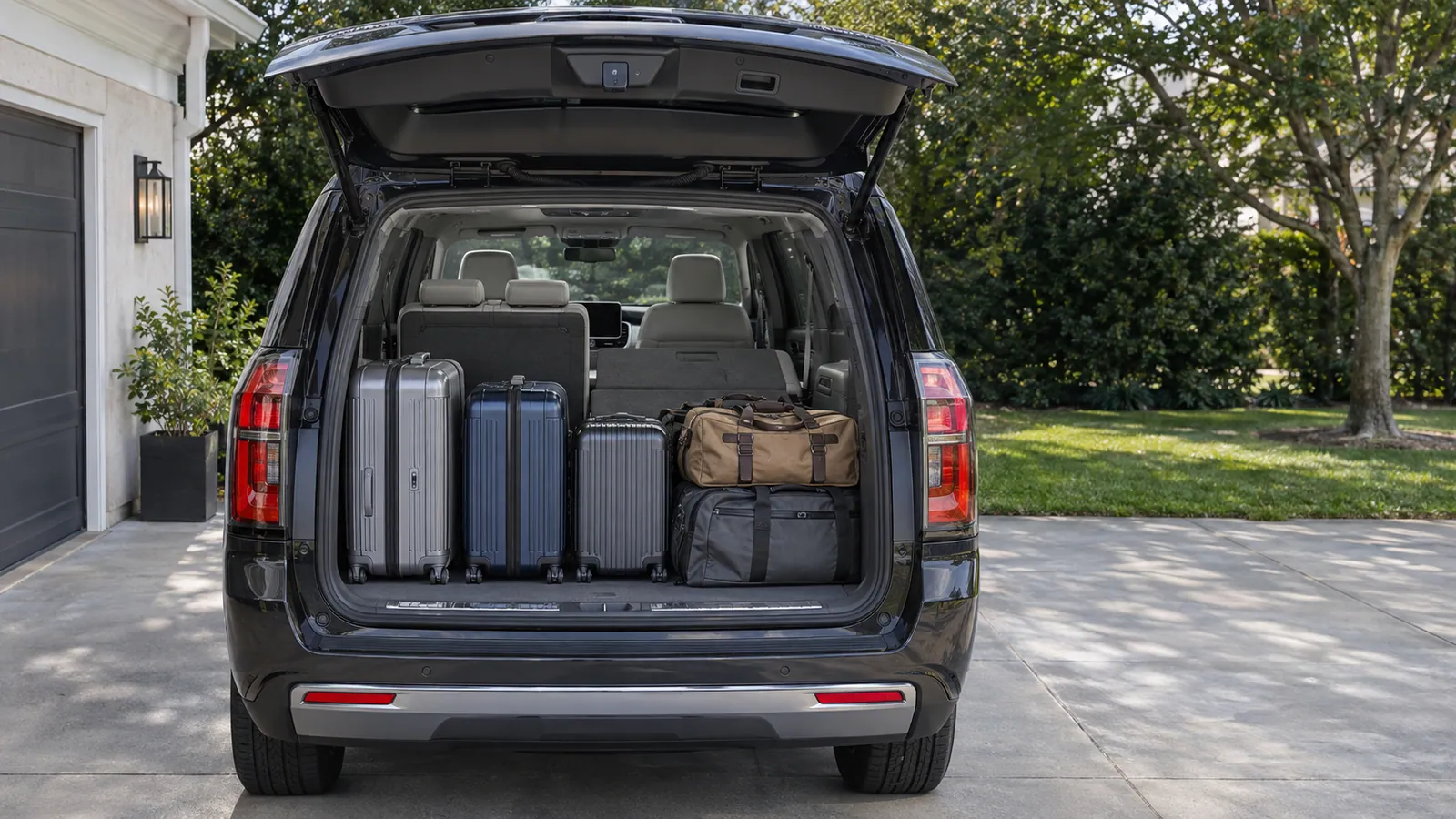 AI-generated illustration of the cargo area behind the third row of a Suburban-style full-size SUV for visual reference; not an official Chevrolet photo or evidence of measurements.
Read each figure as a different trip. A full family heading to the airport has a different packing problem from two adults collecting furniture. For the airport run, folding away seats you need does not solve the problem. For the furniture pickup, keeping unused rear seats upright may unnecessarily restrict the load.
The table also avoids assuming a passenger count for every Suburban. Check the actual vehicle’s seating layout rather than treating a photo of one trim as a promise about another. When comparing listings, record both the row you need to keep and the seating configuration you are inspecting.
Third row up: check the whole family’s load
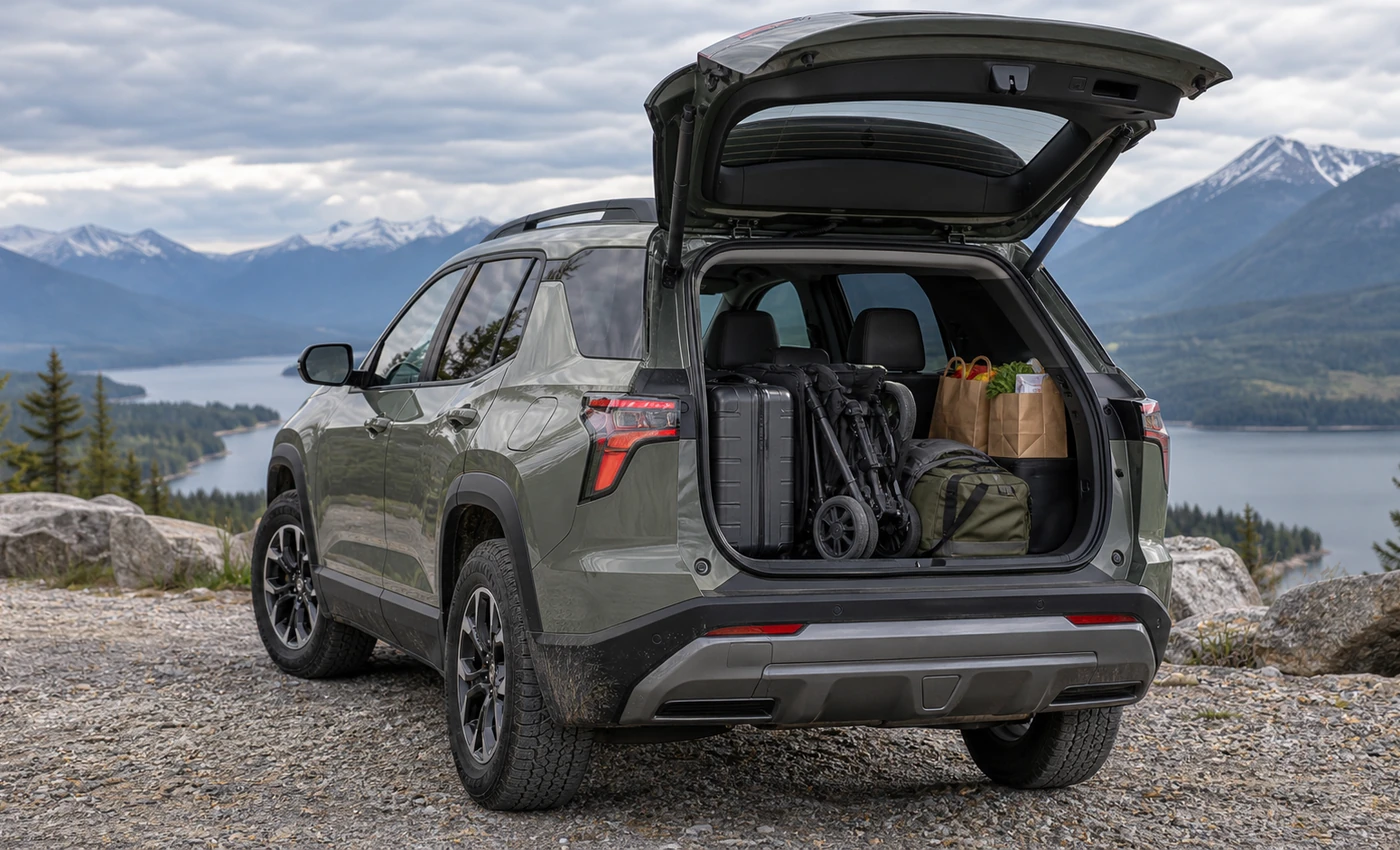
The first useful test is the least flexible trip you regularly make. Bring the people and equipment that must travel together, or write a complete packing list before visiting the vehicle. Include the easy-to-forget pieces: stroller attachments, school bags, a cooler, sports equipment and the small bag someone needs during the drive.
Set passenger seats for the people who will use them. A demonstration that gains room by moving an occupied seat into an uncomfortable position gives a misleading result. Follow the vehicle and child-restraint instructions when arranging seats around installed child seats.
For a stroller, use its normal folded shape. Measure the outermost wheels, handle and attached accessories rather than just the frame. Try both orientations, then check whether the remaining space accepts the rest of your load. A stroller fitting by itself does not establish that your usual weekend packing will work.
Luggage deserves the same treatment. Two cases sold under the same size label can have different exterior shapes once wheels and handles are included. Instead of relying on a suitcase count, bring the cases you own. Place the bag needed first where you can retrieve it without unloading everything at a roadside stop.
Before leaving, close the liftgate normally and inspect clearance carefully. Do not force the hatch against an item to turn a near fit into a successful test. A load also needs appropriate restraint; an object resting neatly in the opening is only the beginning of the check.
Third row folded: decide which passengers still need seats
The middle configuration is worth evaluating separately from maximum capacity. It lets you investigate a larger cargo area while retaining the second row for passengers. For a household that rarely uses the third row, this may be the arrangement to test most thoroughly.
Start by deciding whether you need the whole third-row area or only part of it. Inspect the actual vehicle’s folding arrangement and instructions before planning around a particular split. Any seat section used for cargo is unavailable to its passenger; keep that constraint in your packing sketch.
Next, look at the floor as a surface rather than a number. A long box can be sensitive to a small change in height across folded seatbacks. A wheeled item may need support at several points. Check your object’s contact points and stability instead of assuming that a visually continuous floor is perfectly level.
If you use an accessory cargo liner, test with it installed. Raised edges, folds and the space around a liner can affect a tight rectangular load. Include the everyday equipment you leave in the vehicle, too. A fit check in an empty demonstrator may miss the storage bin or emergency kit you always carry.
Maximum cargo: do not skip the driver’s position
For a bulky pickup with both rear rows out of passenger use, set the driver’s seat first. Measure the available length only after the driver has a comfortable, safe driving position. Borrowing space from that position to accommodate an object is not a workable loading plan.
Measure from the closed-hatch boundary to the relevant seatback, along the route the item will actually occupy. Check above floor level as well: a seatback angle or the hatch’s interior shape may limit a tall object differently from a low box. A measurement taken with the hatch raised can miss that boundary.
A sheet, cabinet or flat-pack needs more than enough total volume. Its rigid edges must clear the opening, pass between trim surfaces and reach the intended resting position. Rotating an item during loading may need additional clearance beyond its final parked dimensions. Make a simple cardboard outline if transporting the actual object to the viewing is impractical.
We do not claim that a particular plywood sheet, mattress or piece of furniture fits this Suburban. Such a claim needs the object’s exact dimensions and a verified loading check. The published maximum is a useful comparison point, but it cannot settle those questions by itself.
The measurements to take before buying
Use this worksheet on the specific Suburban you are considering. Record the seat arrangement beside every measurement so you can repeat it later.
| Check | How to make the result useful |
|---|---|
| Floor length | Measure with the needed passenger seats set normally and account for the closed hatch |
| Narrowest floor width | Find the limiting trim or wheelhouse point along the item’s path |
| Opening width | Check at the height where the widest part of the item must pass |
| Opening height | Include the item’s handles, wheels or other projections |
| Interior height | Measure over the place where the object will stand |
| Loading path | Check whether the item can turn into its final position |
| Access after packing | Confirm you can reach essential bags and the item’s own doors or handles |
We have not verified a manufacturer floor-length or hatch-opening table for this guide, so those fields are deliberately left for an actual measurement. Do not substitute exterior vehicle width for interior clearance. Likewise, the widest visible part of the cabin may be irrelevant to an object that must pass through a narrower section first.
For a pet crate, include its outside shell, handles and door movement. For a mobility device, measure the actual transport configuration and check whether dismantling it is realistic for the person who will load it. If lifting or rotating an object is difficult, assess the loading process alongside its final fit.
Compare the right configuration, then check the vehicle
Compare three-row SUVs using the same seating requirement. Start with space behind the third row if that row must stay occupied; move to maximum capacity only when both vehicles can give up their rear seats. Our GMC Acadia cargo guide and Ford Explorer cargo guide separate those arrangements for the same reason.
Also keep model years attached to every number. This guide’s figures apply to the 2026 model covered by the cited Chevrolet page. They should not be copied into an older Suburban listing or a newer model-year comparison without checking the relevant documentation.
At the viewing, confirm the model year and installed seats, bring your largest awkward item and repeat the load with the equipment you normally carry. Check the vehicle’s loading label and owner’s manual for weight limits and securement instructions. Cargo volume does not establish how much weight a particular vehicle can carry.
The most useful result is a repeatable packing arrangement: required passengers seated normally, essential items reachable and the hatch closed without pressure on the load. Record a few measurements and a packing photo for your own reference. That is more useful when shopping than an unsupported promise that everything will fit.
Related SUVLook research
- Chevy Equinox Cargo Space and Dimensions: 2024–2026
- Ford Edge Cargo Space: A Practical Guide for Used-SUV Buyers
- Cargo Fit Check: test a rigid item against published cargo measurements
Frequently asked questions
How much trunk space does the 2026 Chevy Suburban have with all seats up?
Chevrolet lists 41.5 cubic feet behind the third row for the U.S. 2026 Suburban. That is the relevant published volume when all three seating rows remain available. Actual item fit still depends on the object and the shape of the cargo area.
How much cargo space is available with the third row folded?
The published volume behind the second row is 93.8 cubic feet. This arrangement uses third-row space for cargo, so those passenger positions are unavailable. Check the actual seat layout before planning a partially folded arrangement.
What is the Suburban’s maximum cargo capacity?
Chevrolet lists 144.5 cubic feet behind the first row for 2026. This uses both rear-row areas for cargo. It is not the space available while carrying passengers in those rows.
How long is the cargo floor, and will a large sheet fit?
This guide does not establish a verified cargo-floor length or a sheet-fit result. Measure the actual floor, opening and closed-hatch clearance with the front seats in their normal driving positions. A cubic-foot rating alone cannot prove that a rigid sheet fits.