Dimensions · Space · Buying guides
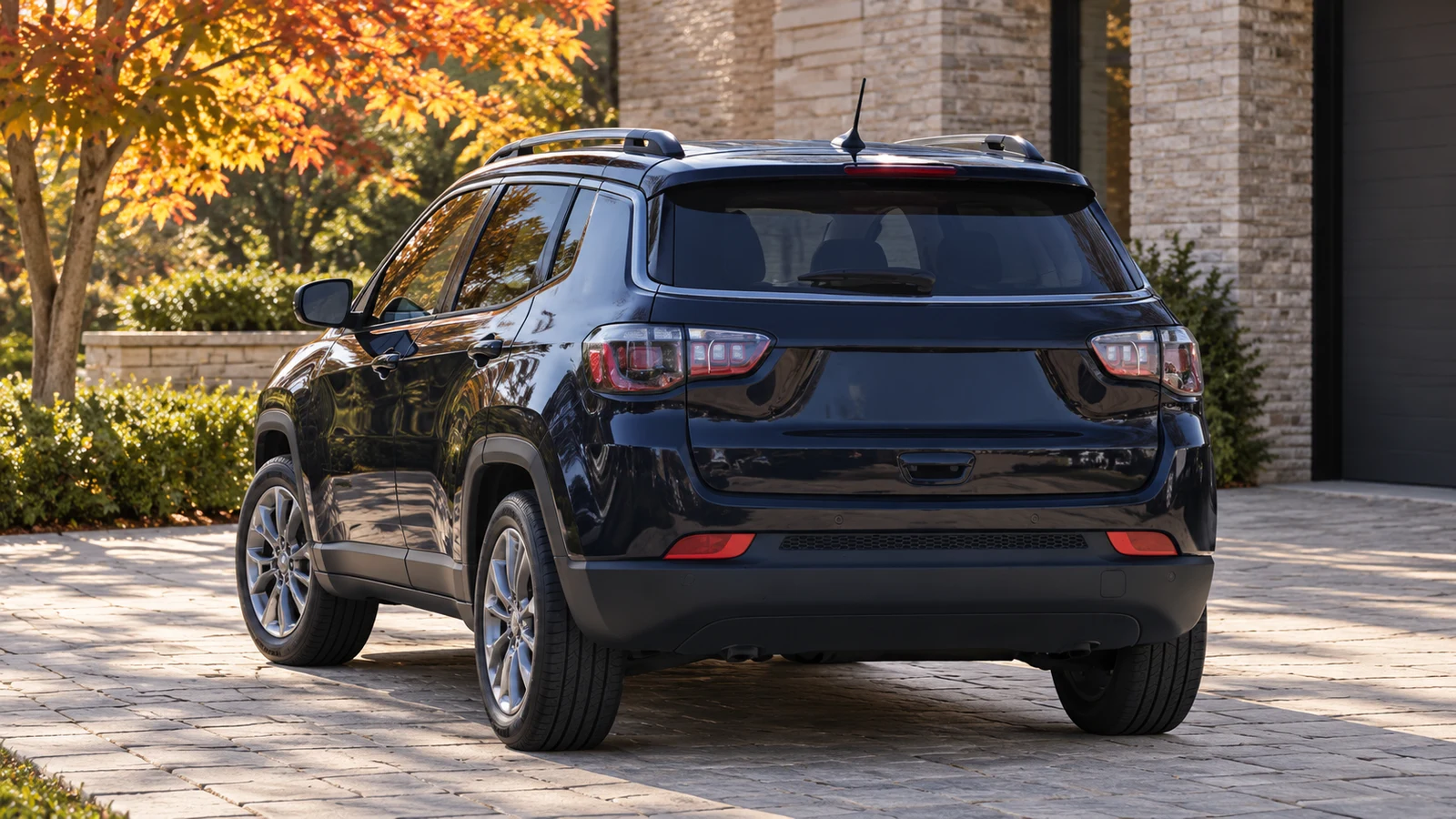
The U.S. 2025 Jeep Compass has 27.2 cubic feet of cargo space with the rear seats up and 59.8 cubic feet with them folded, according to the Stellantis fleet guide. If you are buying a stroller, crate or flat-pack box, however, start with the hatch opening and usable floor rather than the maximum volume.
This guide separates verified 2024 opening measurements from 2025 volume figures. They are not interchangeable evidence for every Compass model year or market. SUVLook reviewed the documents on October 24, 2026; we have not physically measured or load-tested a Compass.
How much trunk space does the Compass have?
An SUV's “trunk space” usually means the load area behind the rear seat. Search results may instead lead with the larger figure obtained after folding that seat, so always check the configuration beside the number.
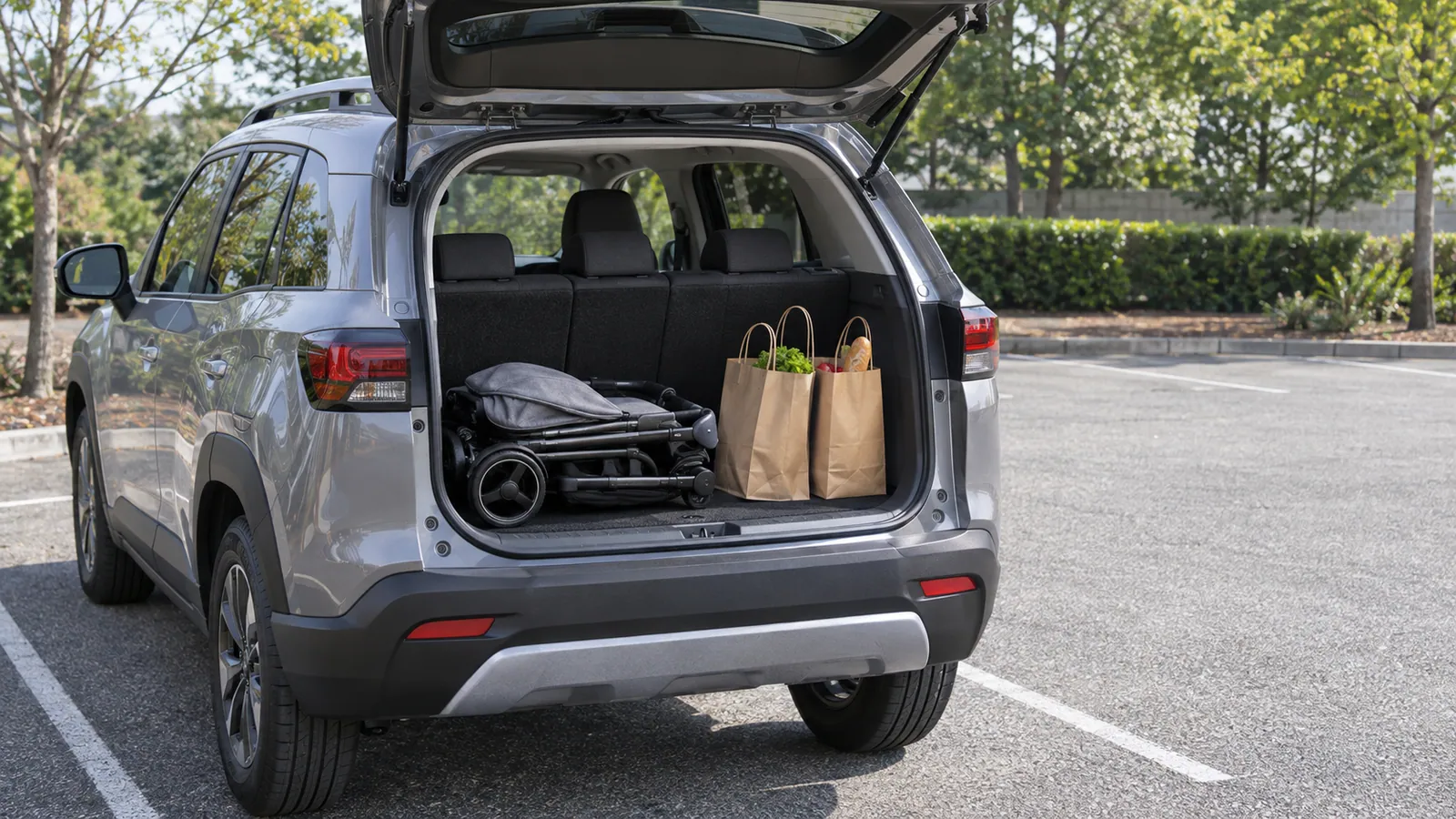 AI-generated illustration of the cargo area of a Compass-style compact SUV with a folded stroller for visual reference; not an official Jeep photo or evidence of measurements.
| U.S. model year and configuration | Manufacturer cargo volume |
|---|---|
| 2025: rear seats upright | 27.2 cu. ft. |
| 2025: rear seats folded | 59.8 cu. ft. |
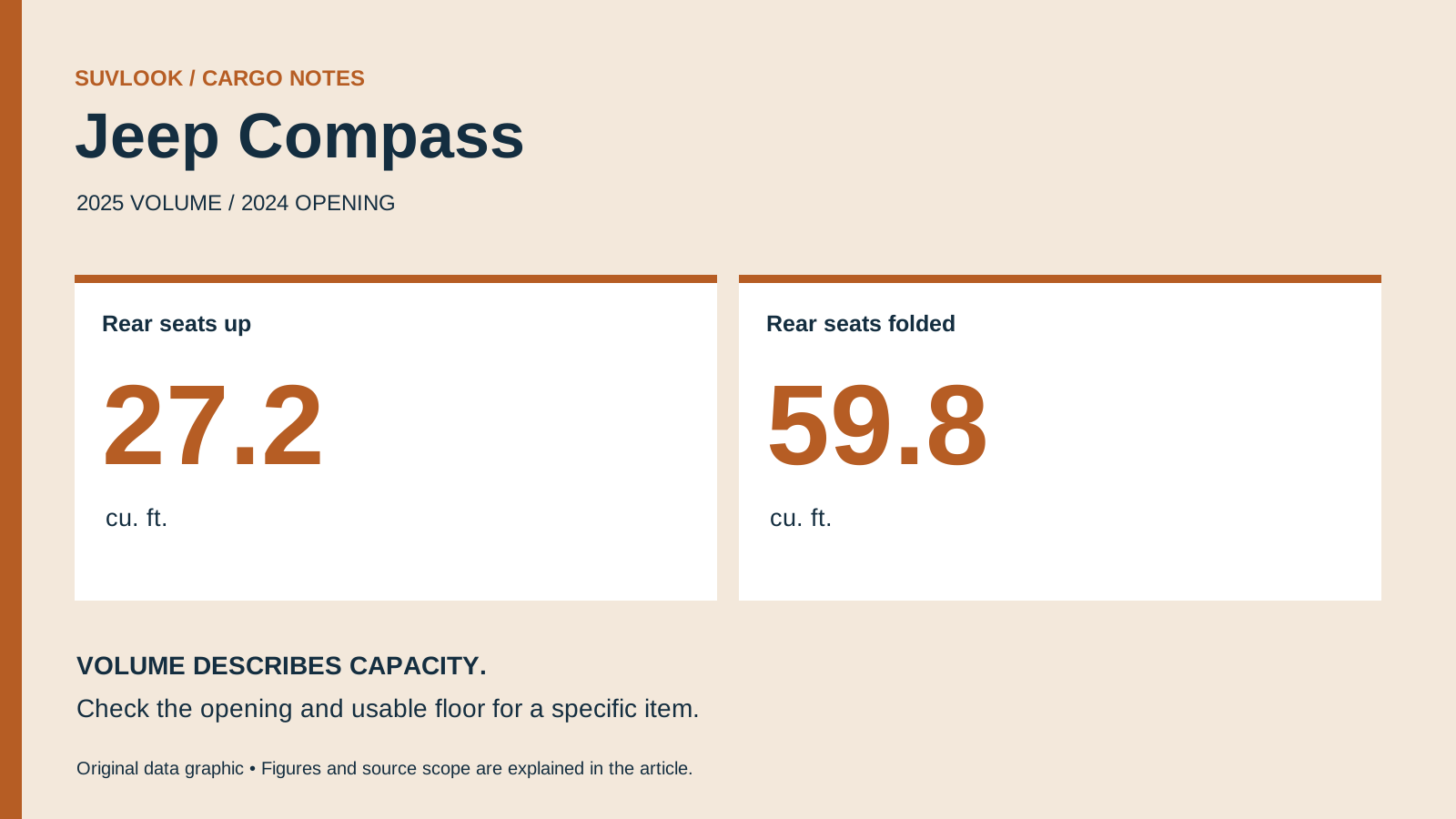 |
Summary graphic of the 2025 Compass cargo volumes in the table above; figures come from the sources cited in this guide.
Use the upright-seat configuration when checking a family trip with rear passengers. Use the folded-seat configuration when evaluating a bulky load that can occupy that seating area. The bigger number is useful only when you can actually give up the passenger positions it requires.
A packing plan can also fail without reaching either published limit. A rigid cooler can block another box, a tall bag can meet the sloping hatch glass, and a stroller's wheels can stop it from lying across the narrow part of the floor. Those are shape problems; dividing cubic feet by the volume of a suitcase will not solve them.
Verified hatch measurements: 2024 U.S. Compass
Jeep's 2024 U.S. specification sheet, pages 4–5 provides unusually useful opening dimensions. Keep their year attached when comparing a used example.
| 2024 manufacturer measurement | Inches | How to use it |
|---|---|---|
| Minimum liftgate-opening width | 36.9 | Check the narrow opening, not just its widest section |
| Maximum liftgate-opening width | 42.1 | Extra width exists at part of the opening |
| Maximum opening height | 27.2 | Maximum height is not clearance at every point |
| Width between wheelhouse trim | 38.1 | Helps evaluate a rigid object's resting position |
| Liftover height | 31.1 | Manufacturer measurement from curb ground to liftgate scuff trim |
An important coincidence: 27.2 inches of opening height and 27.2 cubic feet of volume describe completely different things. One is a linear measurement; the other represents three-dimensional space. Keep the units visible when saving a comparison.
The manufacturer sheet does not establish a usable floor length for this guide, nor does it establish those linear measurements for a later-year vehicle. Ask to measure the exact car rather than substituting overall vehicle length, rear legroom or a photo-based estimate.
Check the opening before the floor
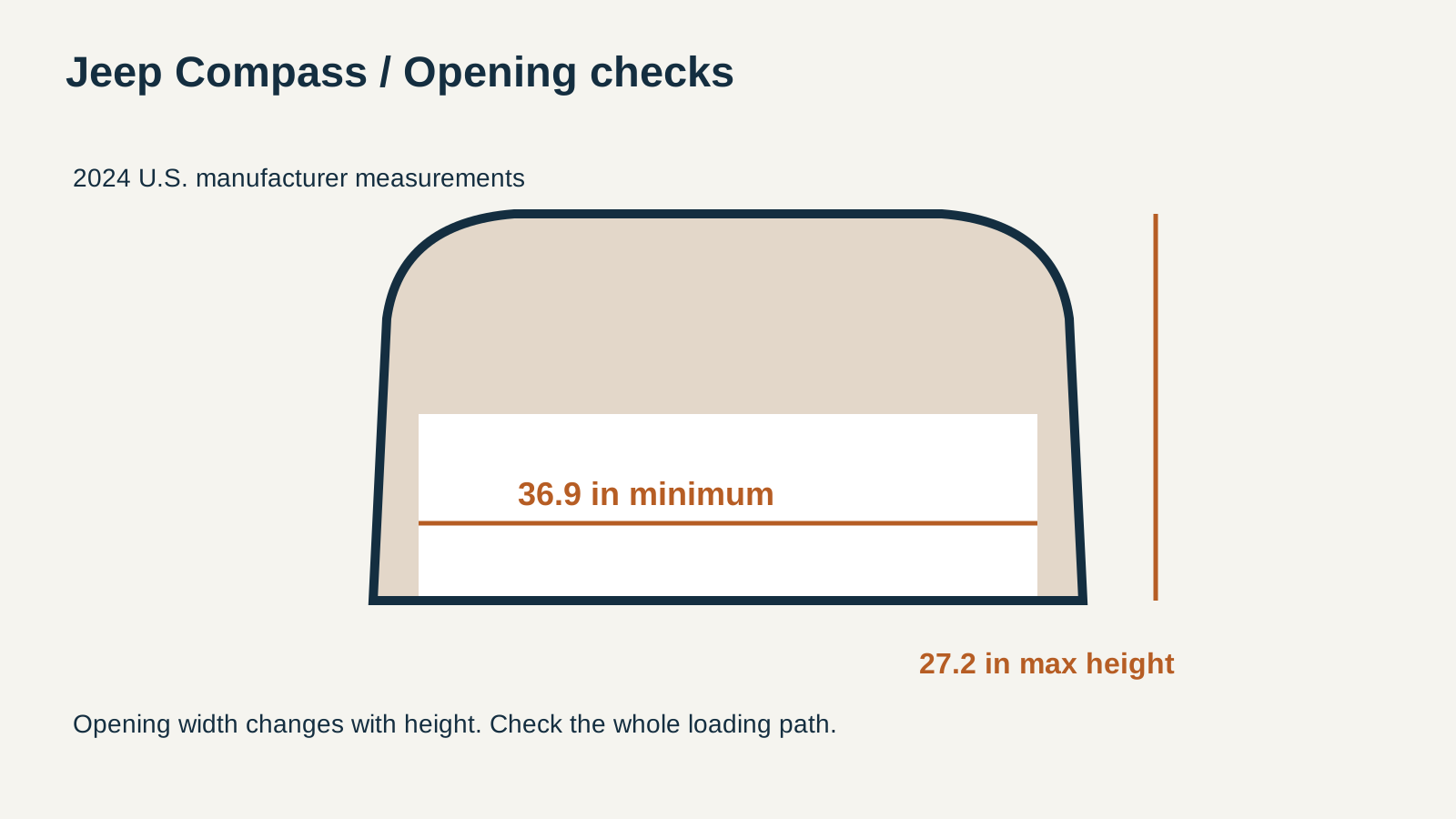
Original measuring schematic; not to scale. Arrows identify checks to perform on the actual vehicle, not additional factory measurements.
There are three separate fit questions. Can the object enter through the hatch? Can it rest in the intended position? Can the hatch close without pressing against it? A “yes” to the first two does not establish the third.
For a rigid box, write down its packaged length, width and height, including handles, hinges or protruding feet. Identify whether the box can be rotated and whether its contents allow it to travel on its side. An appliance that must stay upright has a different loading problem from an empty storage tote with the same exterior dimensions.
At the vehicle, measure the opening at the height where the box will pass. A wide section near the middle does not guarantee equivalent space at the upper corners. Then measure the floor between the trim pieces that will actually touch the load. Finally, inspect the closed-hatch envelope with the load positioned safely and without forcing a powered liftgate against it.
If a measurement is close, bring a lightweight template or the item itself with the seller's permission. Allow room to handle and secure it; an exact paper match is a reason to investigate further, not a fit guarantee. Do not choose an arbitrary clearance margin and treat it as a manufacturer requirement.
Seats down: plan around the people coming along
Begin with the passenger arrangement, then decide which seating area can become cargo space. Do not demonstrate a load using an empty vehicle and later discover that a rear passenger needs the area the object occupies.
Set the driver's seat to its normal driving position before measuring an extended load area. Moving it unusually far forward for a demonstration may produce an arrangement you cannot use on the road. Check the front passenger's needs separately rather than assuming both front seats will be positioned identically.
Use the owner's manual for the exact vehicle's seat-folding procedure. Before folding, remove items that could obstruct a seat's movement and check the positions of belts and restraints. After the load is removed, follow the manual's instructions for returning the seats to passenger use. This guide's volume figures do not replace those operating instructions.
A partial-fold arrangement also needs its own measurement. Do not multiply the full folded-seat volume by the fraction of the seat you fold. The resulting space has its own shape, and a long object may interfere with the remaining occupant even when it appears to fit on the floor.
Strollers, suitcases and dog crates
Strollers: measure the folded stroller with the wheels and accessories you normally leave attached. Check both the loading orientation and the position it occupies once inside. If removing wheels makes the difference, decide whether you are willing to do that every time and where the removed parts will go.
Suitcases: compare the entire set you travel with, not one manufacturer's nominal carry-on size. Handles and wheels affect the outside dimensions. Try the arrangement with any grocery bins, sports equipment or other bags you also need, and keep frequently used items accessible.
Dog crates: use the crate's external dimensions and allow for its door to operate. A crate being physically inside the car does not establish an approved restraint installation. Follow the crate manufacturer's instructions and the vehicle's loading guidance; do not assume any convenient hook is a rated anchorage.
Furniture and flat packs: check the delivery carton rather than the assembled product's dimensions. Look for a required transport orientation and consider weight as a separate constraint. A load that fits geometrically can still be unsuitable for the vehicle or for one person to lift across the sill.
None of these checks amounts to SUVLook having tested a particular stroller, suitcase set or crate in the Compass. They describe a repeatable way to check your own equipment.
A useful checklist for a dealer visit
Save a note with the vehicle's model year, trim and the items you need to carry. Record the following while the car is in the configuration you will use:
- Passenger seating and normal front-seat positions.
- Narrow opening width and height at the relevant points.
- Usable floor length and the width between obstructions.
- Closed-hatch clearance around the tallest or rearmost part of the load.
- Access to any equipment you need without unloading everything.
- The vehicle's own loading limits and the instructions for securing cargo.
Photograph your tape-measure reference points if the seller permits it. A number labeled “width” becomes much more useful when you can see whether it was taken between wheel wells, across the opening or at a wider section of trim.
If you are comparing the Compass with other compact SUVs, use the same item and seating assumptions. Our RAV4 cargo guide and CR-V cargo guide can help structure that comparison, but their measurements apply to their stated vehicles and years.
Related SUVLook research
- Ford Edge Cargo Space: A Practical Guide for Used-SUV Buyers
- GMC Acadia Cargo Space: Third Row Up, Folded and Maximum Room
- Honda Passport Cargo Space: Why 83.8 and 104.6 Are Different Figures
- Cargo Fit Check: test a rigid item against published cargo measurements
Frequently asked questions
Is Compass trunk space the same as cargo space?
People often use the terms for the same rear storage area. The useful distinction is whether the quoted figure applies with the rear seat upright or folded. Check that label before comparing numbers.
How much cargo space does the 2025 Jeep Compass have?
The cited Stellantis fleet guide lists 27.2 cubic feet with the rear seats up and 59.8 with them folded. These are 2025 U.S. manufacturer figures, not verified linear measurements for every Compass year.
How wide is the Compass hatch opening?
For the 2024 U.S. model, Jeep lists a 36.9-inch minimum opening width and a 42.1-inch maximum. Check the width at your object's actual loading height; maximum width is not available everywhere in the opening.
Will a large dog crate fit in a Compass?
There is no reliable answer from cargo volume alone. Compare the crate's external measurements, hatch opening, floor space, closed-liftgate clearance and the required restraint installation on the exact vehicle.